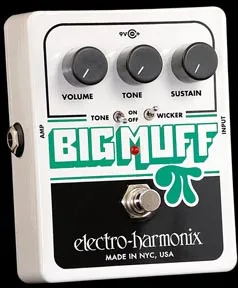


The Electro-Harmonix Big Muff Pi with Tone Wicker is an analog fuzz / distortion / sustainer pedal from Electro-Harmonix, built on the standard Big Muff Pi circuit but with two toggle switches that change its voicing at a flick1. One, the Wicker switch, opens up the high frequency bandwidth for a brighter, raspier top end; the other removes the tone control from the circuit entirely, for a gain boost and a different midrange response12.
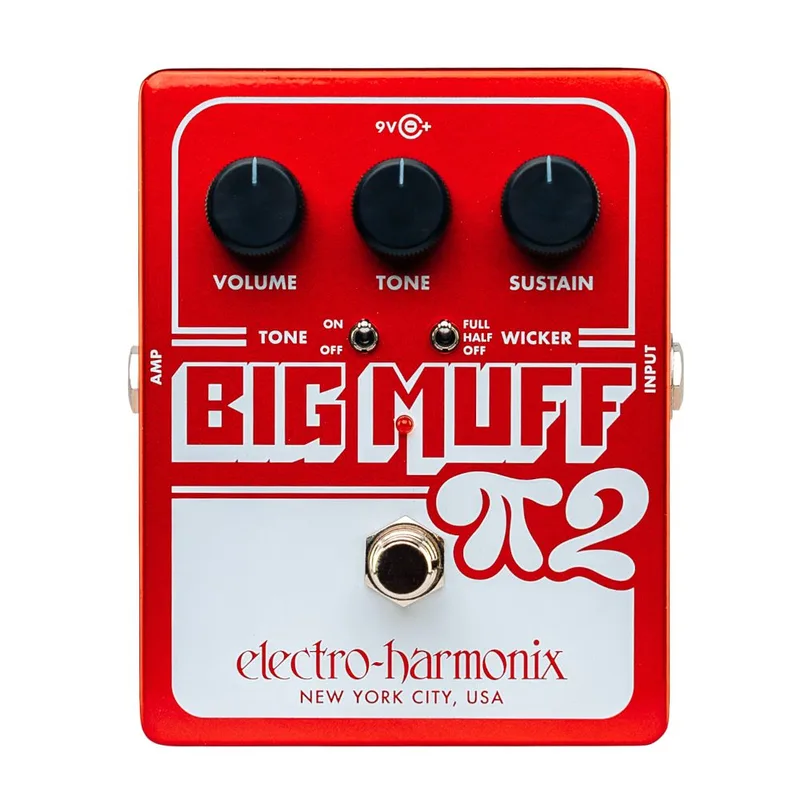
Delicious Audio reports the pedal is now discontinued, with the Tone Wicker concept carried over into newer models such as the Big Muff Pi 2 with Tone Wicker3.
The Tone Wicker and tone bypass switches
The two toggles are what separate this pedal from a stock Big Muff, and each works on a different part of the circuit.
The Wicker switch. Electro-Harmonix says it activates Wicker mode, "where the high frequency bandwidth is opened up for a bright and clear top end"1. The maker describes it as opening up 3 high frequency filters, "providing a sustain that is raspy and defined"1. Kit Rae's circuit history explains the mechanism: the switch "bypasses the roll-off filter capacitors in the first three stages of the circuit, adding a top end boost to the sound"5. Delicious Audio characterizes the result as a "spitty, raspier sound"2.
The Tone switch. This one either activates the Tone knob or completely bypasses the tone circuitry1. With the tone stage out of the circuit, the knob has no effect, and the pedal gains output level and a changed midrange response52. Kit Rae notes this mirrors the TONE-BYPASS Big Muffs of the late 1970s and early 1980s5, and Delicious Audio points to the V5 revision of the original pedal, whose tone bypass switch removed the EQ section, increasing output level and changing the midrange response2. Electro-Harmonix's own summary of the Tone switch promises "a devastating broadband Big Muff slam!"1.
"The Wicker switch opens up 3 high frequency filters providing a sustain that is raspy and defined"
The two switches work independently, so a player can run the pedal in standard Big Muff mode, Wicker only, tone bypass only, or both at once. Kit Rae found that in standard mode it can match the tones of the V10 Little Big Muff somewhat, while with the Wicker on "it becomes a much sharper and brighter sound, but not too harsh"6. He also notes the buzzy-fizzy character of the V9 and V10 Muffs can be smoothed out, and that with gain high and the Wicker on it produces a very clear high gain distortion, though a rather noisy one, with a built-in boost that cuts through a band mix very well6.
Controls and circuit
The knob set is the classic three, plus the two toggles and a bypass footswitch.
| Control | What it does |
|---|---|
| Volume | Sets the overall output level of the effect1 |
| Sustain | Adjusts the amount of sustain and distortion1 |
| Tone | Dials in the setting between deep bass and high treble1 |
| Wicker switch | Opens the high frequency bandwidth for a bright, clear top end1 |
| Tone switch | Activates the Tone knob or completely bypasses the tone circuitry1 |
| Bypass switch | Toggles between effect mode and bypass mode1 |
Under the hood it is the standard Big Muff Pi architecture. Kit Rae's analysis of the circuit counts five stages: an input/gain stage, two clipping stages, a tone stage, and an output stage, built from 46 components including 4 transistors, 4 diodes, and 3 potentiometers7. In this version the four transistors are BC550Cs5. The tone stage is a passive stack: the signal splits into a high-pass and a low-pass filter, blended back together by the tone potentiometer78. That stack is what gives the Big Muff its characteristic scooped mids, with cutoff frequencies in the midband, roughly 200 to 2500 Hz8, which is the midrange loss players often fight in a band mix9.
The pedal runs on the included 9V battery or an optional 9.6VDC-200mA adapter with negative tip polarity, using standard Boss-type adaptors15. At 5mA it draws little current, so it is easy to power alongside other pedals15.
How it differs from the Big Muff π
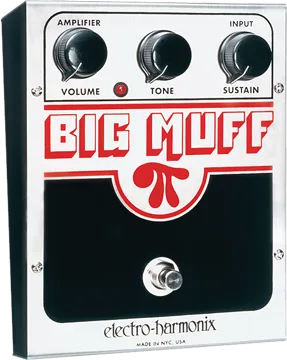
Against the original NYC Big Muff Pi, the differences are the two switches and the size. Gearnews, picking it for a fuzz roundup, called it "both more versatile and smaller than the OG"10. The enclosure measures 4.75 x 4 x 2.25 in1. Kit Rae dates production from 2009 onward65.
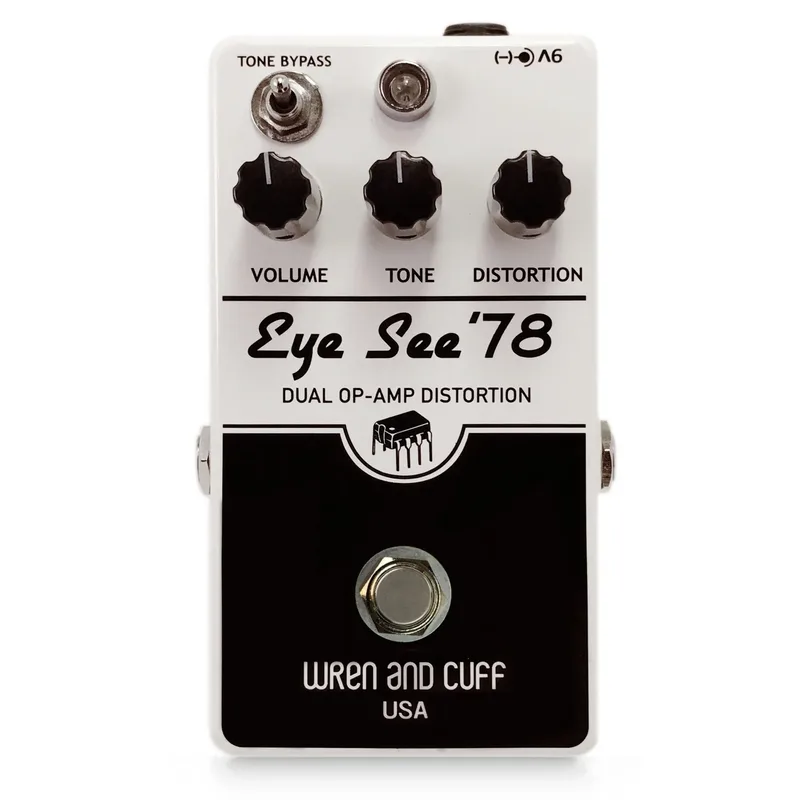
The concept has since moved to other pedals. Delicious Audio notes the Tone Wicker feature first appeared here, and that the tone bypass switch from the op-amp version was brought back in this design32. Electro-Harmonix later applied the same idea to the Big Muff 2 circuit in the Big Muff Pi 2 with Tone Wicker11.
Who uses it and what reviewers said
No artists are documented in the available material as users of this specific pedal, so none are named here. Reviewer opinion that exists is favorable. Kit Rae, whose site is the standard reference for Big Muff history, wrote that "this is one of my favorites of the Muffs produced since 2000"5. At Gearnews, a writer noted the pedal "I have owned for many years and still like using"11. Delicious Audio described what players found with the Wicker engaged: harmonics and "raspy, sustaining distortion" that cut through a live band without losing the thickness the Big Muff is known for3.
The design is credited to E-H junior engineer David Tuzman, supervised by senior engineer John Pisani, based on the original Bob Myer circuit5.
Videos
ProGuitarShopDemos
EHX
MarshallGTV
Questions
What does the Tone Wicker switch do?
The Wicker toggle bypasses the roll-off filter capacitors in the first three stages of the circuit, opening up the high frequency bandwidth. Electro-Harmonix describes the result as a bright and clear top end with sustain that is raspy and defined, compared with the darker, smoother sound of a stock Big Muff with the switch off.
How is it different from the Big Muff π?
It is built on the same Big Muff Pi circuit but adds two toggle switches: Wicker, which bypasses high-end roll-off capacitors for a sharper, brighter sound, and Tone bypass, which removes the tone control entirely for a gain boost and an altered midrange response. Gearnews also notes it is smaller than the original NYC Big Muff Pi enclosure.
Sources (11)
- Big Muff Pi with Tone Wicker, Electro-Harmonix
- Best Big Muff Pedals In 2025: Reissues, Clones & Evolutions, Delicious Audio, 2025-04-07
- New Pedal: Electro-Harmonix Big Muff Pi 2 With Tone Wicker, Delicious Audio, 2026-04-22
- A Fuzz and Muff pedal Timeline, Kit Rae (kitrae.net), 2014-07
- The Big Muff History of All Versions 3, kitrae.net, 2017-03
- Big Muff Versions_Quick Identifier, Kit Rae (kitrae.net), 2009
- BIG MUFF TRANSISTORS AND OTHER COMPONENTS, Kit Rae (kitrae.net), 2012-07
- Coda Effects, Coda Effects, 2026
- Coda Effects, Coda Effects, 2026
- The 7 Best Fuzz Pedals: Perfect For Stoner Rock, Psychedelic, or Shoegaze!, gearnews.com, 2025-05-05
- EHX Big Muff 2 Tone Wicker: Even More Options!, gearnews.com, 2026-04-28