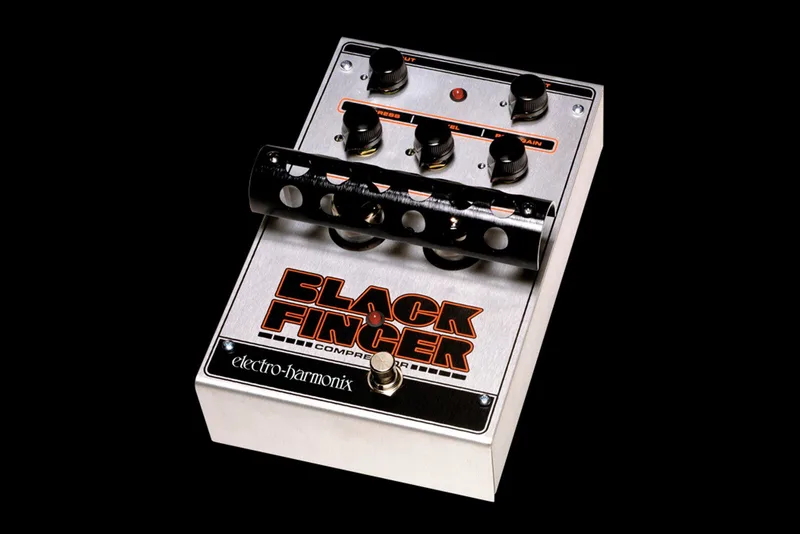


The Electro-Harmonix Black Finger is a tube-driven optical compressor pedal, discontinued by Electro-Harmonix in 20191. Unlike most compressor pedals, it runs its gain reduction through an optical attenuator whose light source you can select, and it passes the signal through two 12AX7 vacuum tubes driven by a toroidal transformer that, in the maker's words, allows "a full 300 volts of swing, preserving the attack while providing the" sustain1. The maker sums up the design as "Dual tube magic!"1.
The Black Finger was discontinued in 20191. It is also not the same pedal as the 1970s Electro-Harmonix stompbox compressor that carried the same name: that earlier solid-state design had a completely different circuit and controls2.
A tube-driven optical compressor
The Black Finger compresses with an opto device: a light source shines on a light-dependent element that turns gain down as the signal rises. What sets it apart is that you can choose between two opto devices, a lamp and an LED, and that the signal path is tube-based rather than purely solid-state2. Two 12AX7EH vacuum tubes are included, and a TL074 quad JFET op-amp controls the selectable lamp or LED light sources12.
Electro-Harmonix points to the power supply as the key to the design: unlike tube products running on 9 to 50 volts, the Black Finger's toroidal transformer allows a full 300 volts of swing1. The tubes sit on the outside of the housing, so they are visible rather than tucked inside the box3.
The name has history. A 1970s Electro-Harmonix solid-state stompbox compressor was also called the Black Finger, but it was out of production for many years and had a completely different circuit and controls from the tube version2. A later DIY community also traced an LM13700-based version of the circuit, with one commenter recalling a vintage unit powered by two 9V batteries4.
The controls and switches
The front panel is built around input and output gain controls plus two mode switches12.
| Control or switch | What it does |
|---|---|
| Pre-gain knob | Controls the input level; at higher settings it can provide mildly overdriven textures2 |
| Compress knob | Controls the amount of compression2 |
| Post-gain knob | Controls the output level2 |
| Lamp/LED switch | Selects the light source for the optical attenuator5 |
| Sqsh/Norm switch | Selects between Norm (compression) and Sqsh (leveling) modes5 |
| Gain reduction LED | An LED's light changes intensity as it tracks the amount of gain reduction2 |
The two switches shape the compressor's character:
- Lamp/LED: the lamp-driven opto-coupler gives a slower attack time with reduced high-frequency compression, while the fast-acting LED gives more evenly balanced compression for fidelity-conscious applications2.
- Sqsh/Norm: in sqsh mode, the amount of compression is increased dramatically and the attack becomes longer and more "squashed," with a significant volume drop that you can recover with the post-gain knob2.
Guitar Player's 2003 review described the pre-gain control as adjusting the input level and determining how much signal will pass the threshold5.
Power: a 12-volt AC adapter, not a 9 volt supply
The Black Finger runs on a 12-volt AC adapter only, which is provided with the pedal2. It is not a standard 9-volt power supply, and plugging one in can blow up the pedal3. Do not substitute a typical 9V DC pedal supply.
The AC requirement and the toroidal transformer are part of what give the tubes their high voltage swing1, but they also mean the pedal will not share a daisy chain with ordinary 9V DC pedals.
On stage and in reviews
Bass Player's September 2003 review carried the full specification, including the $298 list price, the 82k ohm input impedance, and the dimensions and weight listed above2. Guitar Player reviewed it in June 2003, describing the LED/lamp and Norm/Sqsh switching5.
Whitney Petty keeps a Black Finger as a permanent pedal on her board and uses it on every song, telling Stompbox Book, "I don't think there's a song where it isn't used"3. She also noted the practical side of owning one:
"It's very sensitive, and it's got a finicky design"
Her advice for players relying on one live is to carry a backup, since the pedal is prone to breaking3.
Where it sits among EHX compressors
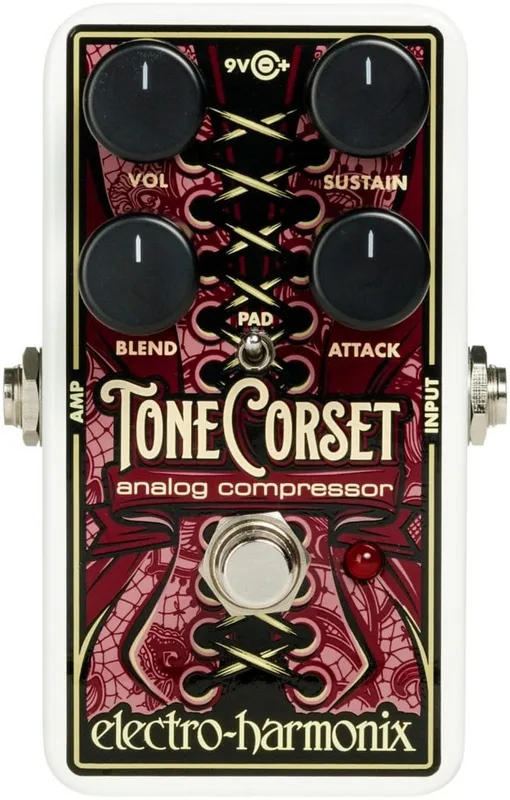
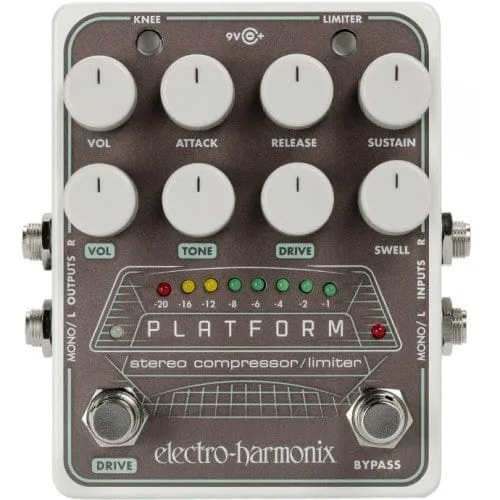
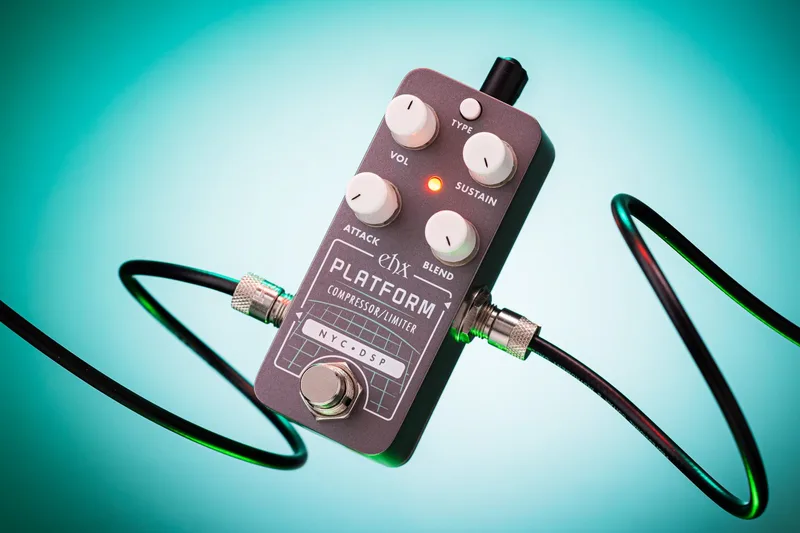
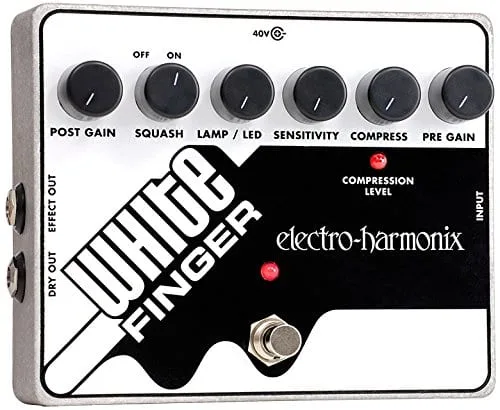
Since the Black Finger was discontinued, Electro-Harmonix has continued making compressors in different formats: the compact OTA-based Tone Corset (2017), the stereo Platform compressor/limiter (2017), and the mini Pico Platform compressor/limiter (2023). The optical approach of the Black Finger also appeared in the solid-state White Finger, discontinued in 2023. None of these carries the Black Finger's tube gain stage or its 300-volt power supply.
Videos
ProGuitarShopDemos
EHX
gearwire
Questions
What do the Lamp/LED and Sqsh/Norm switches do?
The Lamp/LED switch selects the light source for the optical attenuator. The lamp gives a slower attack with less high-frequency compression, while the fast-acting LED gives more evenly balanced compression. The Sqsh/Norm switch selects between normal compression and a leveling mode that increases compression dramatically, with a longer, more squashed attack and a volume drop you can recover with the post-gain knob.
Is the Electro-Harmonix Black Finger true bypass?
Yes. Electro-Harmonix describes the Black Finger as true bypass using a mechanical relay, so when the pedal is off it does not load down or color the signal passing through it.
Which tubes does the Black Finger use?
It uses two Electro-Harmonix 12AX7 vacuum tubes, which ship with the pedal. The tubes are mounted on the outside of the housing, so they are visible and exposed rather than hidden inside the enclosure.
Is the Electro-Harmonix Black Finger discontinued?
Yes. Electro-Harmonix discontinued the Black Finger in 2019, so it is no longer made. It is not the same circuit as the 1970s solid-state stompbox that also carried the Black Finger name, which had a completely different circuit and controls.
How big and heavy is the Black Finger?
Bass Player's 2003 review listed it at 7 1/2 by 4 3/4 by 3 1/4 inches and 1 lb, 8 oz, which is larger and heavier than a typical compact compressor pedal, partly because of its toroidal transformer and tube circuitry.
Sources (5)
- Black Finger, Electro-Harmonix, 2019
- COMP-1 | Bass Player (September 2003) | Demeter Amplification, Bass Player, 2003-09
- Whitney Petty, Stompbox Book (stompboxbook.com), 2019-08-02
- Guitar FX Layouts: Electro Harmonix Black Finger Compressor/Sustainer, tagboardeffects.blogspot.com, 2016-09-27
- COMP-1 | Guitar Player (June 2003) | Demeter Amplification, Guitar Player, 2003-06