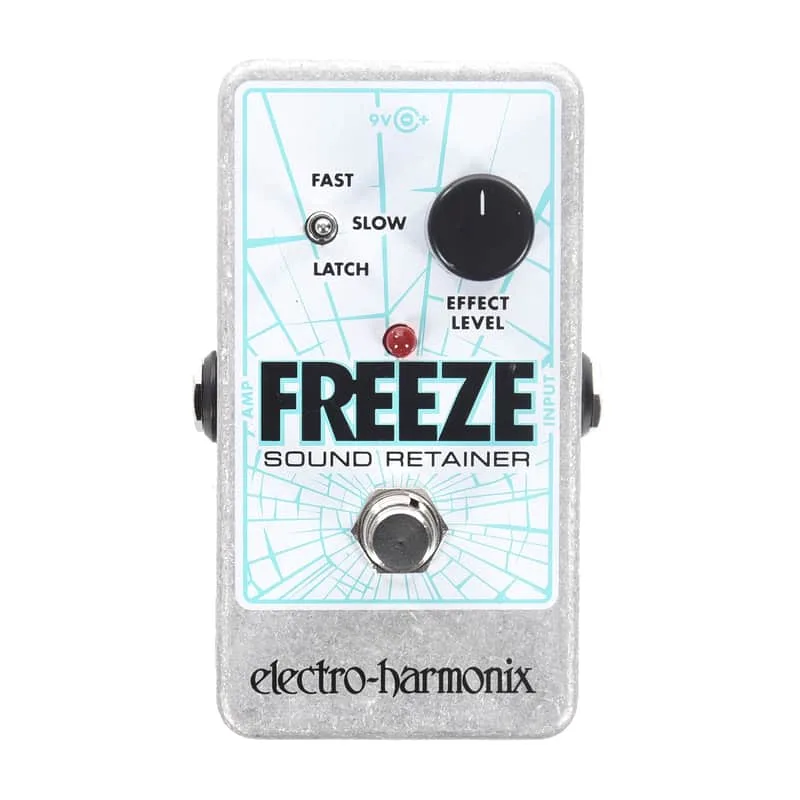


The Electro-Harmonix Freeze is a Sound Retainer pedal: a digital effect that samples whatever your guitar is playing at the moment you stomp the footswitch and holds that sound, at that volume and with that timbre, for as long as you leave it engaged. Electro-Harmonix sums it up as the ability to "sample and hold notes or chords with infinite sustain!"1 Premier Guitar's reviewer put it more plainly: "Simply put, the Freeze sustains any note or chord you play."2
That single trick opens up a lot of ground. MusicRadar's review found the effect "ideal for creating thick soundscapes and drones with your guitar," especially when the frozen sound is run through other effects like wah, tremolo or delay placed after it in the chain3. Because the held sound is a snapshot of your signal, everything downstream of the pedal keeps processing it while your hands are free to play something else on top.
How the Freeze works
The Freeze is not a looper, even though Electro-Harmonix describes its capture as "real time sample capture with perfect looping"1. The distinction matters to how you play it. MusicRadar's reviewer Stuart explained that "unlike a looper it takes a snapshot of the signal running through the pedal at the moment" you stomp it, and sustains that snapshot until the footswitch is reset3. A looper records a passage you play over time; the Freeze grabs an instant and holds it.
That instant can be a single note or a full chord, and once held it behaves like a sustained pad under whatever you play next. Run into delay, tremolo or wah, the frozen sound becomes a moving backdrop. The Effect Level knob sets the volume of the sustained signal, so you can sit the drone under your playing or push it up as the featured voice2.
The controls and the three modes
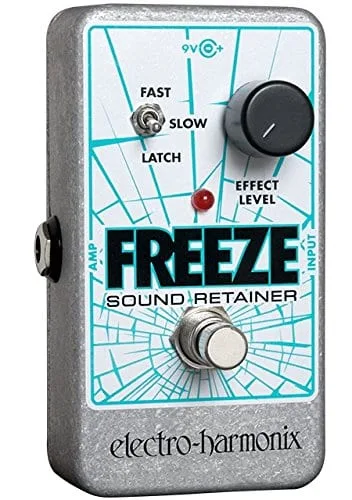
The control set is minimal. Premier Guitar's later piece on the pedal noted that "the pedal only requires one knob for volume, one toggle for latching or fast/slow swell modes, and a footswitch"5. Everything on the panel:
| Control | What it does |
|---|---|
| Effect Level knob | Controls the volume of the sustained sound1 |
| Mode switch | Selects between one of three effect modes: FAST, SLOW, and LATCH1 |
| Bypass footswitch | Toggles between effect on and bypass1 |
| Status LED | On while the effect is sounding or fading out1 |
| Input jack | Connect the output of your instrument or another effects pedal1 |
| AMP jack | Connect to your amplifier input or the input of another effects pedal1 |
The mode switch is where the playing character lives. MusicRadar's review describes the toggle as flipping "between Fast, Slow or Latch modes"3. Slow mode "gives a variable-speed fade in and out to the sustain, which, when you're switching between chords, is much smoother"3. Latch holds the frozen sound after you release your foot, so you can set a chord droning and leave it there while you play over it.
The Freeze runs on its power supply only. Premier Guitar's review notes "the Freeze does not offer the option of 9-volt operation, it's power supply or nothing"2. With a 140mA draw1, it also wants an isolated output or a dedicated adapter rather than a shared daisy chain.
History and the Cockerell design
The Freeze dates to 20101, but its circuit has a longer lineage. Premier Guitar's review reports that the Freeze "is derived from the HOG's Freeze Gliss function," the hold feature of Electro-Harmonix's HOG synthesizer pedal2. The designer behind it is David Cockerell, the longtime EHX engineer who also worked on the HOG5.
The idea itself goes back further. Cockerell explained to Premier Guitar that "back in the '70s, the EHX team had worked on the idea for a sustain pedal," using an approach the piece calls intelligent-splice-single-cycle-looping. The concept was revived in the early 2000s once DSP chips made it practical, while Cockerell was working on the HOG5. Premier Guitar's reviewer argued the result stood on its own: "This wasn't some new iteration of some other effect, a crazy fuzz or a weird flanger. This was a new category."5
Bill Frisell has been seen using one during a solo set, which gives a sense of the territory the pedal covers for ambient and textural playing5.
What reviewers said
Published reviews were positive about the pedal's creative value. Premier Guitar's verdict: "From subtle to radical, the Freeze is a device that inspires creative playing without being gimmicky," and a great tool for composing music and harmony by yourself2. The same reviewer later credited its simplicity for leaving the creative decisions to the player5.
The Pico Deep Freeze
Electro-Harmonix also makes a scaled-down descendant, the Pico Deep Freeze, a Sound Retainer and Sustainer in the compact Pico chassis4. Guitar.com's demo describes it as "a scaled down version of the Freeze Sound Retainer"6. It goes beyond the original's feature set with layering, adjustable attack and decay speeds, glissando, dedicated volume controls, and three modes of operation: Latch, Moment, and Auto47. Its Latch mode "holds the frozen sound each time the footswitch is pressed, releasing it upon bypass," and its SPEED/LAYER knob adjusts attack and decay time or layering amount depending on the mode8. It draws 100mA at 9.0VDC and also uses buffered bypass4.
| Freeze | Pico Deep Freeze | |
|---|---|---|
| Modes | Fast, Slow, Latch1 | Latch, Moment, Auto4 |
| Extra controls | Effect Level only1 | Speed/Layer, Gliss, layering, dedicated volume controls78 |
| Current draw | 140mA1 | 100mA at 9.0VDC4 |
| Bypass | Buffered1 | Buffered4 |
Videos
EHX
Reverb
Patrick Hunter
Questions
What is the difference between Fast, Slow and Latch on the Freeze?
The three-position mode switch selects Fast, Slow or Latch. Slow mode gives a variable-speed fade in and out to the sustain, which makes switching between chords much smoother. Latch holds the sustained sound after you release the footswitch, while the other modes sustain only while the switch is held, with Fast giving an immediate attack.
Can the Freeze run on a battery?
No. Premier Guitar's review notes the Freeze does not offer 9-volt battery operation, it is power supply only. Electro-Harmonix ships it with a 9.6DC 200 adapter, and the pedal draws 140mA, so it needs a supply that can deliver that current.
Is the Freeze true bypass?
No. Electro-Harmonix lists the Freeze as buffered bypass, and Premier Guitar's review explains that while most Electro-Harmonix pedals are true bypass, the Freeze's circuitry requires a high-quality buffered bypass instead.
Is the Freeze a looper?
Not in the usual sense. MusicRadar's review explains that unlike a looper, the Freeze takes a snapshot of the signal running through the pedal at the moment you stomp it and sustains that snapshot until the footswitch is reset. Electro-Harmonix describes it as real time sample capture with perfect looping.
How much current does the Freeze draw?
The Freeze draws 140mA according to Electro-Harmonix. It runs on the included 9.6VDC 200mA power adapter, and there is no battery option, so it needs a dedicated supply or an isolated output capable of that draw.
Sources (8)
- Freeze | Sound Retainer - Electro-Harmonix, Electro-Harmonix
- Electro-Harmonix Freeze Sound Retainer Pedal Review, Premier Guitar, 2010-10-20
- Electro-Harmonix Freeze Sound Retainer review, MusicRadar, 2010-10-21
- Pico Deep Freeze, Electro-Harmonix (ehx.com)
- The Simple Beauty and Bold Possibilities of the EHX Freeze, Premier Guitar, 2024-11-05
- 60 Seconds S1E8: Electro-Harmonix Pico Deep Freeze, Guitar.com, 2023-11-17
- Electro-Harmonix unveils the NYC DSP Series: 9 ultra-compact stompboxes for your 'board, Guitar.com, 2023-09-22
- New Pedal: Electro-Harmonix Pico Deep Freeze, Delicious Audio, 2023-09-28