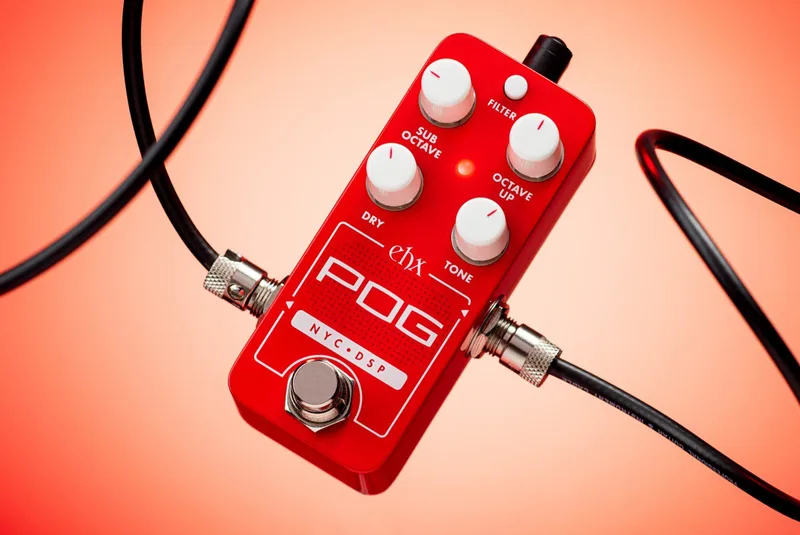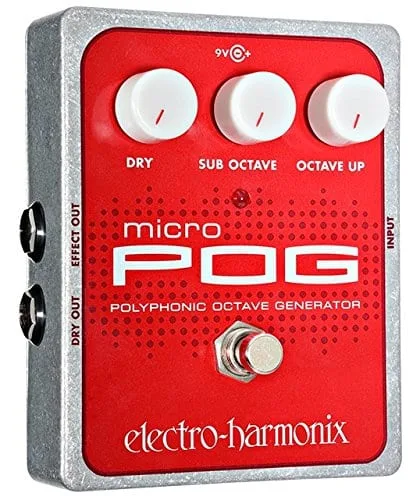


The Electro-Harmonix Micro POG is a compact octave and pitch pedal that generates two extra notes from whatever you play: one an octave above your original note and one an octave below. You mix those two octaves with your dry signal using three volume knobs, which makes it a straightforward tool for fattening a single line or making a six-string sound like a 12-string, or wider still. Electro-Harmonix calls it a Polyphonic Octave Generator, and it is fully polyphonic: chords, arpeggios and single notes all track, which the maker describes as glitch-free1.
It was released in 2007 as a simplified, pedalboard-friendly version of the original POG, in a small die-cast chassis, and it is a digital pedal1. Guitar World's buying guide notes it "has long been a favorite of players in two- and three-piece bands"2, which fits what it does: one knob blend lets a lone guitarist add bass weight or shimmer without touching another instrument.
What the Micro POG does
The core idea is a three-way blend. Your input signal is split into a dry path plus two generated octaves, and each of the three has its own volume control. Electro-Harmonix describes it this way: you can "mix together your original 'dry signal' with two different octaves (one above and one below your original note) to create totally new inspiring tones"1. MusicRadar's review puts the same thing more plainly: "Offering an octave below and above a given note, all three sounds can be balanced with the responsive controls"3.
| Control | What it does |
|---|---|
| DRY knob | Sets the output volume of the dry signal1 |
| SUB OCTAVE knob | Sets the output volume of the octave-down signal1 |
| OCTAVE UP knob | Sets the output volume of the octave-up signal1 |
| BYPASS footswitch | Toggles between effect and bypass modes1 |
That is the whole control set, and it is the point of the pedal. Pedal of the Day's review, written by Mike B, framed it as "the controls being simpler than the original POG"4, and MusicRadar's reviewer found the payoff in the tracking: "The tracking is tighter and quicker than on the original POG"3. In a separate MusicRadar review of the Epitome multi-pedal, which built a Micro POG into one of its sections, Trevor Curwen wrote that "the Micro POG does the business if you fancy making your six-string sound like it has 12 or even 18 strings"5.
Tracking and polyphony
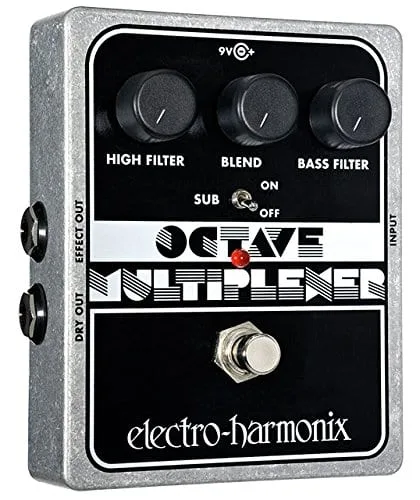
The Micro POG's headline feature for many players is that it is polyphonic. Electro-Harmonix promises "polyphonic super fast tracking: play chords, arpeggios or single notes with no glitches"1. That is what separates it from monophonic octave pedals such as the vintage Octave Multiplexer, which only track single notes. On the Micro POG, a full chord comes out with the octave-up and octave-down voices generated for every note in it, which is what makes the 12-string simulation work.
Jacks and signal routing
There is a single input and two outputs3. The EFFECT OUTPUT carries the blended wet signal, while the DRY OUTPUT jack "outputs a buffered version of the input signal"1. MusicRadar highlights the practical use: "There's a single input and two outs that allow you to split the dry and wet signals"3. A common application is sending the wet signal to one amp and the dry signal to another, or keeping a clean dry feed for a tuner or a second destination.
The Micro POG is buffered bypass, not true bypass1. If you run it in a long chain of true-bypass pedals, the buffer stays in your signal path when the pedal is off.
Power
The Micro POG runs on the included 9.6VDC-200mA power adapter and draws 180mA1. That is a substantial draw for a small-format pedal, closer to a digital delay than an analog overdrive, so it needs a proper power supply rather than a shared low-current output.
History and versions: a simplified POG
The Micro POG came out of the original POG, the larger Polyphonic Octave Generator that preceded it. Electro-Harmonix positions it directly: "The EHX Micro POG delivers the same perfect tracking and smooth polyphony in a simplified design"1. Where the original offered a wider control set, the Micro POG cut everything back to the three blend knobs and the bypass switch, and moved into the small die-cast chassis it still uses1.
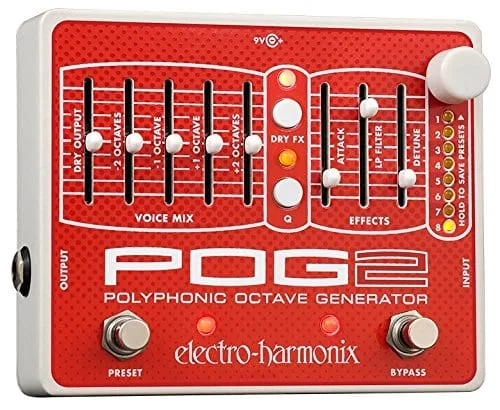
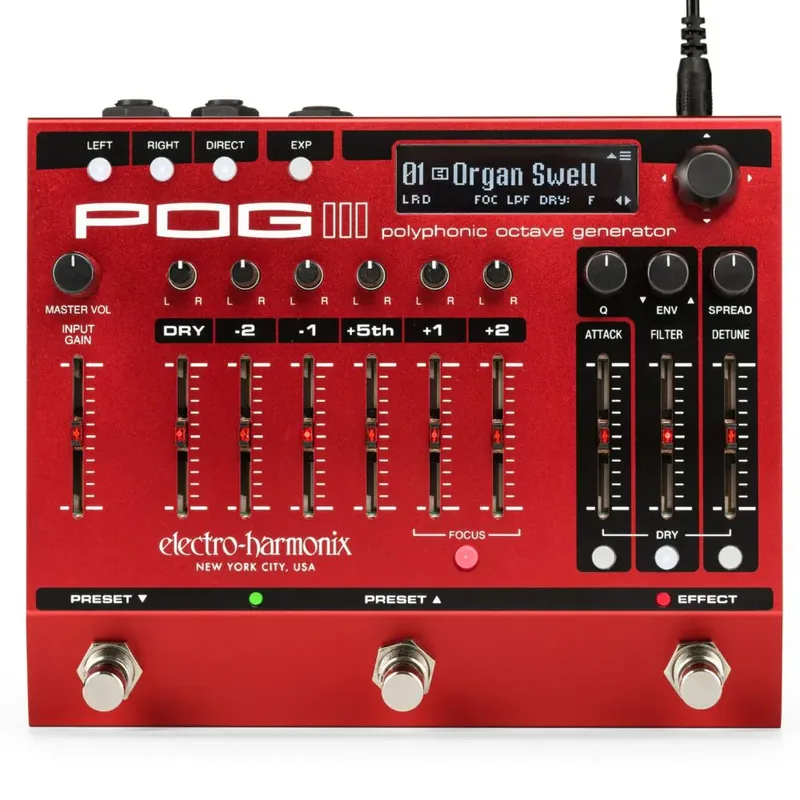
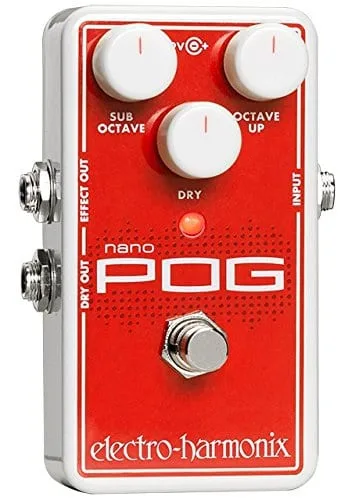
The line continued in both directions after it: the full-featured POG2 and later the POG III carry the original concept forward, while the Nano POG and Pico POG shrink it further. Electro-Harmonix also applied the same polyphonic pitch engine to other pedals, including the Pitch Fork pitch shifter.
There have been at least two circuit revisions inside the same pedal. A technical analysis on the Guitar FX Layouts blog, by the writer known as IvIark, found that "the original used 5K linear pots for all the controls," while a newer unit he examined had 10K linear pots6. The same analysis notes the newer Rev F circuit board uses a buffered input and different outputs from the original revision, and that its author found the original footswitch "incredibly loud" compared with the newer switching6. None of this changes the control layout or the sound concept; it is internal revision history that matters mainly to anyone servicing or modifying the pedal.
What reviewers and players say
Published coverage has been consistent about what the pedal is for. MusicRadar's review team found the tracking tighter and quicker than the original POG's3, and Trevor Curwen, reviewing it as part of the Epitome, described it as the piece that "supplies extra notes an octave above and below the played pitch" and concluded it "does the business" for the 12- or 18-string effect5. Pedal of the Day's Mike B highlighted the simpler control set relative to the original POG4. Guitar World's writers, in a 2025 pitch-shifter buying guide, noted its long-standing popularity with players in two- and three-piece bands2. On That Pedal Show, Daniel and Mick discussed the Micro POG with sound examples in their octave pedals episode7.
Videos
ProGuitarShopDemos
Guitar World
Reverb
Questions
Is the Micro POG true bypass?
No. Electro-Harmonix lists the Micro POG as buffered bypass. The BYPASS footswitch toggles between effect and bypass modes, and a technical analysis of the newer Rev F circuit board notes it uses a buffered input, which is consistent with the maker's buffered bypass specification.
How much current does the Micro POG draw?
The Micro POG draws 180mA, according to Electro-Harmonix. It runs on the included 9.6VDC-200mA power adapter. That current draw is high for a compact pedal, so it is worth planning for on a powered pedalboard.
Can the Micro POG track chords?
Yes. Electro-Harmonix describes its tracking as polyphonic and super fast, letting you play chords, arpeggios or single notes with no glitches. MusicRadar's review found the tracking tighter and quicker than on the original POG.
What is the difference between the Micro POG and the original POG?
The Micro POG is a simplified version of the original POG. Electro-Harmonix says it delivers the same tracking and smooth polyphony in a simplified design, with three volume knobs instead of the original's larger control set, in a smaller die-cast chassis.
What do the two outputs on the Micro POG do?
The EFFECT OUTPUT jack carries the wet signal, while the DRY OUTPUT jack outputs a buffered version of the input signal. MusicRadar notes the two outs let you split dry and wet signals onto separate paths, for example sending each to a different amp.
Sources (7)
- Micro POG, Electro-Harmonix
- Best pitch shifter pedals: top picks from Digitech, Eventide and more, Guitar World, 2022-01-13
- Electro-Harmonix Micro POG review, MusicRadar, 2008-01-28
- Electro-Harmonix Micro POG Polyphonic Octave Generator, Pedal of the Day, 2015-09-04
- Electro-Harmonix Epitome review, MusicRadar, 2013-08-28
- Guitar FX Layouts: Micro POG Dual Control modification, Guitar FX Layouts (tagboardeffects.blogspot.com), 2014-12-22
- That Pedal Show, That Pedal Show, 2016-10-07