

The Electro-Harmonix Nano POG is a compact polyphonic octave pedal released in 2015 by Electro-Harmonix. It is a Polyphonic Octave Generator: you mix your dry signal with two generated octaves, one above and one below the note you are playing1. Because it is polyphonic, it tracks chords as well as single notes, and it works on bass as well as guitar.
The Nano POG arrived as a smaller member of the EHX POG series, which already included the POG2 and the Micro POG2. It carries a current list price of $230.40 from the maker1, against a US list price of $270.50 when it launched in 20153.
What it does to your sound
The pedal generates an octave-up voice and a sub-octave voice and lets you blend each against your dry signal. Electro-Harmonix says it tracks chords, sweeps and single notes with no hitches or glitches, and that it can produce a great 12-string guitar sound, turn your guitar into a bass, or create organ-like sounds1. Guitar World's buying guide lists its range as +3 oct / -3 oct and records it as not glitchy4.
Premier Guitar's reviewer found the low end especially convincing: the octave-down transpositions are deep and fat, with a percussive attack suggesting a bass played pickstyle5. On the octave-up side the same reviewer found the tones sound inorganic, and took issue with the 12-string claim, finding the blended tones sound nothing like a 12-string guitar5.
"Bass transpositions are deep and fat, with a percussive attack suggesting a bass played pickstyle."
One documented player: Andy Cairns of Therapy? uses his Nano POG in tandem with a Marshall Supervibe for the Twilight Zone style riff in "Ugly"6.
The controls and mode switch
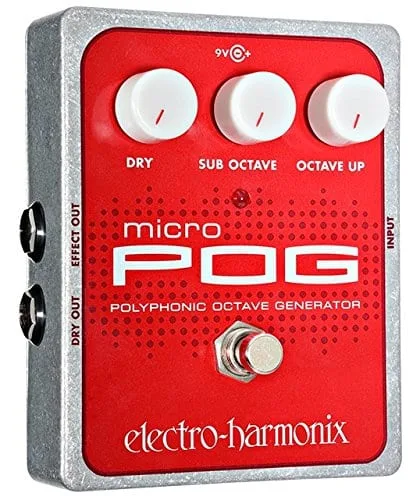
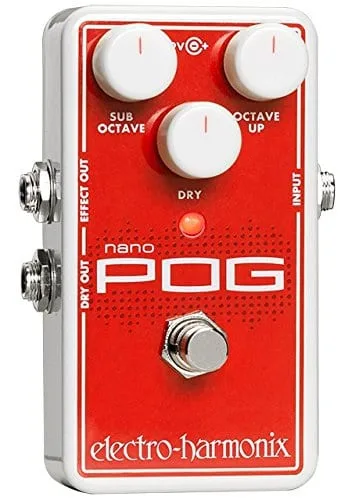
The front panel is deliberately minimal. Guitar World's Alex Lynham described it as having just three controls: an upper octave, the sub octave, and the dry signal7. Premier Guitar's reviewer noted the same layout, calling them level pots for the dry, octave-up and octave-down signals5.
| Control | What it does |
|---|---|
| DRY knob | Sets the output volume of the dry signal at the Effect Out jack1 |
| SUB OCTAVE knob | Sets the output volume of the sub-octave signal1 |
| OCTAVE UP knob | Sets the output volume of the octave-up signal1 |
| Mode switch | Selects the algorithm used for the octave-up sound8 |
The Mode Switch, added for the Nano, lets the player choose between two octave-up algorithms: one position is optimized for fast single-note playing, the other enhances the harmonic content of chords8. That is the main functional difference from the simpler Micro POG formula of three knobs and nothing else.
Jacks, power and switching
The pedal has three jacks. The Input jack takes your instrument; the Effect Out jack outputs the effect; and a separate Dry Out jack outputs a buffered version of the input signal, which lets you split your signal for greater flexibility and control, for example sending the dry sound to one amp and the effected sound to another12.
A single footswitch toggles between effect and bypass modes. Electro-Harmonix describes the footswitching as silent and reliable, which the launch coverage noted can be especially useful in recording sessions or with mic'd acoustic musicians, where a loud mechanical click would be picked up2. The housing is a road-worthy die-cast package1.
Power comes from the included 9.6VDC-200mA adapter, or from an optional 9V battery, which is not included1. At 25mA the draw is low enough that a battery is a realistic option1.
The Nano POG uses buffered bypass, not true bypass1. If you run it with a long cable run or among other buffered pedals, the Dry Out jack also gives you a buffered split1.
How it differs from the POG2 and the Soul POG
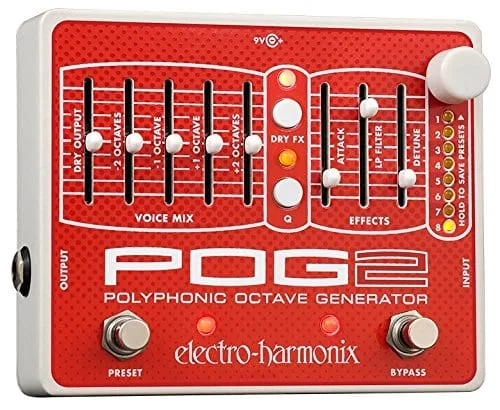
The POG2 is the deluxe version of the original POG9. Where the Nano POG gives you one octave up and one octave down, the POG2 provides harmonization one and two octaves above and below the direct signal, along with true bypass510. The Nano trades that extra range and flexibility for a much smaller box and a simpler control set.
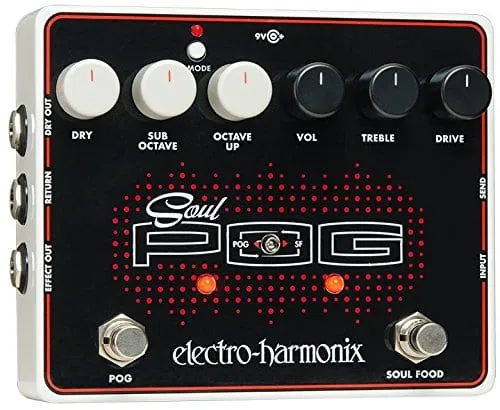
In 2016 Electro-Harmonix released the Soul POG, which combines the Nano POG's polyphonic octave generator section with a synth engine11. Both the Nano POG and the synth pedal it was paired with were already popular EH pedals at the time of that announcement12.
What reviewers said
Reviews have been consistently positive about tracking and tone, with reservations about the octave-up voice13514.
- Premier Guitar: "Near-foolproof octave effects. Excellent polyphonic tracking." The reviewer found it hits the sweet spot on range versus ease of use, fidelity versus funkiness, and price versus performance, calling it compelling enough to excite experienced sound-sculptors yet simple enough for beginners. Cons: octave-up tones sound inorganic, and the blended tones do not sound like a 12-string guitar5.
- MusicRadar: the Nano POG "continues to handle like a champ, with infallible tracking and some of the most natural octaves you'll get out of a pedal-based pitch-shifter"13.
- Guitar World's 2025 octave pedals guide named the Nano POG best overall4.
"It's compelling enough to excite experienced sound-sculptors, yet simple enough for beginners."
Videos
Premier Guitar
EHX
Ryan Kiesshauer
Questions
Does the Nano POG track chords?
Yes. Electro-Harmonix says it tracks chords, sweeps and single notes with no hitches or glitches, and Premier Guitar's reviewer called its polyphonic tracking excellent, describing the octave effects as near foolproof. MusicRadar likewise found infallible tracking and some of the most natural octaves you get from a pedal-based pitch shifter.
Can the Nano POG run on a 9V battery?
Yes. The pedal ships with a 9.6VDC-200mA power adapter, but it also runs on an optional 9V battery, which is not included. Current draw is 25mA, so a battery is a practical option for players who want to travel light.
Is the Nano POG true bypass?
No. The Nano POG uses buffered bypass, and its Dry Out jack outputs a buffered version of the input signal. The larger POG2 in the same series is true bypass, so players who insist on true bypass may prefer that model.
What is the difference between the Nano POG and the POG2?
The Nano POG gives you dry, one octave up and one octave down, with three knobs and a mode switch. The POG2 is the deluxe version of the original POG, adding harmonization one and two octaves above and below the direct signal, plus true bypass. The Nano is smaller, simpler and cheaper.
Can the Nano POG make a 12-string sound?
Electro-Harmonix markets it partly that way, saying it can produce a great 12-string guitar sound. Premier Guitar's reviewer disagreed, finding that the blended tones sound nothing like a 12-string guitar. It does make convincing organ-like sounds and deep bass transpositions.
Does the Nano POG work on bass?
Yes. Electro-Harmonix says it can turn your guitar into a bass, and Premier Guitar's reviewer found the octave-down transpositions deep and fat, with a percussive attack suggesting a bass played pickstyle. Andy Cairns of Therapy? uses one for a riff on the song Ugly.
Sources (14)
- Nano POG, Electro-Harmonix (www.ehx.com)
- Electric-Harmonix Unveils Nano Pog Pedal, Guitar Interactive Magazine, 2015-04-23
- Electro-Harmonix Releases the Nano POG, Premier Guitar, 2015-04-22
- Best pitch shifter pedals: top picks from Digitech, Eventide and more, Guitar World, 2022-01-13
- Electro-Harmonix Nano POG Review, Premier Guitar, 2015-08-17
- Electro-Harmonix unveils the incredible shrunken Pico POG, MusicRadar, 2023-07-25
- Classic gear: Electro-Harmonix POG, Guitar World, 2020-03-09
- Electro-Harmonix Announces the Soul POG, Premier Guitar, 2016-01-13
- The Best Octave Pedals In 2024, Delicious Audio, 2024-08-08
- POG2 | Polyphonic Octave Generator - Electro-Harmonix, Electro-Harmonix (ehx.com)
- Soul POG, Electro-Harmonix
- Electro Harmonix Soul Pog: a combination of two popular EH pedals in one, gearnews.com, 2016-01-15
- Electro-Harmonix Nano POG review, MusicRadar, 2015-12-04
- Atreides Analog Weirding Module review | MusicRadar, MusicRadar, 2021-08-17