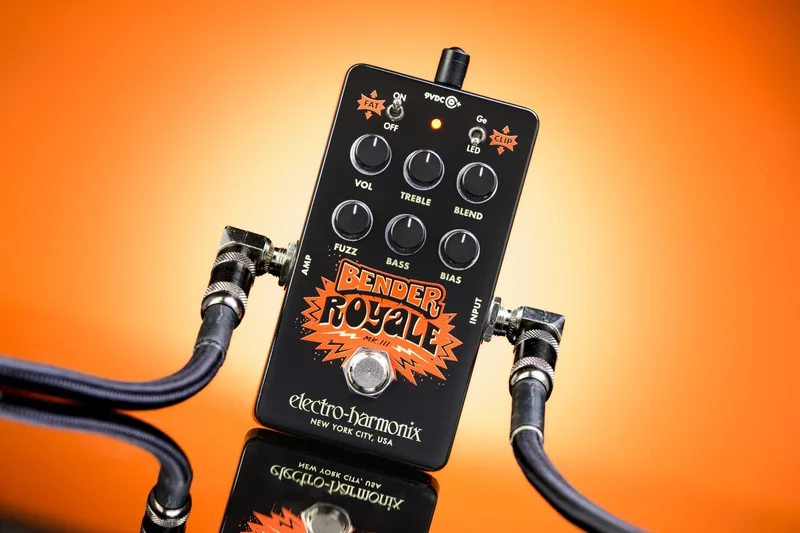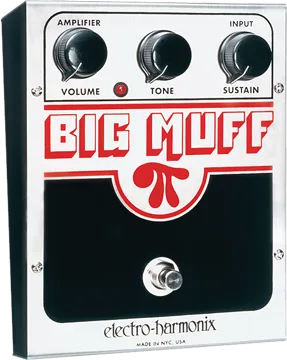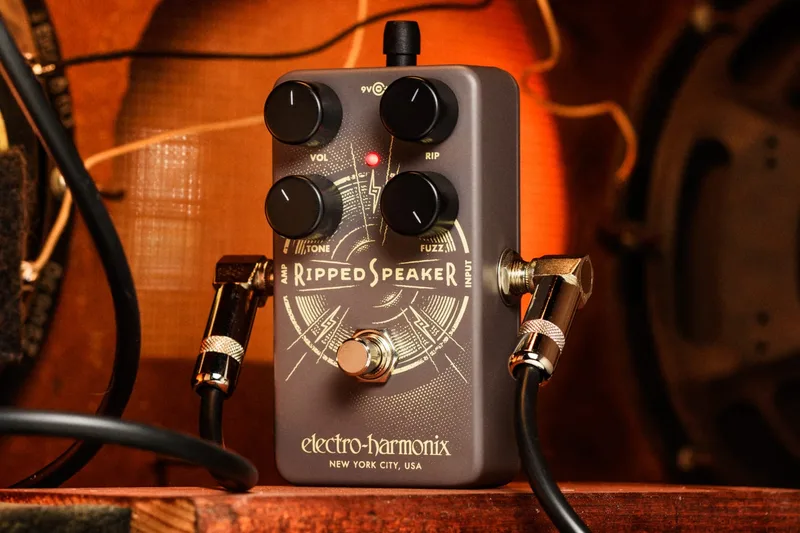


The Electro-Harmonix Ripped Speaker is a nano-sized analog fuzz pedal released by Electro-Harmonix in 202112. Where a Big Muff aims for smooth, saturated sustain, the Ripped Speaker goes the other way: it is built around the lo-fi, rough-edged distortion that early players got by damaging their amps, and Electro-Harmonix describes it as "a modern fuzz with old school roots" that "pays homage to one of the ways that early, distorted guitar and bass sounds were made"1.
The pedal's signature feature is its Rip knob, a bias control that changes how the waveform is clipped. Set near noon it behaves like a conventional fuzz; turned either way it collapses into gated, sputtering textures that reviewers compared to a sound-effect generator more than a normal drive34. MusicRadar's review team summed up the pedal's purpose as "lo-fi distortion and rough-housing fuzz tones"5.
The controls: Rip, Fuzz, Tone and Volume
The Ripped Speaker carries four knobs plus a true bypass footswitch3. Two of them do the usual fuzz-pedal jobs, and two are where the character lives.
| Control | What it does |
|---|---|
| FUZZ | Controls the amount of input gain that goes into the fuzz circuit1 |
| TONE | Controls an active tilt-shift type EQ to further shape your fuzz tone1 |
| VOL | Adjusts the output volume of the Ripped Speaker1 |
| RIP | A bias control that varies the amount of clipping at either the top or bottom of the signal waveform1 |
Performer Mag's reviewer found that "the Volume and Fuzz do what you'd expect on a pedal of this sort," and that with all controls at noon the fuzz is already quite present, going "right up the middle" of the mix8. The Tone control earned specific praise: at its 9 o'clock position it "makes a huge difference, with usable low-end response for great fat rhythm and sweet lead parts"8.
The footswitch toggles the pedal between effect and true bypass mode, and an LED lights when the effect is engaged1. Performer Mag noted the true bypass switching prevents tone suck and placement issues, so the pedal needs no buffer in a normal pedalboard8.
Where the Rip knob takes the sound
The Rip knob is the heart of the pedal, and it is worth understanding before buying. Because it is a bias control, it changes which part of the waveform gets clipped, and that changes both the texture and the decay of the notes1.
- Around noon: Guitar World's reviewer found this the optimum setting for a conventional fuzz sound, "fat but rough-edged, straight out of the mid-'60s," and at its best in the upper reaches of the Fuzz knob3. MusicRadar's launch coverage similarly reported that "set at noon, the fuzz is fat with just enough bite"9. The manual itself points players here, saying the most open sound comes with the Rip control at noon10.
- To the left: The gating is smoother and less extreme. Guitar World found "subtle musical variations just left of centre," while MusicRadar described it as "a smoother affair with the signal fading out quickly"39.
- To the right: The bias tightens into a hard gating effect that Guitar World's reviewer called "almost unplayable at its extreme"3.
GuitarPlayer's reviewer put the two extremes together: "Turn it in either direction and the tones descend into gated and spitty-sounding timbres that are more sound-effecty" than conventional fuzz. The same reviewer found the smoothest, least compressed response with the knob between 11 o'clock and noon, suited to jacked-up blues or hard rock4.
History: from Dave Davies to a nano pedal
The pedal's name and concept trace back to one of the most famous acts of gear abuse in guitar history. The Kinks' Dave Davies got the tone of "You Really Got Me" by slashing the speaker cone of his amp, and Guitar World notes the Ripped Speaker "pays homage to that sort of damaged cone action, as well as the lo-fi distortion caused by faulty electronics"3. Premier Guitar's writers describe the pedal as "designed to emulate the distorted tones on '50s and '60s records that were created with broken or misused gear"11. Guitar.com's history feature frames it more directly: Electro-Harmonix released the pedal in 2021 "in response to the coveted You Really Got Me sound"12.
The idea was not entirely new. Guitar.com's review pointed out that "there's already a fuzz pedal that does the same thing: the Devi Ever Torn's Peaker"10. The Ripped Speaker is Electro-Harmonix's own take on that territory, in the company's compact nano enclosure, and it launched at a US street price of $99.007.
Inside, the build follows EHX's usual practice: GuitarPlayer's reviewer found a glass-epoxy PCB holding the components, visible by removing the bottom plate4.
What reviewers made of it
Published reviewers were broadly positive about what the pedal sets out to do. Guitar World's overall verdict was short and to the point3:
"Gnarly with knobs on. Edgy fuzz with all the fine adjustment you'll need."
Performer Mag's Chris Devine found the fuzz present and usable straight out of the box at noon settings, with the Tone control opening up fat rhythm and lead tones8. GuitarPlayer's review flagged the trade-off that comes with the concept: the gated, spitty settings that give the pedal its name are more sound-effect than drive pedal, and players after a smooth, sustaining fuzz will want to live near noon on the Rip knob4.
Videos
EHX
TheGuitarGeek
Guitar Bonedo
News
Questions
Is the Ripped Speaker true bypass?
Yes. Electro-Harmonix lists the pedal as True Bypass, and the footswitch toggles between effect and true bypass mode, with an LED that lights when the effect is engaged. Performer Mag's reviewer noted the true bypass footswitch prevents tone suck and placement issues on a pedalboard, so no buffer is needed for normal setups.
Does the Ripped Speaker run on a battery?
Yes. A 9V battery is included with the pedal, and an optional 9.6VDC-200mA power adapter is available but not included. The pedal also accepts a standard EHX 9 Volt power supply, so it can run either on battery or off a power brick.
Is the Ripped Speaker the same as the Devi Ever Torn's Peaker?
No, they are separate pedals, but they chase the same idea. Guitar.com's reviewer pointed out that the Devi Ever Torn's Peaker was already a fuzz pedal doing the same torn-speaker thing before the Ripped Speaker arrived in 2021. The Ripped Speaker is Electro-Harmonix's own take on that lo-fi, damaged-cone sound.
Can you get the You Really Got Me sound from the Ripped Speaker?
The pedal was released in 2021 in response to the coveted You Really Got Me sound, according to Guitar.com's history of deleted scenes in guitar history. That Kinks track is the reference point: Dave Davies got his tone by slashing the speaker cone of his amp, and the Ripped Speaker emulates that damaged-cone distortion in pedal form.
Sources (12)
- Ripped Speaker, Electro-Harmonix
- EHX launches the new, affordable Ripped Speaker fuzz, guitar.com, 2021-02-10
- Electro-Harmonix Ripped Speaker review, Guitar World, 2022-04-25
- Electro-Harmonix Ripped Speaker Review, GuitarPlayer (www.guitarplayer.com), 2022-02-01
- Electro-Harmonix Ripped Speaker review, MusicRadar, 2022-10-18
- Big Muff Pi, Electro-Harmonix (www.ehx.com)
- New Ripped Speaker Fuzz Pedal by Electro-Harmonix, Premier Guitar, 2021-02-16
- REVIEW: Electro-Harmonix Ripped Speaker Fuzz Pedal, Performer Mag, 2022-03-24
- Electro-Harmonix goes old school with the Ripped Speaker fuzz pedal, MusicRadar, 2021-02-10
- Electro-Harmonix Ripped Speaker review: a noisy misnomer that delivers splat-fuzz fun, Guitar.com, 2022-02-01
- The Fuzz Boxes That Fuel PG Staff’s Meanest Musical Moments, Premier Guitar, 2025-05-12
- Josh Scott: The deleted scenes of guitar history, Guitar.com, 2022-01-24