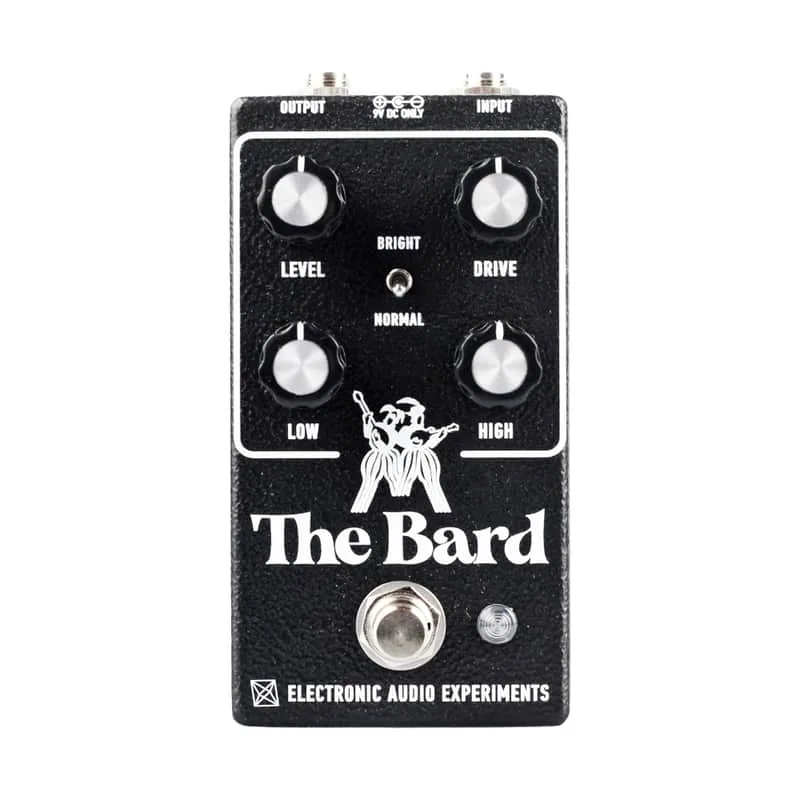


The Electronic Audio Experiments Bard is a compact analog overdrive preamp pedal that takes its circuit design from the Music Man HD130 guitar amplifier, a hybrid amp manufactured from 1974 to 1984 that combined a solid state preamp with a tube power amp1. Where the original amp used that unusual split design, the Bard recreates the preamp side in pedal form, with op amps standing in for tubes1.
The maker describes the result as a wide-ranging dirt pedal: clean tones are clear and sparkly with a gentle midrange dip from the passive tone stack, and the gain range extends from those cleans into overdrive territory1. Delicious Audio's write-up characterized the pedal's range as "pristine cleans to lively mid-gain, all the way to a robust gain that defies traditional tube characteristics"2. The pedal is currently listed as Temporarily Unavailable at $199.003.
A Music Man HD130 preamp in op amps
The Music Man HD130 is the Bard's reference point. Electronic Audio Experiments calls it "one of our favorite misunderstood amplifiers of the past," noting that its combination of a solid state preamp with a tube power amp was an unusual choice that led to the amps being underrated14. The Bard takes the preamp half of that design and, in the maker's words, "editorialized our favorite parts of this cult classic into a compact overdrive pedal"1.
Circuit-wise, the maker says the Bard's circuitry resembles a classic 1960s American amplifier reimagined with op amps in the place of tubes1. RockBoard's PedalPedia entry, which classifies the pedal under preamp, overdrive and distortion, describes its character as "pristine (but not quite vintage) clean tones, trashy overdrive, and very wide frequency response that suits both guitar and bass"4. Delicious Audio likewise notes the pedal suits guitar, bass or other instruments2.
Controls
The control set is amp-like rather than overdrive-like: gain plus a passive tone stack2.
| Control | What it does |
|---|---|
| Level | Turns clockwise to increase output volume; the maker calls it "handy as a boost"1 |
| Drive | Sets the gain amount2 |
| Low | Passive low EQ control2 |
| High | Passive high EQ control2 |
| Bright switch | Alters the character of the High band2 |
Because the EQ is passive, it cuts rather than boosts, the same approach used in traditional amplifier tone stacks. The clean tones' gentle midrange dip comes from that passive tone stack1.
Power and connections
The Bard runs on a standard 9V DC, 2.1 mm center negative barrel supply and draws 60 mA1. RockBoard's independent listing matches the 9V DC center negative specification and the 60 mA current draw4.
The Bard does not accept batteries1. It needs a pedalboard power supply or a dedicated 9V adapter, and at 60 mA it draws more current than a typical analog overdrive, so plan for it when sizing an isolated supply.
Signal connections are a single input and output, with an input impedance of 200kΩ at 1 kHz and an output impedance under 5kΩ at 1 kHz1. Bypass is relay switching with true bypass, so the signal path is unbuffered when the pedal is off1.
History and versions
The Bard was first released as V1 in January 20241. Its history goes back further than the finished product: Electronic Audio Experiments says it "originally took shape as an open source DIY project" and that the company "substantially modified the design for production"1.
The DIY roots are still visible in the maker's catalog. Electronic Audio Experiments sells an HD130 DIY PCB described as "similar to (but not the same as) The Bard," which includes a 3PDT daughterboard for builders who want to wire their own switching5. So a player who wants the circuit lineage in build-it-yourself form has that option, while the production Bard is the refined, relay-switched version.
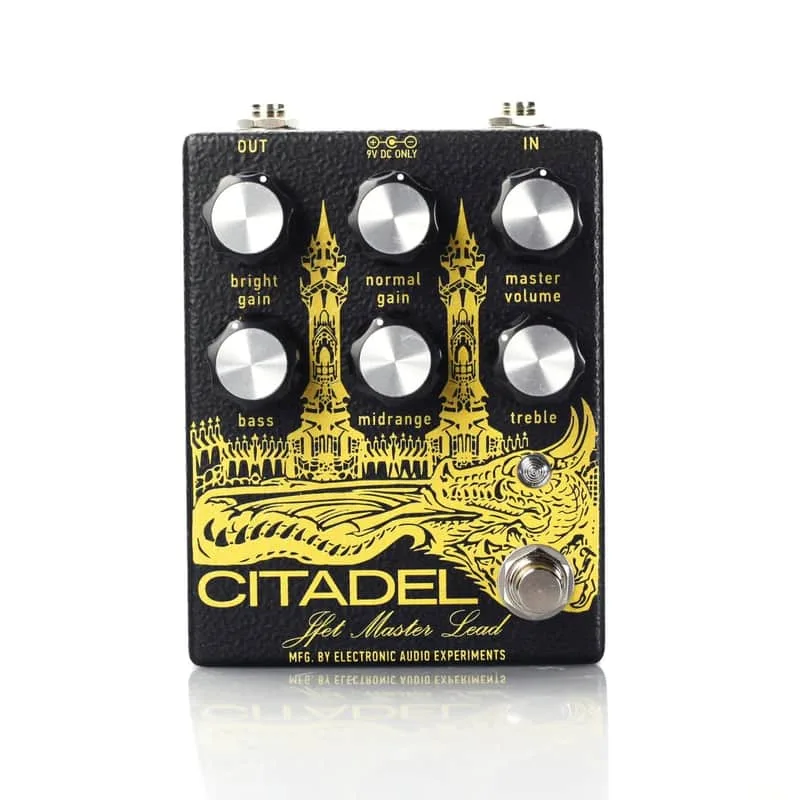
The pedal sits in the maker's lineup alongside other dirt pedals such as the Citadel, and it is currently listed as Temporarily Unavailable at $199.003.
Videos
ambienttrash
collector//emitter
Mark Johnston
Questions
Does the EAE Bard take a battery?
No. Electronic Audio Experiments states that its pedals do not accept batteries. The Bard runs on a 9V DC power supply through a 2.1 mm center negative barrel connector, drawing 60 mA, so it needs a spot on a pedalboard power supply.
Is the Electronic Audio Experiments Bard true bypass?
Yes. The maker lists the bypass as relay switching with true bypass, so when the pedal is off the signal passes through without buffering. The relay handles the switching action rather than a mechanical footswitch contact.
Can the Bard be used as a clean boost?
Partly. The Level control turns clockwise to increase output volume, and the maker describes it as handy as a boost. With the Drive control set low the pedal produces clean tones, so it can push an amp harder while staying relatively clean.
Is the Bard based on an open source DIY circuit?
It started that way. Electronic Audio Experiments says the Bard originally took shape as an open source DIY project and was substantially modified for production. The company also sells an HD130 DIY PCB that is similar to, but not the same as, the finished Bard.
Why is the EAE Bard unavailable?
The maker's product page lists the Bard as Temporarily Unavailable at its $199.00 price, which suggests a production gap rather than a discontinuation. No return date is given, so availability depends on the maker's next production run.
Is the Electronic Audio Experiments Bard an overdrive or a preamp?
It is both. The maker calls it a Solid State Overdrive Preamp, a compact overdrive pedal built around the preamp circuit of the Music Man HD130 amplifier. It ranges from clean tones through mid-gain overdrive to higher gain, with passive Low and High EQ controls.
Sources (5)
- Electronic Audio Experiments Bard, Electronic Audio Experiments, 2024
- Electronic Audio Epxeriments The Bard Preamp, Delicious Audio, 2024-01-23
- Electronic Audio Experiments Citadel JFET Master Lead, Electronic Audio Experiments
- The Bard by Electronic Audio Experiments, RockBoard PedalPedia, 2026
- HD130 DIY PCB, Electronic Audio Experiments