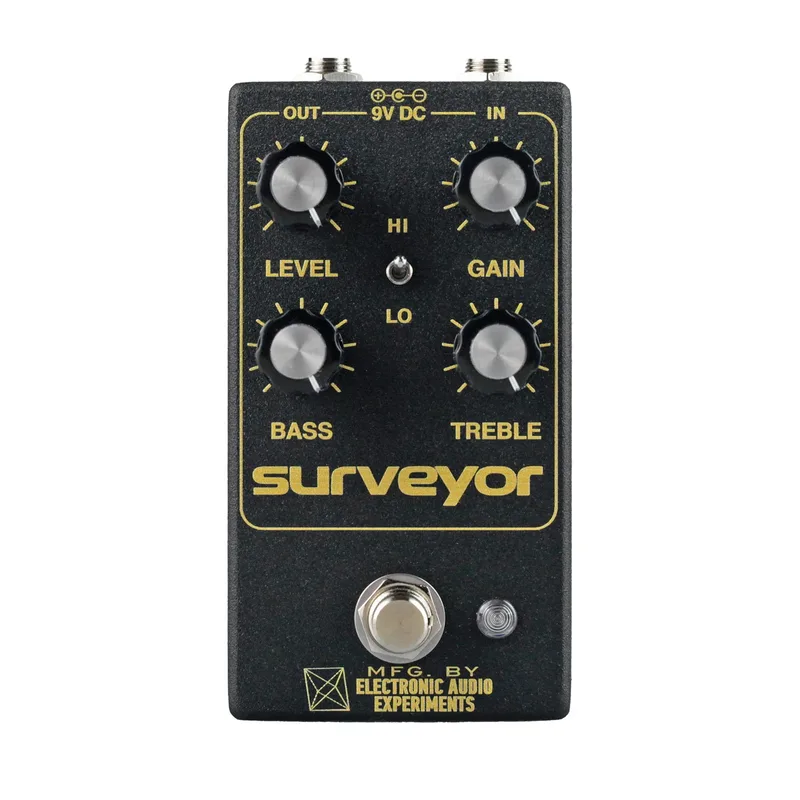


The Electronic Audio Experiments Surveyor is a compact re-interpretation of the Instrument Voicing Preamp, better known as the IVP, a cult classic and long discontinued rackmount preamplifier from the late 1970s1. Where most overdrive pedals shape the tone after the clipping stage, the Surveyor puts a two-band shelving EQ before the distortion is applied, which Electronic Audio Experiments describes as the complete opposite of most drive pedal designs2. The result is a solid-state drive that lets you push specific frequency bands into the distortion, boosting treble for a signature clang or maximizing bass for what the maker calls fuzz overload23.
At the heart of the pedal is a transformer-loaded "Tube Voice" distortion generator that Electronic Audio Experiments says is highly responsive to the frequency content of the input signal2. The Surveyor is currently listed as temporarily unavailable at $249.00 USD2.
What the Surveyor does: IVP-style solid-state drive
The original Intersound IVP was a rack preamp from the late 1970s that included a clean channel, a 4-band parametric equalizer and the Tube Voice channel5. That Tube Voice circuit is what the IVP is best known for: a distinctively clangy tone and harsh attack at high treble settings, a unique solid-state voice rather than an attempt to mimic a tube amp2. Aion FX, whose Isotope project documents the same circuit, notes the original ran on a +/-15V internal supply, while pedal adaptations run on 9V5.
Electronic Audio Experiments streamlined the Tube Voice channel into the Surveyor, and the maker says the pedal is equally at home on bass, synthesizers, drum machines, even vocals21. Because the shelving EQ sits before the clipping, gain can be selectively applied to a specific frequency band: Guitar Pedal X's Stefan Karlsson described this as letting you "boost the treble for that signature clang, or maximize the bass for fuzz overload"3.
The controls: Level, Gain, Bass, Treble and Hi/Lo
The Surveyor has four knobs and one switch4. The Gain and tone controls are highly interactive, since the EQ feeds the distortion stage rather than shaping it afterward2.
| Control | What it does |
|---|---|
| Level | Overall volume, with more than enough range for line level output or to overdrive the next thing in your signal path2 |
| Gain | Amount of overdrive/saturation, equally applied to all frequencies; highly interactive with the Bass and Treble settings2 |
| Bass | Active bass shelving control, ±12 dB at 100 Hz3 |
| Treble | Pre-clipping high shelf boost/cut, ±12 dB at 3 kHz2 |
| Hi/Lo switch | Sets the range of the gain control: +0 dB in the Lo position, +14 dB in the Hi position2 |
The Level control's line-level range is worth noting for anyone running the Surveyor into a mixer, interface or rack gear rather than straight into an amp2.
Power and connections
The Surveyor runs on a 9V DC power supply through a 2.1 mm center negative barrel connector and draws 70 mA2.
The Surveyor does not accept batteries. Electronic Audio Experiments states that its pedals do not take them, so the pedal needs a pedalboard power supply or a dedicated 9V adapter2.
Bypass is relay switching with true bypass, so the dry signal passes through untouched when the pedal is disengaged2. Input impedance is 1MΩ at 1 kHz and output impedance is under 1kΩ at 1 kHz, figures consistent with driving a long cable run or a normal amp input2.
History: from the IVP rack preamp to V2.5
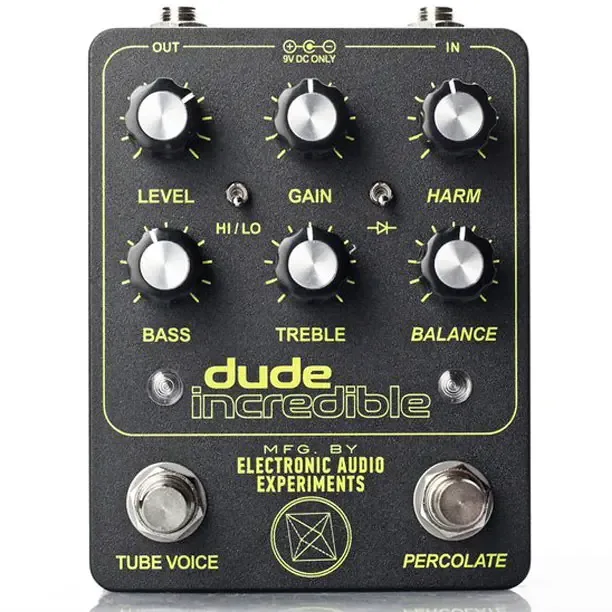
The Surveyor's lineage runs through the Electronic Audio Experiments Dude Incredible, a dual-channel pedal combining a percolator-style two-transistor fuzz with a streamlined version of the Intersound IVP1. The two channels sit in series, with the Percolator feeding the IVP, and the IVP side carried the same Level, Hi/Lo Gain switch, Gain, Bass and Treble controls the Surveyor now has61. Electronic Audio Experiments later offered that Tube Voice channel as a standalone unit, which is the Surveyor itself1.
The pedal has gone through several revisions2:
| Version | Period | Changes |
|---|---|---|
| V1 | Original release | First standalone release of the IVP circuit2 |
| V2 to V2.4 | 2021 to 2022 | New mechanical format (changed enclosure shape, knob spacing, jacks), added power supply over-voltage shutdown circuit and ESD protection, added the Hi/Lo toggle to increase gain range2 |
| V2.5 | Spring 2024 | Minor electrical adjustments, simplified bypass circuitry to remove the microcontroller, minor artwork and print adjustments2 |
Guitar Pedal X reported the V2.5 reissue in May 2024, crediting designer John Snyder with once more extracting the IVP side from the Dude Incredible as the standalone Surveyor preamp/overdrive3. The Copper finish was updated to a new powder coat in October 2025, and Electronic Audio Experiments notes that older units may vary in appearance2.
What reviewers said
Published coverage of the Surveyor itself is thin, but what exists is positive. Writing at Guitar Pedal X in May 2024, Stefan Karlsson covered the V2.5 reissue and admitted the pedal had him weighing it against its parent product3:
"I'm caught now between whether I get the V2 Dude Incredible - or just the I.V.P. side of that. The decision could go either way."3
RockBoard's PedalPedia entry lists the Surveyor as an analog, 4-knob drive previously found in the left half of the Dude Incredible pedal, and ties the circuit to the Intersound IVP's reputation for famous noise rock tones4.
Videos
Electronic Audio Experiments
Noise Generator
Harsh Tones, Inc.
Questions
What is the Instrument Voicing Preamp?
The Intersound IVP, also known as the Instrument Voicing Preamp, is a rackmount preamp from the late 1970s. It is best known for its Tube Voice channel, a solid-state distortion circuit with a distinctively clangy tone and harsh attack at high treble settings. Electronic Audio Experiments reinterpreted that channel as the Surveyor pedal.
Does the EAE Surveyor take a battery?
No. Electronic Audio Experiments states plainly that its pedals do not accept batteries. The Surveyor runs on a 9V DC power supply through a 2.1 mm center negative barrel connector, drawing 70 mA, so it needs a pedalboard power supply or a dedicated adapter.
Is the Surveyor true bypass?
Yes. The current version uses relay switching with true bypass, so the signal passes untouched when the pedal is off. The V2.5 revision simplified the bypass circuitry by removing the microcontroller, but the true bypass behavior remains.
Can the Surveyor be used on bass or synths?
Yes. Electronic Audio Experiments says the Surveyor is equally at home on bass, synthesizers, drum machines and even vocals. Its active Bass control, ±12 dB at 100 Hz, gives low-frequency instruments real shaping range before the drive is applied.
Why is the EAE Surveyor unavailable?
The maker lists the Surveyor as temporarily unavailable, which is common for Electronic Audio Experiments pedals built in small batches. The listed price is $249.00 USD, and the page remains up with full specifications, so it is a pause in production rather than a discontinuation.
Sources (6)
- Dude Incredible, Electronic Audio Experiments
- Surveyor, Electronic Audio Experiments, 2024
- Guitar Pedal X, Guitar Pedal X, 2024-05-27
- Surveyor by Electronic Audio Experiments, RockBoard PedalPedia, 2026
- Isotope Amp Overdrive / Intersound® IVP, Aion FX, 2020-06-05
- Guitar Pedal X, Guitar Pedal X, 2022-05-16