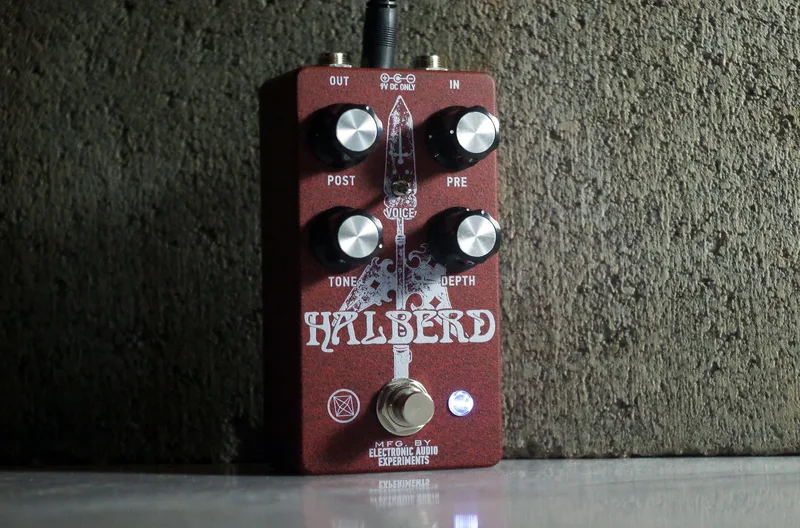


The Electronic Audio Experiments Halberd is a discrete transistor overdrive circuit designed, in the maker's words, "for the greatest possible dynamic range and note clarity"1. Where most overdrives lean on op amps or JFETs doing amp-style breakup, the Halberd gets its character from over a dozen transistors working together, and EAE places it deliberately apart from both camps: "a medium-gain device with the harmonic fullness and grind of a much higher-gain pedal, one that stands apart from both the brazen buzz of op amp distortion and the smooth breakup of JFET amp emulations alike"2. The original version, released in Fall 2019, was built in a BB-type enclosure and used a NOS germanium transistor in one of its gain stages1. The current version 2 arrived in August 2021 with a smaller 125B-type enclosure and a revised circuit, and the pedal is listed at $249.00, currently marked Temporarily Unavailable1.
A discrete transistor overdrive with medium gain and heavy grind
The Halberd's circuit is built from discrete transistors rather than a clipping op amp, and Delicious Audio described the original design as "based on a circuit blending silicon and germanium transistors"3. That blend is what gives the pedal its position in EAE's drive lineup: more grind than a clean boost or light drive, but with the dynamic range and note clarity of a medium-gain pedal. RockBoard's PedalPedia entry, carrying the maker's own description, sums up the character as coming from "over a dozen transistors working in harmony"2.
The pedal is also flexible about what you plug into it. EAE says it is "equally at home on guitar, bass, and synthesizer"1, which puts it alongside bass pedals rather than being a guitar-only drive. The Depth control is a big part of that, as covered below.
The controls: Pre, Depth, Tone and the Voice switch
The Halberd has three knobs and a three-position Voice switch. The knobs were renamed in V2: the V1 Low control became Depth, and the V1 High control became Tone1. A Post control sets the overall output level, and Delicious Audio noted that this output "is buffered for full transparency at all signal levels"3.
| Control | What it does |
|---|---|
| Pre | Sets the overall signal gain. Lower settings impart light compression, then increasing amounts of clipping up to a fuzzy overdrive depending on Voice and Depth settings1 |
| Depth | An adjustable low frequency shelving filter at the input, very interactive with the Pre control; effectively a second gain control affecting low frequencies only1 |
| Tone | An adjustable high shelf cut at the output, helpful for taming harsher frequencies especially at high gain settings1 |
| Voice | Three-position switch setting the overall drive character1 |
The structure is worth noticing. Depth is an adjustable low frequency shelving filter at the input, before the clipping stages, and Pre sets the overall signal gain, controlling how hard everything hits those stages. Tone is an adjustable high shelf cut at the output, after the drive. That gives you two separate places to manage the extremes of your signal, which is why the same pedal can work for a bass player wanting full lows and a guitarist wanting a tight, aggressive midrange push1.
The Voice switch: Clang, Standard and Deep
The Voice switch is where the Halberd's three personalities live1:
- Clang (up): increases gain in the upper midrange, for an aggressive sound and a sharp attack.
- Standard (middle): moderate gain with a gentle mid push; identical to Halberd V1.
- Deep (down): a full range gain boost with woolly saturation and a fuzzy note attack.
Because Pre and Depth interact with the Voice setting, the same knob positions behave differently in each mode. Deep's full range boost with a fuzzy attack sits closest to fuzz territory, while Clang's upper-midrange focus is the most aggressive and cutting of the three1.
Power and connections
The Halberd runs on 9V DC from a 2.1mm center negative barrel jack and draws 50mA when engaged1. That current draw is a V2 improvement: V1 drew approximately 180mA, and the August 2021 revision cut that to 50mA1. There is no battery option; EAE states that its pedals do not accept batteries1.
The Halberd needs a 9V DC center negative supply and does not accept batteries. At 50mA it is easy to power from a standard pedalboard supply, but V1 units draw approximately 180mA, so owners of the original should check which version they have before planning a power budget1.
Bypass switching is silent electronic switching with a Class A JFET buffer1. In V2 the bypass was converted to a fully electronic CMOS switch1. Input impedance is 1MΩ at 1 kHz and output impedance is under 1KΩ at 1 kHz1.
Versions and finishes
The Halberd's history is a series of documented revisions1:
| Version | Date | What changed |
|---|---|---|
| V1 | Fall 2019 | Original release, BB-type enclosure, NOS germanium transistor in one gain stage |
| V2 | August 2021 | Enclosure reduced to 125B-type; germanium transistor no longer used, supporting circuitry updated to preserve tonal characteristics; Low renamed Depth, High renamed Tone; bypass converted to fully electronic CMOS switch; current draw reduced from approximately 180mA to 50mA |
| V2.5 | January 2025, from Serial #1684 | Improved taper of the Pre control, no longer has an abrupt transition at the lowest end of travel |
The pedal has also appeared in several finishes over its run1:
- Standard: new for late 2025, terra cotta powder coat with black print.
- Black: black texture with light gray print, updated in 2025 to a black wrinkle powder coat.
- Green Dragon: green metallic with light gray print.
- Rust Never Sleeps: brown/orange texture with light gray print, discontinued in November 2025.
- Acid Etch: hand-finished using hydrochloric acid with a toner transfer mask; application and technique vary between batches and individual units.
All Halberd pedals come with EAE's standard warranty1.
Players and availability
In Premier Guitar's rig rundown of Mammoth WVH, the band's Jon Jourdan was shown using an Electronic Audio Experiments Halberd for live performances of "Stone"4.
The maker's product page currently lists the Halberd as Temporarily Unavailable, with no reason or return date given1. The page still carries the $249.00 price and the current specifications, and the pedal's revision history, most recently version 2.5 in January 2025, suggests an active product line rather than a discontinued one1.
Videos
Electronic Audio Experiments
collector//emitter
Mark Johnston
Questions
Does the EAE Halberd work on bass?
Yes. Electronic Audio Experiments says the Halberd is equally at home on guitar, bass, and synthesizer. The Depth control, an adjustable low frequency shelving filter at the input, lets you set how much low end feeds the gain stages, which is what makes it usable on bass rather than a guitar-only drive.
Does the Halberd take a battery?
No. Electronic Audio Experiments states plainly that its pedals do not accept batteries. The Halberd runs on a 9V DC power supply with a 2.1mm center negative barrel jack, drawing 50mA when engaged, so it needs a spot on a pedalboard power supply.
What do the Clang, Standard and Deep settings do on the Halberd?
They are the three positions of the Voice switch. Clang (up) increases gain in the upper midrange for an aggressive sound and sharp attack. Standard (middle) is moderate gain with a gentle mid push, identical to Halberd V1. Deep (down) is a full range gain boost with woolly saturation and a fuzzy note attack.
Why is the EAE Halberd unavailable?
The maker's product page lists the Halberd as Temporarily Unavailable, without giving a reason or a return date. The pedal has been through several revisions since 2019, including V2 in 2021 and version 2.5 in January 2025, so the listing reflects a pause in availability rather than a discontinuation.
Sources (4)
- Halberd - Electronic Audio Experiments, Electronic Audio Experiments, 2021-08
- Halberd v2 by Electronic Audio Experiments, RockBoard PedalPedia, 2026
- Electronic Audio Experiments Halberd Overdrive, Delicious Audio, 2020-06-22
- Mammoth WVH Wolf Van Halen Guitar Rig Rundown, Premier Guitar, 2022-06-01