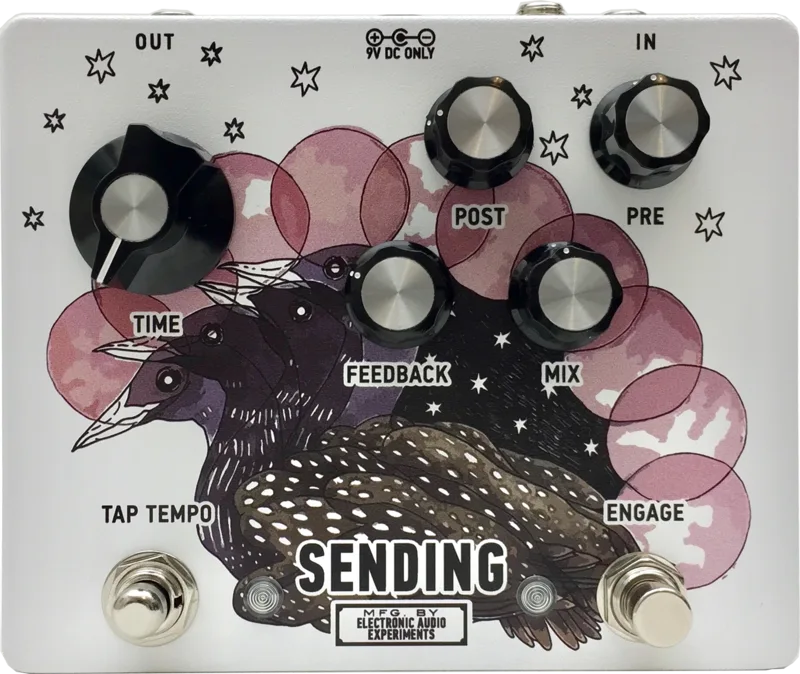


The Electronic Audio Experiments Sending is an analog delay pedal that pairs the voice of bucket brigade devices with a digital control system. The maker describes it as a design that "melds the archaic voice of bucket brigade devices with a fully modern toolbox of digital" control1. Under the hood are two MN3005 BBDs, the same bucket brigade chips that analog delay builders have used for decades, supported by a 32-bit, 100MHz processor that handles presets, MIDI and tap tempo12.
The current version, the Sending V2, arrived in July 2023 as a complete circuit overhaul of a 2018 original that was built in a run of only 55 units1. It is listed at $649.00 and shown as Temporarily Unavailable on the maker's site as of October 20261.
An analog BBD delay with digital control
The Sending's signal path is analog: a pair of MN3005 reissue bucket brigade devices pass the delayed signal, with an all-discrete preamp in front of them4. The preamp is a big part of the pedal's character. Its gain ranges from transparent to what the maker calls a "console-style grind that enriches your delayed tone" and provides a significant boost downstream4. Delicious Audio describes the V2's preamp as a colored stage adding saturation to the affected signal3.
What makes the Sending unusual among BBD delays is the digital layer wrapped around that analog path. Pedal of the Day describes the processor as "conducting this analog ensemble," granting deep user control, preset functionality and MIDI2. The result is a pedal that behaves like a modern digital delay in its control scheme while the repeats themselves stay bucket brigade.
Delay time runs from under 5ms to a full second without clock noise, and it can be pushed further for what the maker calls compelling sonic degradation1. On the V2, the full second extends to 2 seconds via tap tempo or MIDI, with the repeats becoming increasingly aliased along the way3.
The controls
The V2 delegates its controls to seven knobs whose functions are doubled through a Shift system of alternate functions3.
| Control | What it does |
|---|---|
| Time | Delay time from <5ms to 1 second1 |
| Div | Tempo divisions1 |
| Color | Adjusts preamp gain while keeping level consistent1 |
| Depth | LFO intensity3 |
| Trim | Adjusts volume up or down by 6dB1 |
| Mix Mode | Sets Mix knob as a crossfader between wet and dry, or as a delay level control only1 |
| Swell time | Adjusts speed of the feedback swell when Tap is held1 |
The LFO offers sine, triangle and square wave shapes for modulation of the delay line3. A November 2024 firmware update revamped the LFO engine with improved tapering, more natural V/Oct pitch movement, a continuously variable Shape control, clock sync mode and an arpeggio easter egg mode; new units ship with this firmware beginning with Serial Number #5081.
The two footswitches each pull double duty5:
- Engage Footswitch: turns the effect on and off; a long press changes the bypass mode1
- Tap Footswitch: tap four times to set delay time as a running average; hold to enter Feedback Swell mode1
- Preset Select Buttons (I, II, III): long press to save a preset, short press to recall1
Presets total up to 32: 3 from the front panel, the rest via MIDI1. A CV/Expression input can be mapped to one or multiple controls, and a TRS MIDI input handles control changes, preset selection and clocking1.
Power and connections
The Sending runs on 9V DC through a 2.1mm center negative barrel jack and draws 350 to 380mA depending on the Time setting1. MusicRadar's launch coverage cited the same 9V DC, 380mA figure5.
No batteries are accepted, and the current draw rules out sharing a typical small daisy chain output. The maker's V1 page recommended a regulated, isolated supply rated for 250mA minimum, and the V2 draws more than that at longer Time settings14.
Connections on the V2 include two 1/4" instrument jacks, a 1/4" EXP/CV input, a MIDI input and a TRS loop for the feedback loop, all mounted on the top of the pedal5. Input impedance is 1MΩ at 1kHz and output impedance is under 1KΩ at 1kHz1.
Versions: the 55-unit V1 and the V2 overhaul
The original Sending shipped in Summer 2018 in a limited run of 55 units4. It was a simpler pedal: four knobs (Time, Feedback, Mix and Post) plus Pre for input gain and a Tap Tempo that could go far beyond the range of the Time knob, with true bypass and mechanical switching4. Its delay times ran from near unison to 1000ms of clear repeats, and up to two full seconds of what the maker described as gritty, aliased ambient wash4. The V1 page is now retained for archival purposes, with the maker noting that over-voltage can permanently damage the pedal4.
The V2, shipping from the end of July 2023, is a complete circuit overhaul that the maker calls "the new starting point"13. Unlike the original, it is not a limited edition; MusicRadar reported that more would be made if initial runs sold out5. Pedal of the Day framed it as improving on the well-received first version with a myriad of sonic options2.
What reviewers said
Pedal of the Day reviewed the V2 in November 2023 and took a measured view of the price:
"At $649.00, the Sending V2 isn’t for everyone, but those who love that analog delay sound with modern options are really gonna dig it."
The same review highlighted the tap tempo with subdivisions, the hold mode for feedback swells, and the 32-bit, 100MHz processor as the core of the pedal's control scheme2.
Videos
JHS Pedals
Electronic Audio Experiments
Emily Hopkins
News
Questions
What is the maximum delay time on the EAE Sending?
The Time knob covers delay times from under 5ms up to 1 second without clock noise. On the V2, the full second can be extended to 2 seconds via tap tempo or MIDI, though the repeats become increasingly aliased as the time stretches.
Is the Sending true bypass?
The current Sending uses electronic bypass with buffered or Trails modes, and Trails mode passes signal through the preamplifier. The original V1 from 2018 used true bypass with mechanical switching, so the answer depends on which version you are looking at.
Can the EAE Sending run on a battery?
No. Electronic Audio Experiments states plainly that its pedals do not accept batteries. The Sending runs on a 9V DC, 2.1mm center negative barrel supply and draws 350 to 380mA depending on the Time setting, so an isolated power supply is the practical requirement.
Who designed the Electronic Audio Experiments Sending?
The Sending comes from Electronic Audio Experiments, the Boston-based builder that MusicRadar describes as the work of John Snyder. Snyder is also named as the designer behind the Chase Bliss Big Time delay collaboration announced in 2026.
How many presets does the Sending hold?
Up to 32 presets: 3 are accessible from the front panel via the Preset Select buttons, with a long press to save and a short press to recall, and the rest are reachable over MIDI. The TRS MIDI input also handles control changes and clocking.
Sources (5)
- Electronic Audio Experiments Sending, Electronic Audio Experiments, 2024-11
- Electronic Audio Experiments Sending V2 Analog Delay, Pedal of the Day, 2023-11-11
- Electronic Audio Experiments Sending V2 Analog Delay, Delicious Audio, 2025-08-26
- Sending V1, Electronic Audio Experiments, 2018-06
- Electronic Audio Experiments introduces the all-new Sending V2, a digitally controlled analogue delay that Josh Scott has hailed as “a masterpiece”, MusicRadar, 2023-07-11