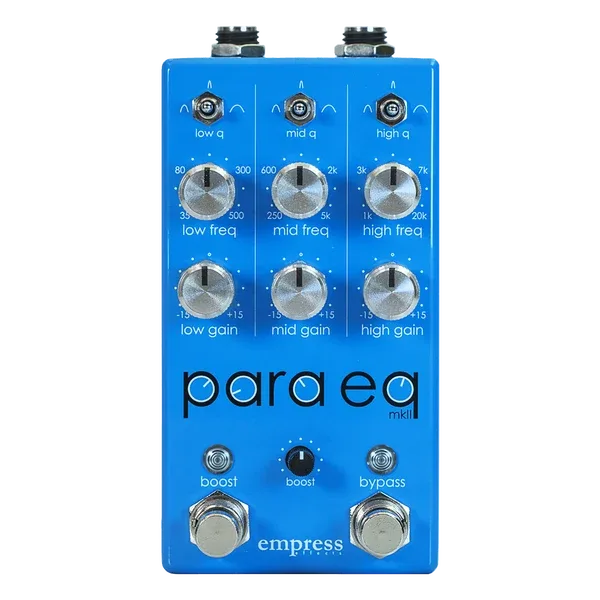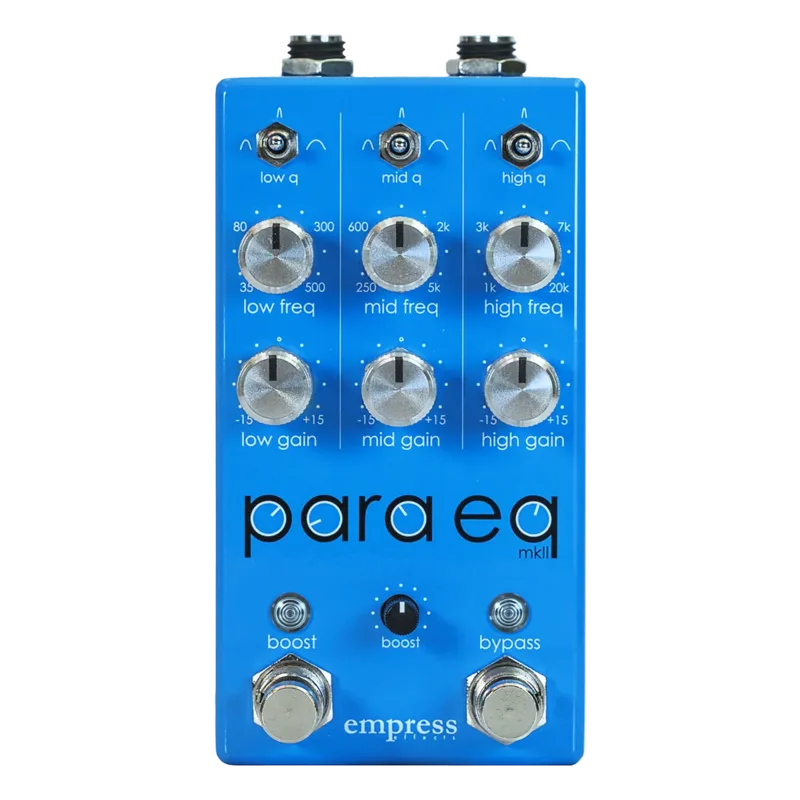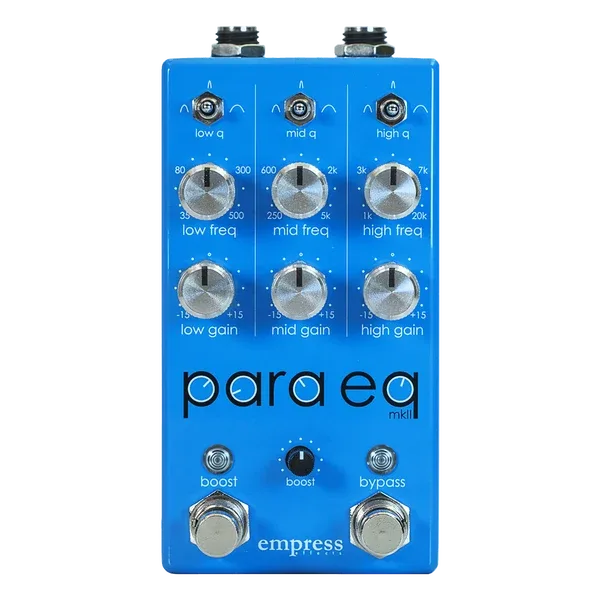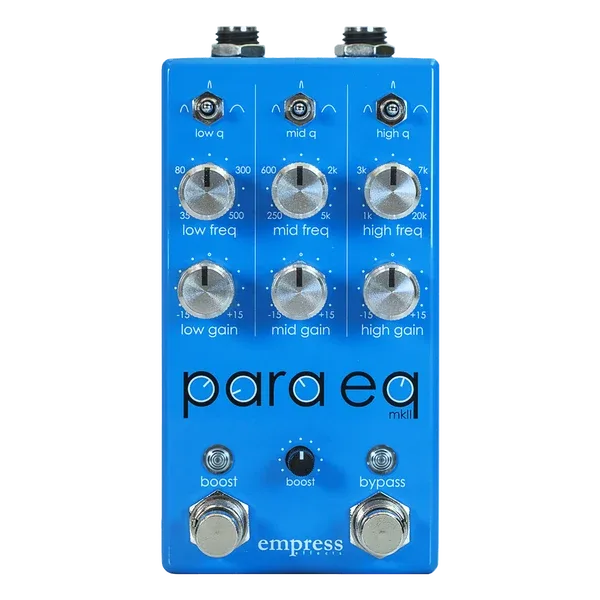


The Empress Bass ParaEq is a three-band parametric EQ and clean boost pedal from Empress Effects, built specifically for bass rather than adapted from a guitar design. Empress describes it as "the only parametric EQ pedal on the market built from the ground up for bass," and says it came about "after hearing from countless players who were already using the ParaEq MKII Deluxe on bass"1. It is now shipping worldwide2.
Where a graphic EQ gives you fixed sliders at set frequencies, a parametric EQ lets you choose the center frequency of each band, how much you boost or cut it, and how wide or narrow the band is. That makes it a tool for surgical fixes: pulling out a resonant note on a low B string, or adding weight around a specific spot without muddying everything around it. Each of the three bands offers frequency selection, boost or cut of up to ±15 dB, and a Q control that adjusts the bandwidth of the band3. On top of the three parametric bands, the pedal includes a low-shelf and high-shelf EQ, along with high-pass and low-pass filters3. A separate boost stage delivers up to 30dB of boost2.
What it does to your sound
The three parametric bands each give up to 15dB of boost or cut, with a Q control for each band that sets how narrow the cut or boost is. A narrow Q lets you zero in on a single problem frequency; a wide Q shapes a broader region of the low end. The pedal also carries a low-shelf and high-shelf EQ plus high-pass and low-pass filters, so you can trim subsonic rumble or tame harsh top end without touching the parametric bands3.
The boost is a separate stage, foot-switchable, with more than 30dB of gain on tap4. The EQ and boost can run linked or independent, so you can use the boost on its own for solos or leave the EQ always on and kick the boost only when needed1.
Empress says the pedal "delivers the same transparent, tone-sweetening power that made the Deluxe a favourite, but with frequency ranges, filters, and features tailored specifically for bass"1. MusicRadar's Jonathan Horsley made the same point from the player's side: "it's not just a guitar pedal that does a great job an octave down, everything here is tuned for bass frequencies"5.
Measured performance
| Specification | Value |
|---|---|
| Frequency response | 14Hz to 22kHz1 |
| Headroom | +30dBu1 |
| Noise | < -107dBu1 |
| Total harmonic distortion | < 0.1%1 |
Although the pedal runs on a standard 9-volt power supply, the internal circuitry steps that voltage up to 27 volts3. That extra internal voltage is what gives the +30dBu of headroom, which matters on bass: a hot low-end signal plus 30dB of boost is exactly the situation where a lower-voltage pedal would clip.
Controls
Guitar Pedal X's coverage of the pedal lists the control set in detail4:
| Control | What it does |
|---|---|
| Low Gain ±15dB | Boost or cut the low parametric band |
| Mid Gain ±15dB | Boost or cut the mid parametric band |
| High Gain ±15dB | Boost or cut the high parametric band |
| Low Q, Mid Q, High Q | Set the bandwidth of each band |
| ±15dB Low Shelf | Shelf EQ for the bottom end |
| ±15dB High Shelf | Shelf EQ for the top end |
| Boost > 30dB | Sets the clean boost level |
| Boost Footswitch, Boost Bypass | Engage or bypass the boost stage |
Empress's own EQ guide notes that the upper EQ section, with its narrow Q, gain boost, and sweepable frequency knob, is well suited to hunting down problem frequencies, and that applying the maker's key-frequencies chart "is incredibly easy with the ParaEq MKII Deluxe and Bass ParaEq"6.
Power and connections
The Bass ParaEq runs on a standard 9V DC supply with a negative tip, through a 2.1mm barrel connector, and requires 300mA1. MusicRadar confirms the 300mA draw5.
There is no battery compartment2, and at 300mA the pedal will exceed what many small daisy-chain outputs deliver. Check that your power supply can provide at least 300mA at 9V on a single output.
For connections, the pedal has an auto-detecting balanced output, which Guitar Pedal X describes as making "it a breeze to send clean signals across long runs without losing your tone"4. Gearnews also highlights the balanced output for long cable runs7. The buffered bypass design keeps your signal strong during long cable runs4, which pairs with the balanced output for players running long signal paths to a console.
Where it came from
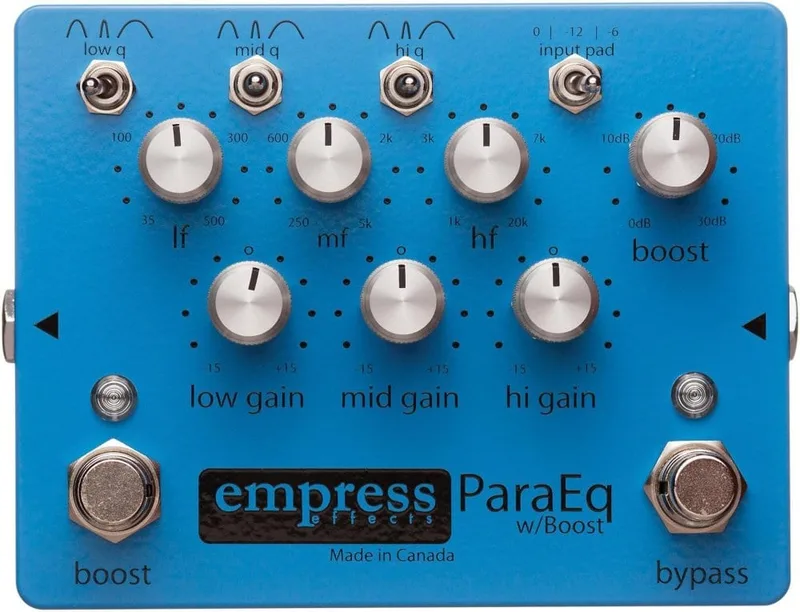
The Bass ParaEq is based on Empress's ParaEq MKII Deluxe, a pedal the company positions as its most feature-rich parametric EQ. The lineage goes back further: the original ParaEq, which Empress says "has been loved and trusted by musicians on a variety of instruments for over a decade"8, was eventually discontinued, a move GuitarPlayer reports left many players questioning why9. The ParaEq MKII and ParaEq MKII Deluxe followed, with the Deluxe adding filters and sweepable Q for what Empress's head of engineering Jay Fee calls the most control and versatility in the line9.
The Bass ParaEq adapts that concept for low-frequency instruments3. Empress's own framing is that the pedal grew out of bass players already adopting the Deluxe: the maker says it built the Bass version after hearing from those players1, and Gearnews reported at launch that the new pedal "has a similar feature set to their ParaEQ MKII Deluxe, but is aimed squarely at bass players"10. Guitar Pedal X describes the frequency clusters as changed and fully honed for bass compared with the guitar version4. The pedal was announced in May 2025 and launched at $3745.
How it differs from the ParaEq MKII Deluxe
| Bass ParaEq | ParaEq MKII Deluxe | |
|---|---|---|
| Tuning | Frequency ranges, filters and features tailored for bass1 | Tuned for guitar and general use1 |
| Bypass | Buffered bypass1 | True or buffered bypass11 |
| Parametric bands | 3 bands, ±15dB each4811 | 3 bands, ±15dB each11 |
| Boost | Up to 30dB2 | +30dB from the boost circuit12 |
| Headroom | +30dBu1 | +30dBu11 |
The core EQ architecture is the same: three parametric bands with 15dB of boost or cut, a boost circuit, and +30dBu of headroom. The differences are the bass-tuned frequency ranges and filters, and the bypass: the Deluxe offers a choice of true or buffered bypass11, while the Bass ParaEq is buffered only1. For a bass player running long cables or a balanced line to front of house, the buffered approach is the consistent choice; players who want true bypass when the pedal is off would look to the Deluxe instead.
What reviewers said
Bass Musician Magazine's Cláudio Ribeiro reviewed the pedal in March 2026 and judged it one of the most capable EQ pedals available, writing that "the ParaEQ delivers precise results without altering the natural character of the instrument"3. MusicRadar's Jonathan Horsley noted the price, saying of the $374 tag, "it ain't cheap"5.
Premier Guitar's John Bohlinger demoed the ParaEq MKII Deluxe and spoke about how this kind of EQ sits in a mix13:
"it's a subtle difference but it makes a huge difference when you're hearing it with bass and drums in a band"
In that demo, Bohlinger also noted the pedal "features an all analog signal path for a rich expressive sound without altering your instrument's original" tone13, a characterization that carries over to the Bass ParaEq's analog design2.
Videos
Empress Effects
Empress Effects
Nate Navarro
Questions
Does the Empress Bass ParaEq run on a battery?
No. It is powered by a standard 9V DC external supply with a negative tip and a 2.1mm barrel connector, drawing 300mA, and it has no battery compartment. You will need a pedalboard power supply that can deliver at least 300mA on its 9V output.
Is the Empress Bass ParaEq analog or digital?
It is analog. The signal path is a transparent analog one, and although the pedal runs on a standard 9-volt supply, the internal circuitry steps that voltage up to 27 volts of headroom, which helps keep the signal clean when boosting.
How much boost does the Empress Bass ParaEq give?
The boost circuit delivers up to 30dB of boost, activated through its own footswitch. The three parametric EQ bands themselves offer up to 15dB of boost or cut each, so the EQ and the boost work as separate stages.
Does the Empress Bass ParaEq have a balanced output?
Yes. It has an auto-detecting balanced output, which lets you send a clean signal across long cable runs, for example from a stage pedalboard to a front-of-house console, without losing tone on the way.
What is the difference between the Bass ParaEq and the ParaEq MKII Deluxe?
The Bass ParaEq is based on the ParaEq MKII Deluxe and keeps the same transparent tone-shaping approach, but its frequency ranges, filters, and features are tailored specifically for bass rather than guitar. Empress built it after hearing from many players who were already using the Deluxe on bass.
Is the Empress Bass ParaEq true bypass?
No. The maker lists its bypass mode as buffered bypass, which keeps your signal strong during long cable runs. The guitar-oriented ParaEq MKII and ParaEq MKII Deluxe, by contrast, offer a choice of true or buffered bypass.
Sources (13)
- Bass ParaEq, Empress Effects Inc.
- Empress Bass ParaEq Pedal Released, Premier Guitar, 2025-06-04
- Review: Empress Effects Bass ParaEQ, Bass Musician Magazine, 2026-03-23
- Guitar Pedal X, Guitar Pedal X, 2025-05-23
- “Studio-grade tone shaping in a compact pedal format that is purpose-built for low-end instruments, not just adapted from guitar gear”: Empress Effects unveils the Bass ParaEQ, the world's first parametric EQ pedal designed especially for bass, MusicRadar, 2025-06-05
- EQ and You, Empress Effects Inc.
- The 7 Best EQ Pedals for Every Budget: Shape Your Tone in Seconds!, gearnews.com, 2025-09-15
- ParaEq MKII, Empress Effects Inc.
- "The Empress Effects ParaEq MKII Pedals Are as Good as It Gets": Head of Engineering, Jay Fee, Explains How Their New Parametric Equalizers Can Take Your Sound to the Next Level, GuitarPlayer (www.guitarplayer.com), 2022-12-09
- Empress Effects Bass ParaEQ: Premium Bass Sculpting, gearnews.com, 2025-05-21
- ParaEq MKII Deluxe, Empress Effects Inc.
- Empress Effects launches the ParaEQ MKII, promising the “most control of any EQ on the market”, Guitar World, 2022-11-02
- Empress ParaEQ MKII Deluxe Demo, Premier Guitar, 2023-07-06