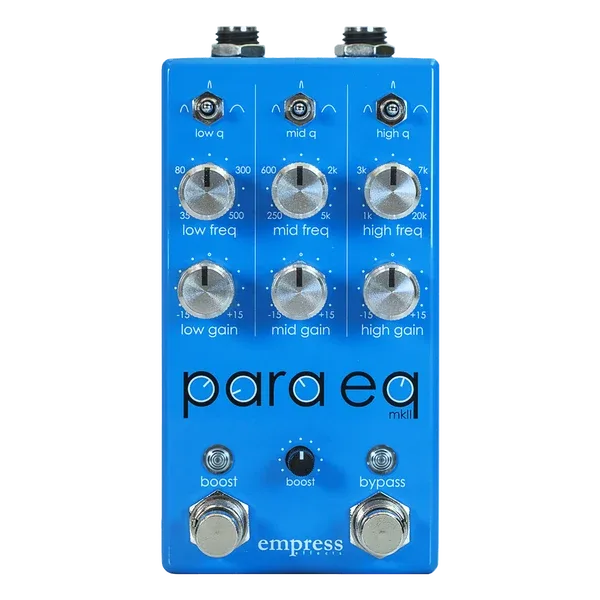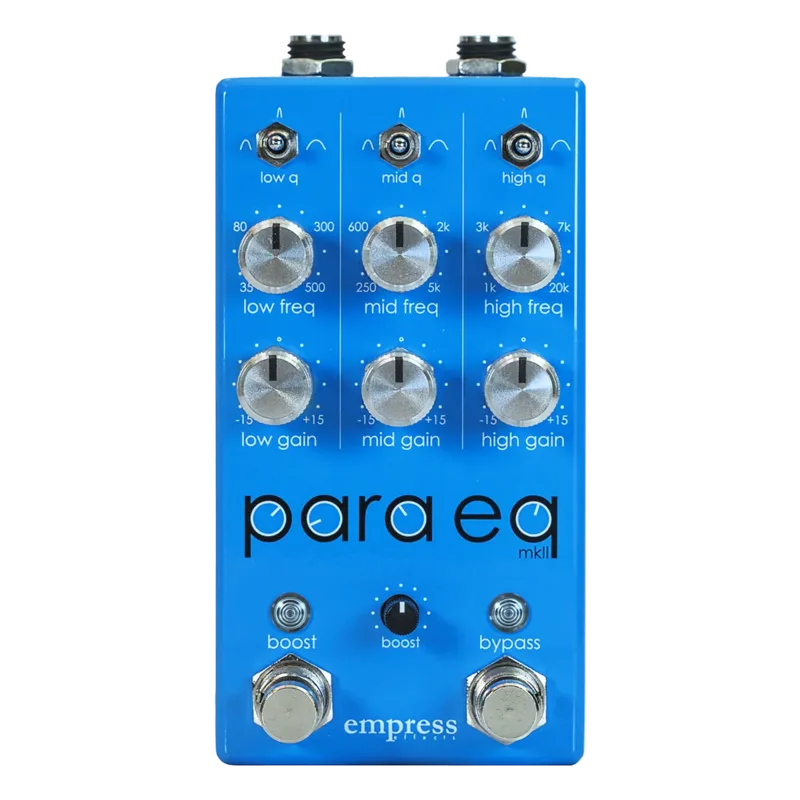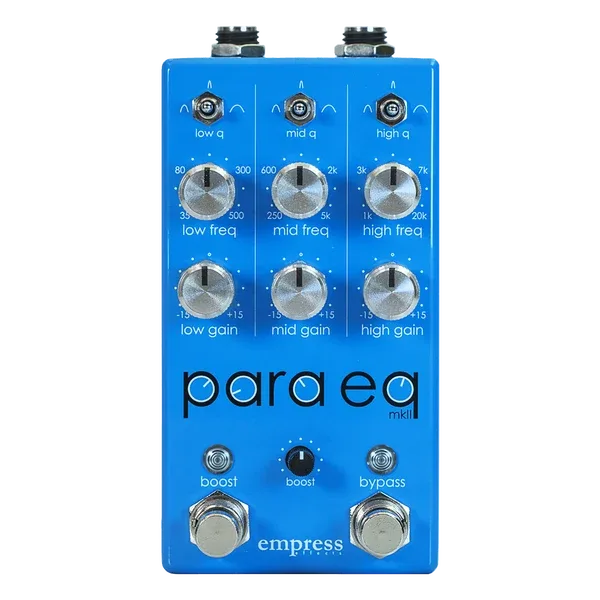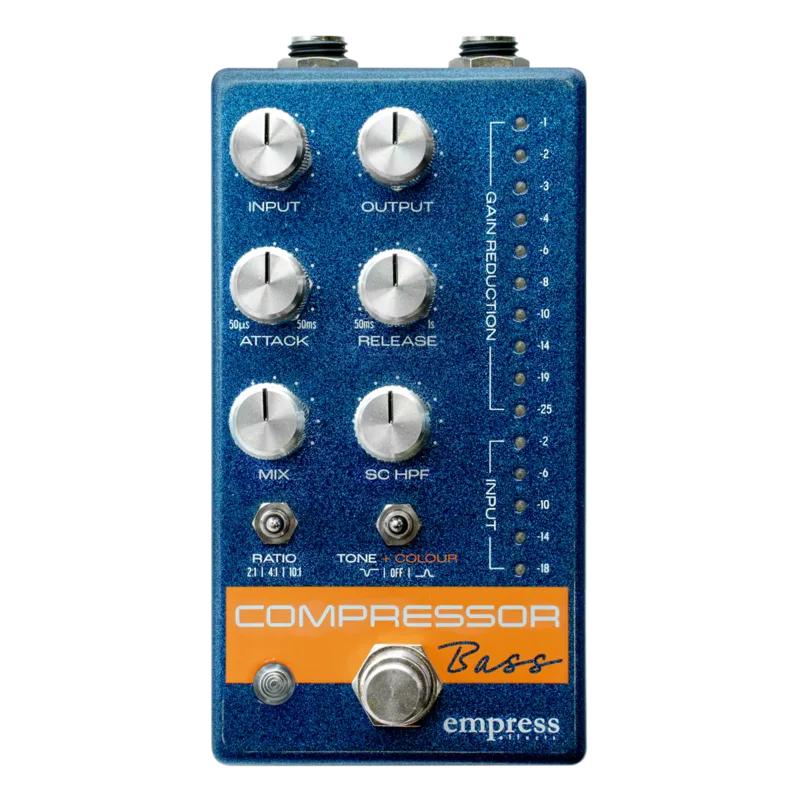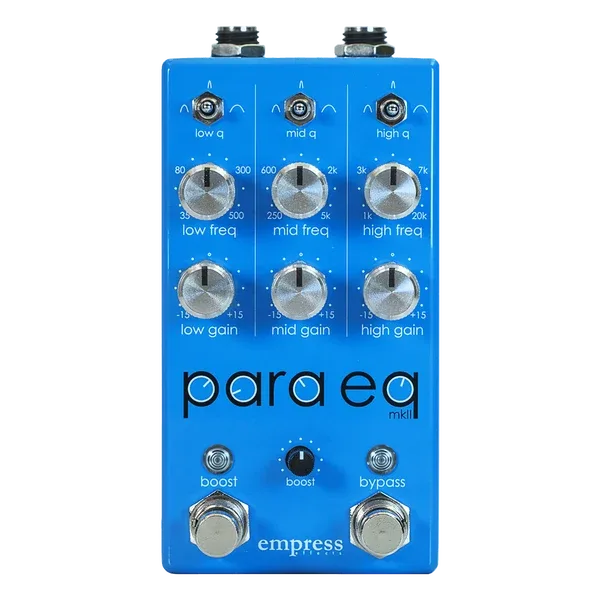


The Empress Effects ParaEQ MKII Bass, sold as the Bass ParaEq, is a three-band parametric equalizer pedal built specifically for bass instruments rather than adapted from a guitar design. Empress Effects describes it as "the only parametric EQ pedal on the market built from the ground up for bass," aimed at electric basses, electrified upright basses and piezo pickups1. It was announced in May 2025 and is based on the company's ParaEQ MKII Deluxe, with frequency ranges, filters and features retuned for low frequencies23.
Where a graphic EQ gives you fixed sliders at set frequencies, a parametric EQ lets you choose the center frequency of each band, how much boost or cut to apply, and how wide or narrow the band is. That makes it a tool for surgical fixes: pulling out a resonant note, taming a boomy room, or adding growl at a specific spot rather than across a whole region. Guitar Pedal X called it "a precision surgical device" that lets you "very specifically and granularly carve out and fully shape" your tone2.
What it does for a bass player
Each of the three parametric bands offers frequency selection, boost or cut of up to ±15 dB, and a Q control that adjusts the bandwidth of the band3. On top of the three bands, the pedal carries a ±15 dB low shelf and a ±15 dB high shelf, plus a foot-switchable clean boost with its own footswitch and a boost bypass2. Guitar Pedal X also lists four highpass and lowpass filters as part of the feature set2.
Empress says the design is ultra-transparent, shaping your sound "without compromising on your instrument's inherent voice"2. The maker's own words on the product page:
"The Bass ParaEq delivers the same transparent, tone-sweetening power that made the Deluxe a favourite, but with frequency ranges, filters, and features tailored specifically for bass."1
Two features set it apart from most EQ pedals. First, the selectable Hi-Z 10 MΩ input: the standard 1 MΩ input works with most electric basses, while a 10 MΩ high-impedance mode suits piezo-equipped instruments, which need a higher input impedance to reproduce their full range13. Second, the auto-detecting balanced output, which Empress says makes it easy to send clean signals across long runs without losing tone, for example straight to a mixer2. Guitar Pedal X also credits the pedal with 27V internal headroom and transparent processing in a standard stompbox form factor2.
The controls
The control set follows the ParaEQ MKII Deluxe layout, with a gain, frequency and Q knob for each band, plus shelving filters and the boost section36.
| Control | What it does |
|---|---|
| Low Freq / Low Gain / Low Q | Sets the center frequency, ±15 dB of boost or cut, and bandwidth of the low band2 |
| Mid Freq / Mid Gain / Mid Q | Same for the mid band2 |
| High Freq / High Gain / High Q | Same for the high band2 |
| Low Shelf | ±15 dB shelving boost or cut at the low end2 |
| High Shelf | ±15 dB shelving boost or cut at the top end2 |
| Boost | Clean boost level, foot-switchable2 |
| Boost Footswitch | Engages the clean boost2 |
| Boost Bypass | Takes the boost out of the signal path2 |
The Q controls are the heart of a parametric EQ: a narrow Q affects only a small slice of the spectrum, useful for hunting down a problem frequency, while a wide Q shapes a broader region more gently. Empress's own EQ guide suggests sweeping a band's frequency knob with a narrow Q and a gain boost to find problem frequencies, then cutting them7.
How it differs from the ParaEQ MKII and the Deluxe
The Bass ParaEQ sits in a family of three current Empress EQ pedals. The ParaEQ MKII is the base guitar model at $274.00, with three parametric bands, selectable Q widths and true or buffered bypass8. The ParaEQ MKII Deluxe at $348 adds low and high shelves plus highpass and lowpass filters, with linked or independent EQ and boost switching9. The original ParaEq preceded both and, in Empress's words, "has been loved and trusted by musicians on a variety of instruments for over a decade"8.
| Model | Price | Bands | Bypass | Distinguishing features |
|---|---|---|---|---|
| ParaEQ MKII | $274.008 | 3 × ±15 dB8 | True or buffered8 | Base guitar model |
| ParaEQ MKII Deluxe | $3489 | 3 × ±15 dB10 | True or buffered811 | Shelves, HP/LP filters, linked or independent switching10 |
| Bass ParaEq | $374.001 | 3 × ±15 dB2 | Buffered2 | Bass-tuned frequencies, 10 MΩ input, balanced output12 |
The Bass ParaEQ exists because, as Empress tells it, countless players were already using the ParaEQ MKII Deluxe on bass1. Empress head of engineering Jay Fee noted in a Guitar Player interview that the ParaEQ MKIIs were already useful for bass players because of the added low shelf and high-pass filters12. The Bass version goes further: MusicRadar's Jonathan Horsley wrote that "it's not just a guitar pedal that does a great job an octave down, everything here is tuned for bass frequencies"13, and Guitar Pedal X reported that the frequency clusters were "changed and fully honed" for bass2.
The bypass is the one clear step back for some players: the guitar models offer a choice of true or buffered bypass, while the Bass ParaEQ uses buffered bypass switching only2510.
Where it came from and what reviewers said
Empress announced the Bass ParaEq on May 21, 2025, with an MSRP of USD 375 / GBP 339 / EUR 39942, and Guitar Pedal X reported it available from the Empress Effects Webstore at $374 two days later2. Bass Magazine and Bass Musician Magazine both reported it shipping worldwide at $374 USD54. Empress's current product page lists it at $374.00 USD1.
Bass Musician Magazine's Cláudio Ribeiro reviewed it in March 2026 and judged it one of the most capable EQ pedals available, noting that it adapts the ParaEQ MKII Deluxe concept for low-frequency instruments3. Gearnews included it in a best-EQ-pedals roundup, highlighting the 10 MΩ high-impedance input as great for piezo or upright bass9.
"This is a precision surgical device - which allows you to very specifically and granularly carve out and fully shape your frequency output."2
Guitar Pedal X also called the +30 dB boost "an excellent utility and a real bonus overall"2. For players weighing it against simpler options, the comparison that matters is parametric against graphic: this pedal trades one-glance visualization for the ability to place each band exactly where your bass needs it, and to reach frequencies a fixed-slider EQ cannot.
Videos
Empress Effects
Nate Navarro
Bass Bonedo
Questions
Is the Empress Bass ParaEQ true bypass?
No. The Bass ParaEQ uses buffered bypass switching, which Empress says keeps the signal strong over long cable runs. This differs from the guitar-oriented ParaEQ MKII and ParaEQ MKII Deluxe, which offer a choice of true or buffered bypass. Players who specifically want true bypass on an Empress EQ would need to look at those guitar models instead.
What is the difference between the ParaEQ MKII Bass and the ParaEQ MKII Deluxe?
The Bass ParaEQ is based on the ParaEQ MKII Deluxe circuit, but its frequency ranges, filters and features are tailored for bass rather than guitar. It adds a selectable 10 MΩ high-impedance input for piezo pickups and upright bass, and an auto-detecting balanced output for sending a clean signal to a mixer. It also uses buffered bypass rather than the Deluxe's switchable true or buffered bypass.
Does the Bass ParaEQ work with upright bass and piezo pickups?
Yes. Empress designed it for electric basses, electrified upright basses and piezo pickups. The standard 1 MΩ input suits most electric basses, and a selectable 10 MΩ high-impedance mode is provided for instruments with piezo pickups, which typically need a higher input impedance to sound natural.
How much boost and cut does each band have?
Each of the three parametric bands offers up to ±15 dB of boost or cut, with a frequency control and a Q control that sets how wide or narrow the band is. The low shelf and high shelf controls also offer ±15 dB. On top of the EQ, the pedal carries a foot-switchable clean boost.
Can the Bass ParaEQ send a balanced signal to a mixer?
Yes. The pedal has an auto-detecting balanced output, which Empress says makes it easy to send clean signals across long runs without losing tone. That makes it usable as a direct interface at the end of a pedalboard when running to a front-of-house mixer or recording setup.
How much does the Empress Bass ParaEQ cost?
Empress lists the Bass ParaEQ at $374.00 USD on its own product page. At launch in May 2025 the announced MSRP was USD 375 / GBP 339 / EUR 399, and Guitar Pedal X reported it available from the Empress Effects Webstore at $374. It sits above the guitar ParaEQ MKII at $274 and the ParaEQ MKII Deluxe at $348.
Sources (13)
- Bass ParaEq, Empress Effects Inc.
- Guitar Pedal X, Guitar Pedal X, 2025-05-23
- Review: Empress Effects Bass ParaEQ, Bass Musician Magazine, 2026-03-23
- Empress Effects Bass ParaEQ: Premium Bass Sculpting, gearnews.com, 2025-05-21
- Empress Effects Releases the Bass ParaEq, Bass Magazine, 2025-06-09
- Best EQ pedals 2026: tame your tone, Guitar World, 2021-12-22
- EQ and You, Empress Effects Inc.
- ParaEq MKII, Empress Effects Inc.
- The 7 Best EQ Pedals for Every Budget: Shape Your Tone in Seconds!, gearnews.com, 2025-09-15
- ParaEq MKII Deluxe, Empress Effects Inc.
- Empress Effects launches the ParaEQ MKII, promising the “most control of any EQ on the market”, Guitar World, 2022-11-02
- "The Empress Effects ParaEq MKII Pedals Are as Good as It Gets": Head of Engineering, Jay Fee, Explains How Their New Parametric Equalizers Can Take Your Sound to the Next Level, GuitarPlayer (www.guitarplayer.com), 2022-12-09
- “Studio-grade tone shaping in a compact pedal format that is purpose-built for low-end instruments, not just adapted from guitar gear”: Empress Effects unveils the Bass ParaEQ, the world's first parametric EQ pedal designed especially for bass, MusicRadar, 2025-06-05