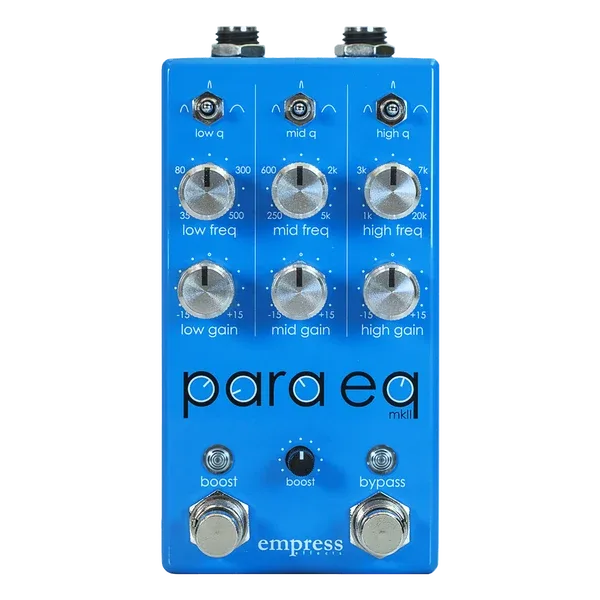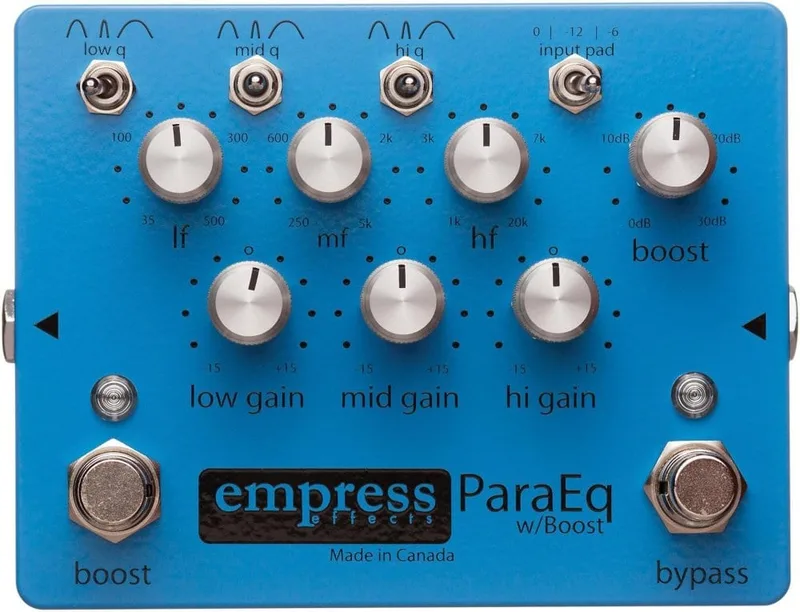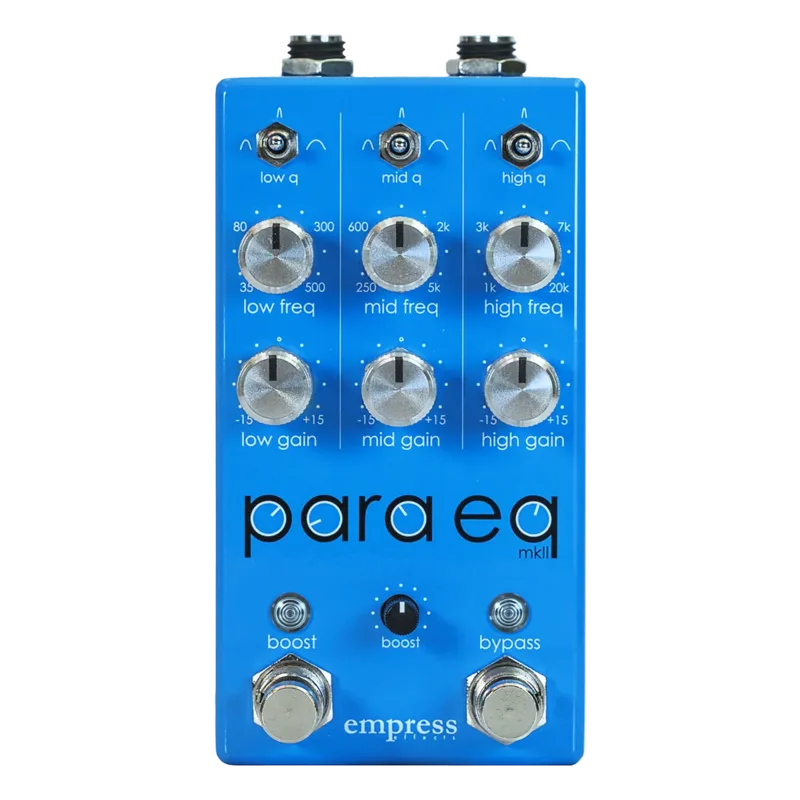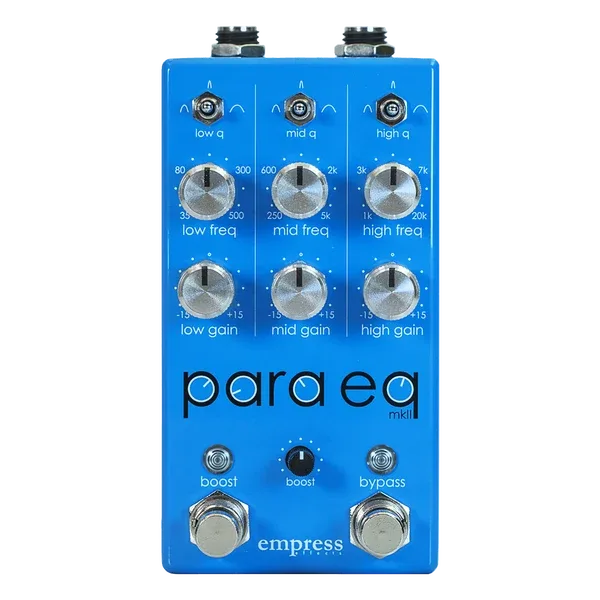


The Empress Bass ParaEq is a parametric EQ and boost pedal made by Empress Effects, built from the ground up for bass rather than adapted from a guitar design. Empress calls it the only parametric EQ pedal on the market built specifically for bass, and says it delivers studio-grade tone shaping in a compact pedal format1. It was announced on 21 May 2025 and is now shipping worldwide23.
At its core it is a three-band parametric equalizer: each band has a frequency selection knob, up to ±15dB of boost or cut, and a Q control that sets how wide or narrow that band is4. On top of that sit low-shelf and high-shelf EQ bands, high-pass and low-pass filters, and a footswitchable clean boost of up to 30dB43. The signal path is analog, with 27V of internal headroom3.
The controls: three parametric bands, shelves and filters
A parametric EQ gives you three things per band: where the EQ acts (frequency), how much (gain), and how wide the action is (Q). On the Bass ParaEq, each of the three bands offers frequency selection, boost or cut of up to ±15dB, and a Q control that adjusts the bandwidth of the band4. Narrow Q settings let you zero in on a problem frequency, such as a boomy room resonance, while wide settings shape broader regions of tone.
The three bands cover bass-specific ranges2:
| Band | Frequency range |
|---|---|
| Low | 35 Hz to 500 Hz |
| Mid | 100 Hz to 1600 Hz |
| High | 375 Hz to 9.7 kHz |
Beyond the three sweepable bands, the pedal includes a low-shelf and a high-shelf EQ, each offering ±15dB, along with high-pass and low-pass filters45. The shelves tilt everything above or below their corner frequency at once, useful for an overall brightness or thickness adjustment, while the filters remove content entirely outside the passband, which can clean up subsonic rumble or hiss.
The boost is a separate circuit with its own footswitch, delivering up to 30dB of gain23. Empress describes the pedal as an EQ/boost pedal with linked or independent switching, so the EQ and boost can be engaged together or separately1. There is also an Advanced Mode, activated by holding both footswitches during power-up, which allows modifying the input jack behavior2.
Power and connections: 9V stepped up to 27V
The pedal runs on a standard 9V DC supply with a negative tip and a 2.1mm barrel connector, drawing 300mA1. Inside, the circuitry steps that 9V up to 27 volts of internal headroom4, the same approach Empress uses across the ParaEq line. As Empress head of engineering Jay Fee explained of the ParaEq MKII pedals, "Although they are powered by a standard 9-volt DC connection, these pedals are running off 27 volts of headroom"6. That extra voltage is why the pedal stays clean: Bass Musician Magazine's reviewer judged it "remains exceptionally clean even when applying large EQ boosts, maintaining clarity and punch across the entire frequency range"4.
There is no battery compartment, and the pedal requires 300mA13, more than a typical compact pedal. It needs a power supply or pedalboard output rated for that current, and it is not a candidate for a low-current daisy chain.
On the connection side, the input impedance is switchable between 1MΩ and 10MΩ1. The 10MΩ setting suits piezo pickups and electrified upright basses, which prefer a very high input impedance71. The output impedance is 100Ω1, and press coverage describes an auto-detecting balanced output for sending clean signals across long cable runs58. Other measured specs from Empress include noise below -107dBu, +30dBu of headroom, total harmonic distortion under 0.1%, and a frequency response of 14Hz to 22kHz1.
History: built on the ParaEq MKII Deluxe
The Bass ParaEq descends directly from Empress's ParaEq line. The original ParaEq was discontinued after more than a decade on the market6, and the ParaEq MKII and ParaEq MKII Deluxe followed in 2022, in a smaller enclosure with a redesigned circuit69. The Deluxe added variable bandwidth per band plus low-pass and high-pass filters and Baxandall shelves109, and it became a fixture on many bassists' pedalboards; MusicRadar called it "already a super popular fixture on bassist's pedalboards"8.
Empress says the Bass ParaEq came about "after hearing from countless players who were already using the ParaEq MKII Deluxe on bass"1. The new pedal keeps the same transparent, tone-sweetening approach but with frequency ranges, filters and features tailored for bass18. Guitar Pedal X described the result as having "the frequency clusters changed and fully honed" for bass5.
In Premier Guitar's demo of the ParaEq MKII Deluxe, John Bohlinger plugged in bass, pedal steel, mandolin and acoustic and electric guitars, and reported that the pedal could bring out the best of each instrument11.
Bass Musician Magazine's Cláudio Ribeiro reviewed the Bass ParaEQ in March 2026, judging it one of the most capable EQ pedals available. He used it live while switching between an active Jazz bass and a passive bass with flatwound strings, and reported that it stayed exceptionally clean even under large EQ boosts4.
Videos
Empress Effects
Nate Navarro
Bass Bonedo
Questions
What is the difference between the Bass ParaEq and the ParaEq MKII Deluxe?
The Bass ParaEq is built on the ParaEq MKII Deluxe circuit but with frequency ranges, filters and features tailored for bass. The low band spans 35 Hz to 500 Hz, the mid band 100 Hz to 1600 Hz, and the high band 375 Hz to 9.7 kHz. Empress made it after hearing from many players who were already running the Deluxe on bass.
Can the Empress Bass ParaEq be used with an upright bass?
Yes. The pedal offers a 10 MΩ high-impedance input option, which press coverage describes as great for piezo pickups and electrified upright basses. The input impedance can be modified through Advanced Mode, activated by holding both footswitches during power-up.
Does the Empress Bass ParaEq take a battery?
No. It is powered by a standard 9V DC external supply with a negative tip and a 2.1mm barrel connector, drawing 300mA. There is no battery compartment, so it needs a pedalboard power supply capable of delivering its current.
Is the Empress Bass ParaEq true bypass?
No. The Bass ParaEq uses buffered bypass, which keeps the signal strong over long cable runs. This differs from the ParaEq MKII and ParaEq MKII Deluxe, which offer a choice of true or buffered bypass.
How much boost does the Bass ParaEq give?
The boost circuit delivers up to 30dB of clean boost, accessible from its own dedicated footswitch. Each of the three parametric EQ bands separately offers up to ±15dB of boost or cut.
Does the Bass ParaEq have a balanced output?
Yes. Press coverage describes an auto-detecting balanced output that sends clean signals across long cable runs without losing tone, alongside a 100Ω output impedance for the standard unbalanced output.
Sources (11)
- Bass ParaEq, Empress Effects Inc.
- Empress Effects Bass ParaEQ: Premium Bass Sculpting, gearnews.com, 2025-05-21
- Empress Bass ParaEq Pedal Released, Premier Guitar, 2025-06-04
- Review: Empress Effects Bass ParaEQ, Bass Musician Magazine, 2026-03-23
- Guitar Pedal X, Guitar Pedal X, 2025-05-23
- "The Empress Effects ParaEq MKII Pedals Are as Good as It Gets": Head of Engineering, Jay Fee, Explains How Their New Parametric Equalizers Can Take Your Sound to the Next Level, GuitarPlayer (www.guitarplayer.com), 2022-12-09
- The 7 Best EQ Pedals for Every Budget: Shape Your Tone in Seconds!, gearnews.com, 2025-09-15
- “Studio-grade tone shaping in a compact pedal format that is purpose-built for low-end instruments, not just adapted from guitar gear”: Empress Effects unveils the Bass ParaEQ, the world's first parametric EQ pedal designed especially for bass, MusicRadar, 2025-06-05
- ParaEq MKII, Empress Effects Inc.
- ParaEq MKII Deluxe, Empress Effects Inc.
- Empress ParaEQ MKII Deluxe Demo, Premier Guitar, 2023-07-06
 Tim Lefebvre