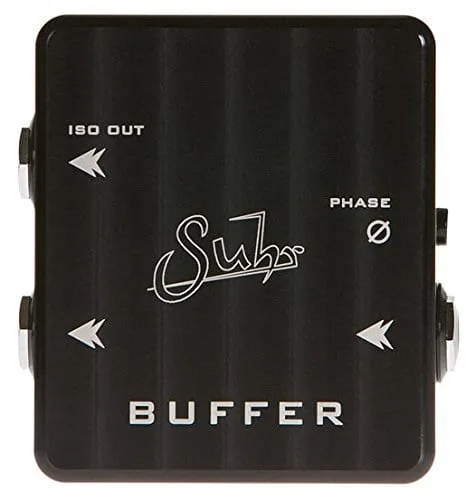


The Suhr Buffer is a compact buffer pedal from Suhr1. A buffer takes a high impedance signal and converts it to a low impedance signal, restoring your signal flow to be the strongest it can be2. In plain terms, it strengthens the weak, high impedance signal from your guitar pickups so it can run over longer cable lengths with no tone degradation, surviving long cable runs and large true bypass pedalboards with far less loss of high end3.
A buffer is a small amplifier at unity gain: it changes the impedance of the signal from high to low and preserves the signal information for long cable runs4. The practical benefit is that you can run very long cable lengths after the buffer, usually as much as 100 feet, with little to no signal loss3.
What it does to your sound
Long cables and many true bypass pedals in series add capacitance to your signal chain, which rolls off high frequencies and dulls the instrument. The Suhr Buffer addresses this at the impedance level: its 1M Ω input impedance presents a light load to your pickups, and its 150 Ω output impedance drives whatever follows it easily6. Suhr's own wording is that it "employs unity buffering to reverse the effects of capacitance without affecting your instruments tone or output level"5.
A point worth understanding: a good buffer does not add anything. On Lehle's technical blog, Joki Schaller argues that a high-end buffer has no sound of its own, and that the extra treble players notice after adding one is simply the return of highs they had been losing to cable capacitance, often compensated for beforehand with the amp's treble knob7. MusicRadar's buying guide makes a similar point from the player's side: "a strongly buffered signal will have noticeable fidelity, edge and presence that's neither a good nor bad thing"8. Schaller also cautions that cheap buffers that exist only as a side effect of some other active circuit can make a signal sound "plastic and artificial"7, which is the case a dedicated unit like this is meant to avoid.
The controls and jacks
The front panel is minimal, because a buffer has little to adjust. What the pedal offers instead is routing flexibility through its two independent outputs, one of which is transformer isolated5.
| Jack or switch | What it does |
|---|---|
| INPUT | Instrument input, for connecting your guitar or bass6 |
| OUTPUT | Primary output, to connect to an amplifier or effect device6 |
| ISO OUTPUT | Secondary, transformer isolated output for splitting your signal to an additional amplifier or sound source6 |
| Phase Switch (ø) | Reverses the polarity of the ISO output by 180º, to keep both output sources in phase6 |
The Phase Switch has two positions: OUT is normal, non-reversed, and IN reverses the signal phase by 180º6. This matters when you run two amplifiers, because two amps can end up out of phase with each other and thin out your combined sound; flipping the ISO output's polarity brings them back together.
The ISO output and ground loops
The ISO output is the feature that separates this buffer from a basic single-output unit. It is transformer isolated, which Suhr states is there "to eliminate noise from ground looping"6. When you split a signal to two amps that are on different ground paths, a ground loop can introduce hum; isolation breaks that electrical connection while still passing the audio signal. So if you run a two amp setup and are fighting ground loop hum on the split, the ISO output is the jack to use, with the Phase Switch available if the two amps cancel each other.
Power and connections
The Buffer runs on a standard pedalboard supply: 9 to 18V DC, center negative, through a 9v power connector56. Its operating range is wider still, 4.5 to 18V DC, with a stated maximum of 20V DC and over voltage protection built in56. Current consumption is under 5mA5, which is light enough that it places almost no demand on a power supply and can share an output with other low draw pedals without issue.
The pedal is designed for a center negative supply, the common standard for most effects. It carries a JST lifetime warranty on workmanship for the initial retail purchaser in the USA, with electronic components such as capacitors, resistors, filters, transformers, jacks and pots covered for 5 years; the lifetime workmanship coverage requires registration with JST within 10 days of purchase from an authorized dealer5.
Where it goes in the signal chain
Suhr recommends placing the Buffer as the first device in your signal chain6. That position lets it convert the signal to low impedance right after the guitar, before the long cable run and the rest of the pedals, which is where a buffer does the most good. Schaller's recommended chain on the Lehle blog is the same idea: guitar, then fuzz, wah and treble boost, then the buffer, then the effects chain, then the amp7.
The exception is fuzz. Suhr specifically recommends placing the Buffer after vintage fuzz pedals such as a Fuzz Face or Tone Bender, to retain their character6. Vintage style fuzz circuits, germanium fuzzes especially, are designed to see the high impedance signal straight from the guitar pickups, and a buffered signal in front of them can change how they clean up and respond8. MusicRadar also notes that a buffer is usually best placed after your drive pedals if fuzz compatibility is a concern8.
A second buffer at the end of the chain is not useful: as Schaller points out, a buffer at the end cannot regain signal that was already lost before it7. JHS's guidance adds that more than one buffer is generally only needed on rigs with 10 or more true bypass pedals2.
How it compares
The Suhr Buffer runs from a 9V power connector and accepts a maximum voltage of 20Vdc6. On a Sweetwater video about buffering, the presenter describes the general principle the Suhr shares with every good buffer: a buffer is a small amplifier at unity gain that changes the impedance from high to low and preserves the signal information for long cable runs4.
Videos
Suhr Custom
Joe Cefalu
Made by Miike
Questions
Does the Suhr Buffer go before or after a fuzz pedal?
Suhr recommends placing the Buffer as the first device in your signal chain, but with one exception: if you use a vintage fuzz pedal such as a Fuzz Face or Tone Bender, place the Buffer after those pedals so the fuzz still sees the high impedance signal straight from the guitar and keeps its character.
What is the ISO output on the Suhr Buffer for?
The ISO output is a secondary, transformer isolated output for splitting your instrument's signal to an additional amplifier or sound source. Because it is transformer isolated, it eliminates noise from ground loops between the two destinations, and a 180 degree phase reversal switch keeps both output sources in phase.
Can the Suhr Buffer fix ground loop hum?
It can help with ground loop noise between two amplifiers. Suhr states that the ISO output utilizes a transformer to eliminate noise from ground looping, so when you split your signal to a second amp through that output, ground loop hum between the two is addressed.
Does the Suhr Buffer change your tone?
Suhr describes it as a transparent signal buffer that employs unity buffering to reverse the effects of capacitance without affecting your instrument's tone or output level. Any apparent extra treble after adding a good buffer is generally the return of highs your cables were already losing.
Sources (8)
- Suhr Introduces the Buffer Pedal, Premier Guitar, 2012-12-10
- UNDERSTANDING BUFFERS, JHS Pedals
- Why Buffers are Important for Great Tone, BOSS (articles.boss.info), 2024-02-05
- Lehle Sunday Driver II: Give Your Darkened Tones a Boost!, Sweetwater, 2023-08-30
- Buffer Manual, Suhr (JS Technologies, Inc.), 2022
- Suhr Buffer, Suhr (www.suhr.com)
- Do I need a buffer?, blog.lehle.com, 2017-06-14
- Effects pedals: True bypass Vs buffers, MusicRadar, 2023-07-13