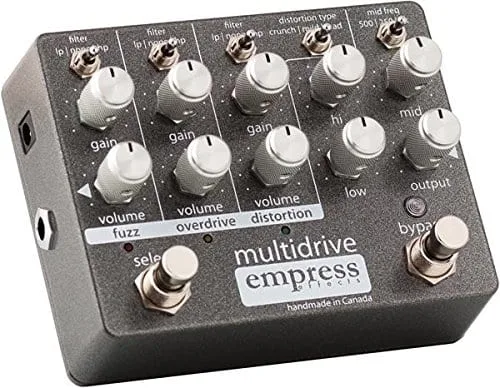


The Empress Effects Multidrive is a drive pedal that puts separate fuzz, overdrive and distortion circuits in one box and lets you blend all three in parallel, rather than stacking them in series123. Each section has its own gain and volume, plus a filter that shapes which frequencies reach it, and a shared 3-band EQ sits over the whole blended output2. Empress announced it in February 2011 as a drive pedal with "three unique circuits"1.
The Multidrive is discontinued, and has been for some time, so it is now a used-market pedal4. It was priced at $299 when last on sale4.
Fuzz, overdrive and distortion blended in parallel
Most multi-gain pedals chain their drive stages one after another, so each colors what the next receives. The Multidrive takes the opposite approach: the fuzz, overdrive and distortion circuits run side by side, and you dial in how much of each is "added in parallel to create the final sound"5. Premier Guitar's reviewer found this topology is what sets it apart:
"But with a parallel, rather than stacked, circuit, the Multidrive offers a lot more flexibility than a stacked multipedal."2
Each of the three sections has its own character. Empress describes the fuzz as offering "smooth, rich sustain and great note definition," the overdrive as having "the smooth germanium break-up and the compressed characteristics of a tube amp," and the distortion as offering three modes that go "from controlled to sizzling, all while retaining a super tight low end"5. Guitar Pedal X traces the lineage of each circuit: an evolved Silicon Fuzz Face style fuzz with far greater range but still the essential guitar-volume cleanup, a germanium-tinged Tweed-drive style overdrive, and a Marshall-esque distortion4.
The controls: three drive sections, filters and a global EQ
The face of the pedal carries ten knobs, five 3-way toggles and two stomp switches, in a gray die-cast aluminum box2. The three drive sections share the same layout, which makes the pedal quicker to learn than its panel suggests2.
| Section | Controls | What they do |
|---|---|---|
| Fuzz | Filter (LP / None / HP), Gain, Volume | Sets the fuzz amount and which frequencies feed it4 |
| Overdrive | Filter (LP / None / HP), Gain, Volume | Sets the overdrive amount and its frequency window4 |
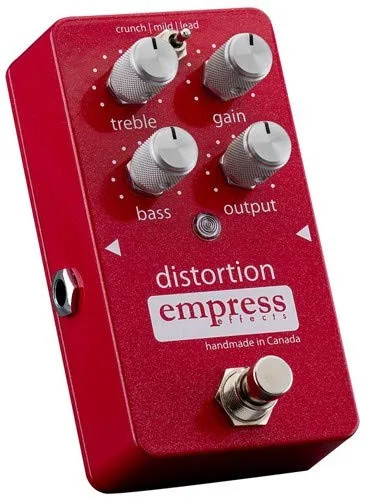
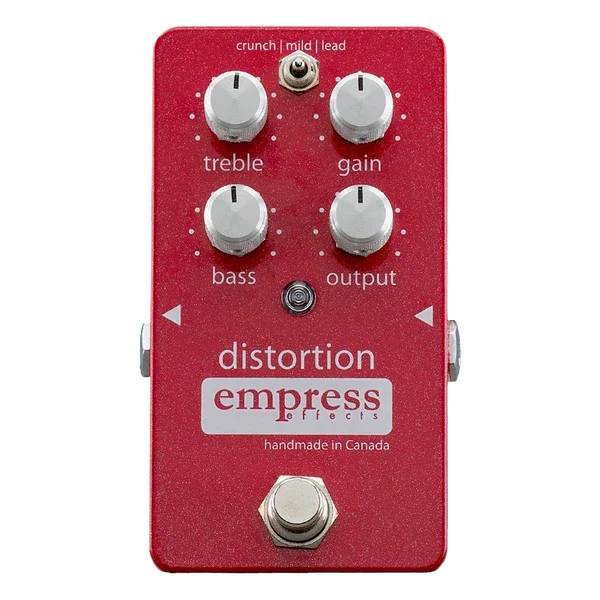
| Distortion | Filter (LP / None / HP), Gain, Volume, Type (Crunch / Mild / Lead) | Same as above, plus a character switch from crunch to lead tones46 |
| Global | Mid Frequency (500Hz / 250Hz / 2K), Mid, Hi, Low, Master Output | 3-band EQ over the blended output78 |
The per-section filter switch is the feature reviewers keep coming back to. In Premier Guitar's review, the Low Pass filter on the fuzz "darkened the tone considerably, like shaving the top off almost completely," while the High Pass "dropped out the bottom almost entirely and made the fuzz sound like it was coming through a telephone"2. On the overdrive side, the reviewer called it "the most dynamic of the three channels, cleans up beautifully by rolling off the guitar's volume control, inspiring, spanky, and expressive," and "perfect for pushing a Stratocaster to the edge"2. The distortion's Type switch covers a wide spread: the reviewer pulled down the 500 Hz mids with the Lead type for a Montrose "Rock Candy" sound, while the Mild setting "shaved off a ton of gain and sounded fairly tame in comparison"2.
MusicRadar's reviewer summed up the pedal's strength:
"Each of the effects types sounds really good, but it's the creation of blends that's the MultiDrive's unique feature, with a huge range of layered tones available."6
Presets and the internal DIP switches
The Multidrive stores two preset combinations, toggled with the Select footswitch5. Those combinations are set by six internal DIP switches: switches 1 through 3 are dedicated to State A and switches 4 through 6 to State B, switching each of the distortion, overdrive and fuzz channels on or off within that state2. Guitar Pedal X lists the internal Channel Combination Select as A and B combinations, each with slots for distortion, overdrive and fuzz, each on or off4.
In practice this means you configure two complete drive recipes, for example a light overdrive blend and a full fuzz-plus-distortion wall, and swap between them with one stomp56.
Power: 9V or 18V
The Multidrive runs on a 9V DC supply with a negative tip, through a 2.1mm barrel connector, and draws 180mA5. That is a relatively high current draw for a compact analog pedal, so it is not a candidate for a battery or a low-current daisy chain8. It will also work with an 18V power supply for extra headroom8.
The 180mA draw means the Multidrive needs a power supply with more headroom than many analog pedals. Plan an isolated output or a supply with headroom before putting one on a board8.
Where it came from
Empress Effects announced the Multidrive on 14 February 2011 as a drive pedal letting guitarists "play with fuzz, overdrive, and distortion through three unique circuits," with true bypass, an all-analog signal path and true display LEDs1. Guitar Pedal X dates the pedal itself to late 2010, with most players not getting their hands on a unit until January 20114. It sold for $2994, a price Premier Guitar's review also recorded as the street price2.
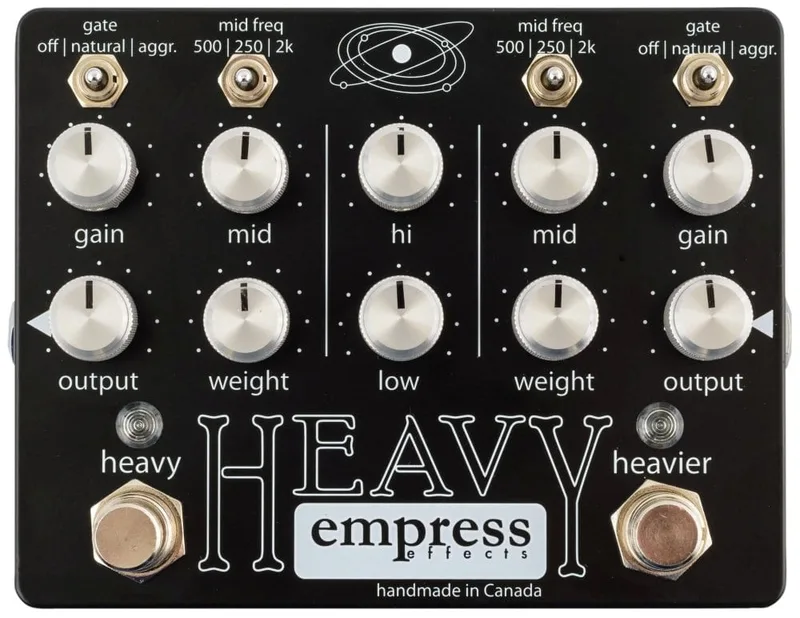
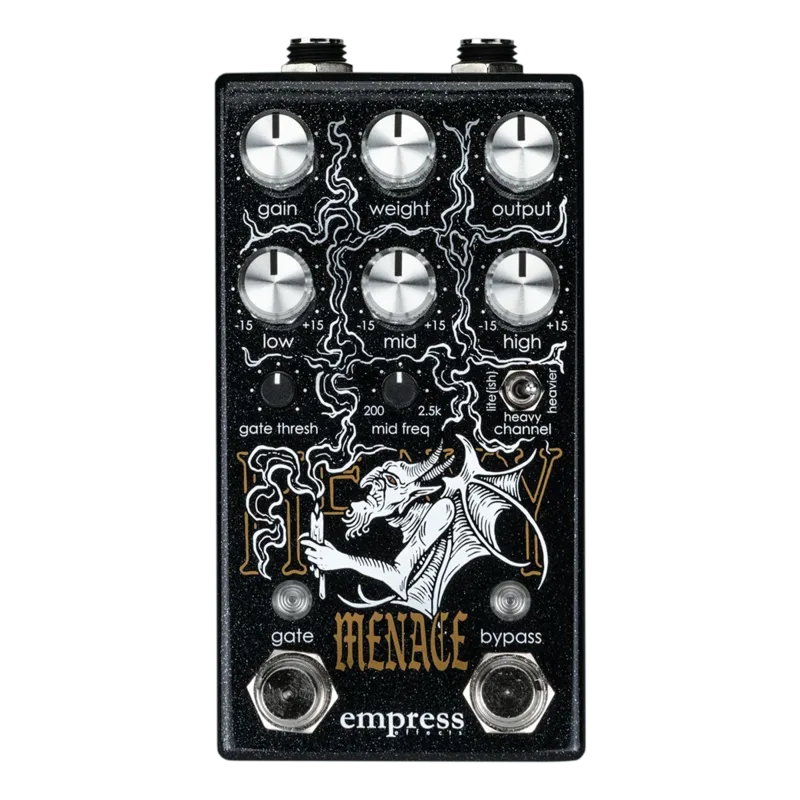
The parallel-blend idea has since echoed elsewhere in the pedal world: Guitar Pedal X notes that Tampco's Distorter collaboration is "somewhat reminiscent of the Empress Multidrive," which lets you blend overdrive, distortion and fuzz in parallel3. Empress itself later went a different direction with high-gain distortion, including the Empress Effects Heavy.
What reviewers said
Published reviews were positive about the concept and the execution. Premier Guitar's reviewer concluded:
"the Multidrive made balanced blends of mixed-gain tones easier than ever, thanks to its filters alone."2
The same review noted one limit: the distortion can reach modern metal territory, though "the bass isn't voiced quite right for super-aggressive modern chunking"2. Tone Island's buying guide highlights the same strengths, the per-section filters and the 3-band master EQ, while flagging the 180mA current draw as the practical cost of all that circuitry8.
Videos
ProGuitarShopDemos
ProGuitarShopDemos
ProGuitarShopDemos
Questions
Is the Empress Multidrive discontinued?
Yes. Empress Effects no longer makes the Multidrive; press reviews describe it as discontinued for some time. It was released in late 2010, with most players getting units from January 2011, and it sold for $299 when last on sale4.
How do the internal DIP switches set the Multidrive presets?
Six internal DIP switches define two channel combinations, A and B. Each state has three switches, one for each of the distortion, overdrive and fuzz channels, turning that channel on or off in that state. The Select footswitch toggles between the two saved combinations65.
Is the Empress Multidrive true bypass?
Yes. Empress states the Multidrive employs true bypass, so it is not affecting the signal when disengaged5. Premier Guitar's review confirms a True Bypass stomp switch at the bottom of the enclosure, alongside the Select switch and a blue LED2.
What circuits is the Empress Multidrive based on?
According to Guitar Pedal X, the three sections evolved from classic designs: a Silicon Fuzz Face style fuzz with far greater range but the same guitar-volume cleanup, a germanium-tinged Tweed-drive style overdrive, and a Marshall-esque distortion4. Empress describes the signal path as all analog, harnessing germanium diodes5.
Sources (8)
- Empress Effects Releases Multidrive Pedal, www.premierguitar.com, 2011-02-14
- Empress Effects Multidrive Pedal Review, Premier Guitar, 2011-07-19
- Guitar Pedal X, Guitar Pedal X, 2025-03-10
- Guitar Pedal X, Guitar Pedal X, 2022-12-14
- Multidrive, Empress Effects Inc.
- Empress MultiDrive review, MusicRadar, 2015-02-20
- Guitar Pedal X, Guitar Pedal X, 2025-11-21
- 13 Best Distortion Pedals For 2026 (Top Picks), Tone Island (toneisland.com), 2026