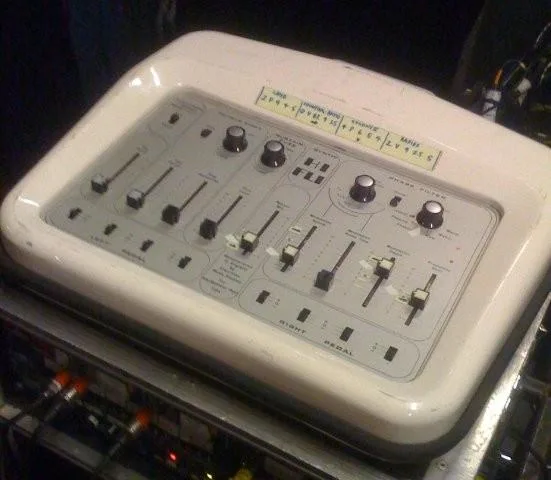


The EMS Synthi Hi-Fli is a guitar treatment unit built as a console on a stand, with two pedal controllers that can be routed as control voltages to any of the slider functions1. EMS introduced it in 1973 at £180, after a design by David Cockerell dating to 1971 and production starting in 197221. It is not a pedalboard stompbox in the modern sense: it is a floor console you stand over, closer in spirit to a synthesizer than a synth pedal, and it was one of the earliest dedicated guitar-synth devices a player could buy.
What it does for a player is combine fuzz, octave shift, top boost, and a phase filter with six modulation modes in one unit, all shaped by nine faders and two expression pedals21. The Musical Box, the Genesis tribute band, uses one for phasing and sound effects, with settings for several songs marked on the top of the unit3.
The controls
The Hi-Fli's front panel divides into sections. On the left are the top boost, octave shift, and sustain fuzz controls, and on the top left sits the solo/strum switch, which determines the attack and decay time sensitivity2. The phase filter section offers six modes: vibrato, phasing 1, phasing 2, waw, wawa, and meow2. A central Bypass Mix slider blends the effects with the original signal1.
| Control | What it does |
|---|---|
| Top boost, octave shift, sustain fuzz | Left-section controls for the fuzz and pitch-shifting side of the unit2 |
| Solo/strum switch | Determines the attack/decay time sensitivity2 |
| Sustain Fuzz Slider | Mixes variable upper harmonics1 |
| Attack Rate rotary | Varies the rise time of the sustained fuzz signal1 |
| Modulation Speed Slider | Fine control of the modulation rate1 |
| Modulation Depth Slider | Controls the depth of modulation applied to the phase filter1 |
| Bypass Mix central slider | Blends the effects and original signal1 |
| Pedal switches | Route either the left or right pedal to voltage-control the slider above it, with an inverted setting so single pedal movements can produce complementary effects1 |
The two foot pedals are the heart of the design. Each switch routes either the left or right pedal to voltage control the slider above it, and being able to select positive or negative voltage for the various sliders, or leave them off, for each pedal puts what Premier Guitar's source calls a vast range of sounds under your feet2. One pedal could simultaneously push one slider up while pulling another down, so a single movement produces complementary effects1. On The Musical Box's unit, the controller pedals sit below the amp, one used to remotely turn the Hi-Fli effect on3.
The nine faders reward careful hands: the slightest movement of each of the nine faders has a significant impact on the sound2.
The growl
Later units also feature the growl, which uses a subharmonic to modulate the phase filter, yielding even wilder sounds than the six standard modes2. Mid-period units were built without the growl modification, and the final units carried a growl switch2.
Versions and the "toilet seat"
The Hi-Fli went through several versions across its roughly 350-unit run2:
- The first 10 prototypes had twin foot pedals built into the supporting stand2
- Later units moved to a separate stand and pedals2
- Mid-period units lacked the growl modification2
- The final units added the growl switch2
- The last 10 or so, built after EMS ran out of cream fiberglass cases, were housed in garish orange-painted wooden boxes2
Industrial designer Martin Holbrook's look for the Hi-Fli was a futuristic, curvaceous cream-colored fiberglass console, and although it was disparagingly referred to as "the toilet seat," that enclosure is now inseparable from the unit's identity2.
Who made it, and who used it
David Cockerell designed the EMS Synthi Hi-Fli2. Reviewers have singled out the unit's range: one wrote, "I know of no other effects unit that is as sonically versatile or as compelling and expressive"2, and another noted it "can do a really cool phasing effect and more crazy sounds like the Colony of Slippermen"3.
The Hi-Fli's best-known user is David Gilmour. He began using a prototype onstage in 1972 and 1973 and in recording Dark Side of the Moon, and according to Premier Guitar he owns two units to this day21. Guitar World likewise credits Gilmour with using a Synthi Hi-Fli on The Dark Side of the Moon4.
What it sounds like, and what it costs
On The Musical Box's unit, AnalogMike reports it can do a really cool phasing effect and more crazy sounds like the Colony of Slippermen2. The Soundgas founder writing in Premier Guitar goes further:
"I know of no other effects unit that is as sonically versatile or as compelling and expressive."2
Prices tell the story of its rarity. It launched at £180 in 1973 and was listed at £308 by 19791. Today, Premier Guitar puts Hi-Flis in the neighborhood of $5,000 and up, calling them an investment in more than a learning curve2.
The Hi-Fli is a 1970s console unit, not a modern pedal: it runs on mains power as a standalone floor console with its own stand and pedals, and finding one today means the vintage market, not a retailer.
Videos
jreeves47
analog mike
David Knight
Questions
Why is the EMS Synthi Hi-Fli called the toilet seat?
Because of its enclosure. Industrial designer Martin Holbrook gave the Hi-Fli a futuristic, curvaceous cream-colored fiberglass console, and players disparagingly nicknamed it "the toilet seat." The final 10 or so units, built after EMS ran out of cream fiberglass cases, were housed in garish orange-painted wooden boxes instead.
How many Synthi Hi-Fli units were made?
Around 350 Hi-Flis were made. The first 10 were prototypes with twin foot pedals built into the supporting stand, later units moved to a separate stand and pedals, and the final 10 or so were housed in orange-painted wooden boxes after the fiberglass cases ran out.
Who designed the EMS Synthi Hi-Fli?
David Cockerell designed the Hi-Fli in 1971, a year before production began in 1972. Cockerell also designed EMS's VCS3 synthesizer, and in 1974 he moved to Electro-Harmonix, where he designed the Small Stone, Electric Mistress, 16 Second Digital Delay, and Microsynth. Martin Holbrook did the industrial design.
Which Pink Floyd recordings used the Hi-Fli?
David Gilmour used a Synthi Hi-Fli on The Dark Side of the Moon. He began using a prototype onstage in 1972 and 1973, during the same period the album was recorded, and according to Premier Guitar he still owns two units to this day.
How much does an EMS Synthi Hi-Fli cost?
When EMS introduced it in 1973, the Hi-Fli sold for £180, rising to £308 by 1979. Today, Premier Guitar puts surviving units in the neighborhood of $5,000 and up, calling them an investment in more than a learning curve.
What does the growl feature do on the Hi-Fli?
The growl, found on later units, uses a subharmonic to modulate the phase filter, yielding even wilder sounds than the standard phasing modes. Mid-period units were built without the growl modification, and the final units carried a growl switch.
Sources (4)
- EMS Synthi Range 1969, emssynthesisers.co.uk, 2001-06-17
- Monster Mutilators: Vintage Guitar Synth Pedals, Premier Guitar, 2018-06-07
- The Musical Box, analogman.com, 2015
- Weird Science: The 10 Strangest Vintage Effects of All Time, Guitar World, 2018-01-12