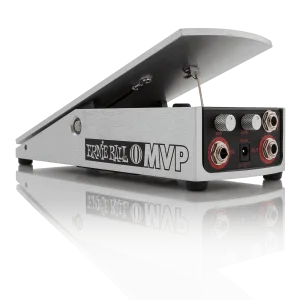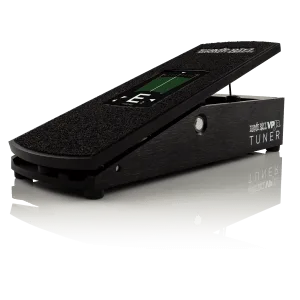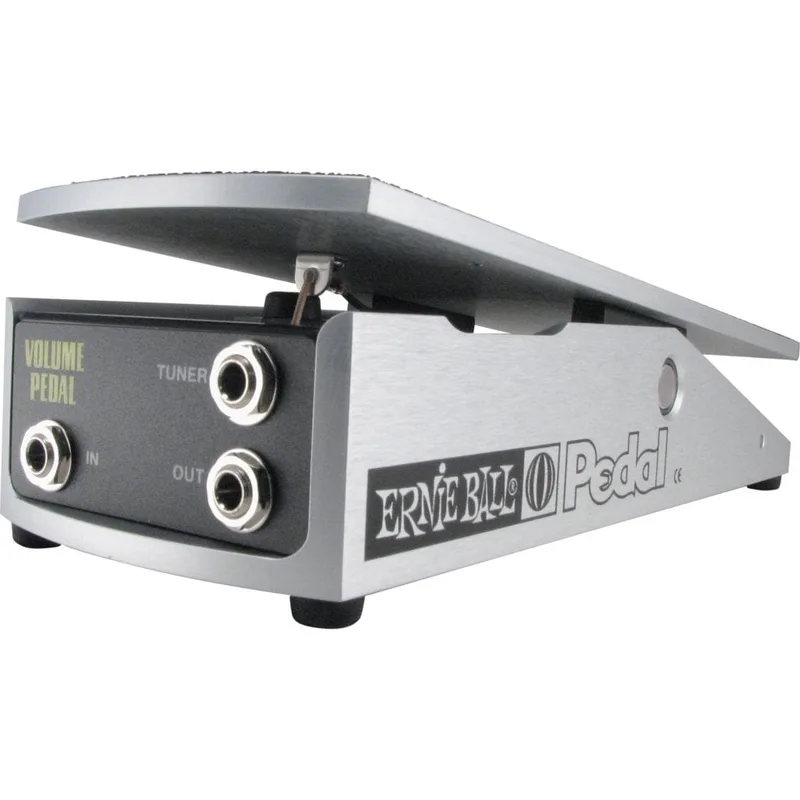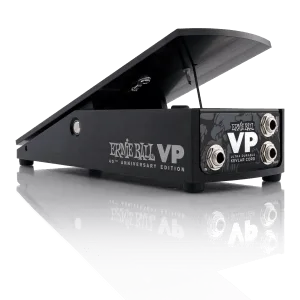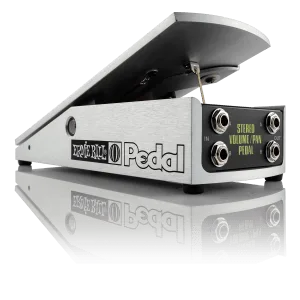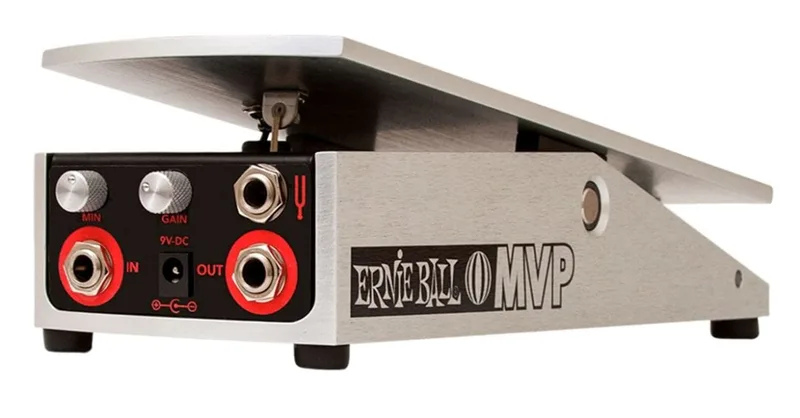



The Ernie Ball MVP, short for Most Valuable Pedal, is a volume pedal from Ernie Ball with a built-in gain boost of up to 20dB. Where a standard volume pedal only turns your signal down from full, the MVP can also push it harder, which Ernie Ball positions as a way to lift solos above the band or drive an amp into more breakup1. MusicRadar's Mike Astley-Brown called it "no ordinary volume pedal," noting the boost "to up your gain for solos"1.
Ernie Ball describes the pedal as providing a smooth foot sweep for precise volume control, with a minimum volume knob and a gain boost that lets players raise the audio signal by up to +20 decibels. It works with both active and passive electronics2.
What it does and how it works
The MVP is built around the familiar treadle format of Ernie Ball's volume pedals, but the boost circuit is what sets it apart. MusicRadar's Trevor Curwen described it as a volume pedal that "went beyond mere volume adjustment" by adding the ability to push an extra 20dB of gain into the signal4. In practice that means the pedal can serve two roles at once: volume control with your foot, and a solo or lead boost you can dial in.
The minimum volume knob sets where the pedal bottoms out, so heel-down can be silence or a quieter rhythm level rather than always full mute. Separate controls for the heel-down and toe-down settings mean the pedal can be configured as a straight volume pedal when you do not want the boost in play1.
| Control or feature | What it does |
|---|---|
| Foot tread | Volume sweep, with a non-slip surface3 |
| Minimum volume knob | Sets the lowest volume at heel-down2 |
| Gain boost | Raises the audio signal up to +20dB2 |
| Heel-down and toe-down controls | Individual settings for each end of the sweep, allowing use as a regular volume pedal1 |
| Tuner out | Works at any volume, for silent tuning on stage or in rehearsal3 |
The tuner out is a practical detail for gigging players: because it works at any volume, you can tune silently mid-set without cutting the pedal out of your chain3.
Power
The MVP runs on a 9V battery or an optional 9V DC adapter3. Ernie Ball's listing specifies a DC 9V supply with a 100mA minimum2, so a typical pedalboard power supply is sufficient.
The boost circuit is active, so unlike a passive volume pedal the MVP needs power. A battery works, but the 100mA minimum draw means a daisy-chain output should be checked before you rely on it.
How it differs from the VP Junior
The MVP sits alongside Ernie Ball's long-running passive volume pedals. The VP Junior is a passive volume pedal built around a 250k potentiometer, with no boost and no tuner out3. The MVP keeps the treadle and volume function but adds the active 20dB boost, the minimum volume knob, and the tuner output, and it works with both active and passive electronics2. Delicious Audio framed the MVP as the next step for players who already loved the passive VP Junior3.
What reviewers said
MusicRadar's Mike Astley-Brown found the boost genuinely useful rather than a gimmick:
"It's a great idea, and the built-in boost works brilliantly, offering an organic way of wringing extra dirt from your amp, as well as full control over your gain levels1."
He summarized the pedal's strengths as "A good idea. Flexible in application. Solid construction."1
Delicious Audio's 2014 review highlighted the build, praising the "über-sturdy aluminum construction" and non-slip foot tread, alongside the tuner out and the boost range3. At the time of that review the pedal listed at $179.00 with a street cost of around $100.003.
Videos
Sammy Bones
Mr Z's Music Lessons
Gear Confessions
Questions
Can the Ernie Ball MVP be used as a regular volume pedal?
Yes. The MVP has separate controls for the heel-down and toe-down positions, so you can set it up and use it as a standard volume pedal. The boost and minimum volume features are there when you want them, but the pedal works fine for plain volume swells and muting.
Does the Ernie Ball MVP have a tuner output?
Yes. The MVP has a tuner out that works at any volume, which makes it useful for silent tuning on stage or in rehearsal. You can leave a tuner connected to that output and tune without the audience or the band hearing it.
Does the Ernie Ball MVP take a battery?
Yes. The MVP runs on a 9V battery or an optional 9V DC adapter. Ernie Ball's listing also specifies a DC 9V supply with a 100mA minimum, so a standard pedalboard power supply meets the requirement.
What is the difference between the Ernie Ball MVP and the VP Junior?
The VP Junior is a passive volume pedal built around a 250k potentiometer, with no boost. The MVP adds an active gain boost of up to 20dB, a minimum volume knob, and a tuner out, so it can push an amp harder for solos as well as controlling volume.
Sources (4)
- Ernie Ball MVP Most Valuable Pedal review, MusicRadar, 2014-06-13
- Volume Pedals, Ernie Ball Inc.
- Review: Ernie Ball MVP "Most Valuable Pedal", Delicious Audio, 2014-08-11
- Ernie Ball Expression Overdrive review, MusicRadar, 2017-05-05