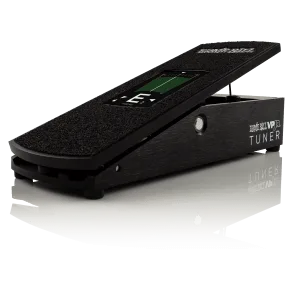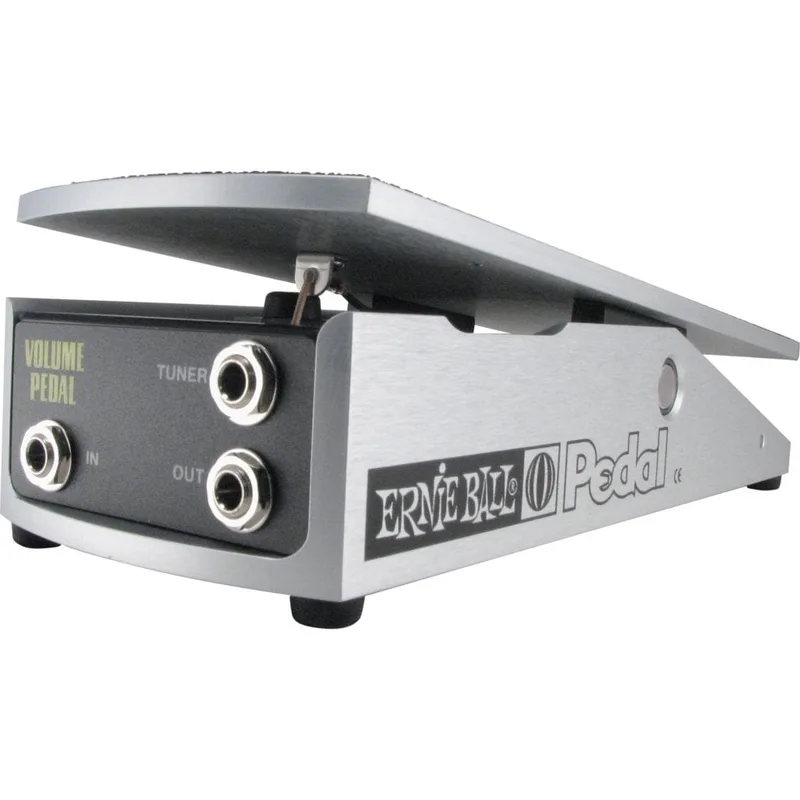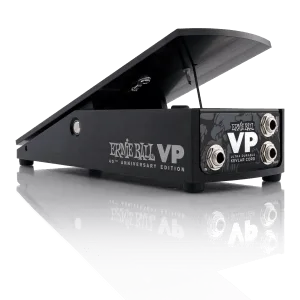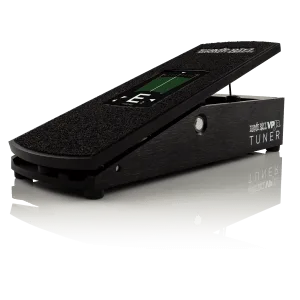


The Ernie Ball VPJR Tuner is a volume pedal with a digital chromatic tuner built into the footboard, made by Ernie Ball. Ernie Ball describes it as combining "Ernie Ball's world-renowned volume pedal with an enhanced definition digital guitar tuner," in the same rugged housing as the company's traditional volume pedal1. Where a normal board needs a volume pedal and a separate tuner pedal side by side, the VPJR Tuner puts both functions under one foot, with a touchscreen in the treadle showing either the tuner or a graphic volume readout.
Premier Guitar's reviewer framed the design as "using their industry-standard, rock-solid VPJR volume pedal as a template"2, and gearnews.com noted at launch that "it has a touch screen tuner built into the top of the main foot pedal" and that it "will look and feel just like a regular Ernie Ball volume pedal"3. The case is made from aircraft-grade aluminum4.
A volume pedal with a touchscreen tuner
The core idea is that the tuner lives where your foot already rests. In the heel-down position, the touchscreen automatically enters tuner mode, allowing silent tuning between songs; sweep the pedal forward and the screen switches to a graphic display of the volume level, with 10 shown at toe fully up19. Guitar World's Paul Riario described this "combo mode" behavior: the pedal "activates the tuner at no signal or minimal volume (heel down) and switches to a graphic volume readout once a signal is detected"6. The signal level that triggers the switch is adjustable and presettable on the touchscreen3.
The tuner itself is chromatic and tunes one string at a time. guitar.com's review noted it "offers simple and precise tuning for each string individually, with both colour- (green for in tune, blue for out) and needle-based readouts"10. The large display is designed to be readable under low-light stage conditions and in direct sunlight5.
Screen controls
| Action | What it does |
|---|---|
| Double tap, upper half of screen | Select volume only, tuning only, or volume + tuning mode1 |
| Double tap, lower half of screen (tuner shown) | Open the pitch menu; single tap a frequency to change reference pitch1 |
| Hold the lock icon | Lock or unlock the touchscreen1 |
| Heel down | Screen enters tuner mode for silent tuning1 |
| Sweep forward | Screen switches to graphic volume display1 |
The chosen display mode stays put: MusicPlayers.com's reviewer confirmed the selected mode "remains even after the tuner is turned off until changed again"7. The screen can also be locked so a stray foot does not change settings mid-gig. Ernie Ball says holding the lock icon for three seconds locks or unlocks it1; MusicPlayers.com's reviewer found the virtual button at the bottom left of the screen needed five full seconds7, so expect a deliberate press either way.
The treadle can be routed as a gain control or as a master volume control, which decides whether the pedal shapes how hard you drive the front of your amp or simply sets overall output level5.
Power and connections: 9 to 18 volts
The VPJR Tuner is an active pedal, so it needs external power for both the volume and tuner functions. Ernie Ball says it "is compatible with almost any 9 to 18 volt power adaptor on the market"1, and MusicPlayers.com confirmed any DC supply in the 9-to-18 volt range works7. Guitar World lists power usage at 150mA minimum6, which is worth noting if you run a compact power supply: that is more current than many small analog pedals draw. There is no battery option7.
The 150mA minimum draw6 and the lack of a battery option7 mean the pedal needs a dedicated outlet on a powered pedalboard, and the 9 to 18 volt range1 means most standard pedalboard supplies will run it. Check your supply's per-output current rating before dedicating an outlet to it.
Connections are 2 x 1/4" TS inputs (instrument, effects return) and 2 x 1/4" TS outputs (main out, effects send)9. The mono input jack accepts both passive and active mono audio signals, with 9 to 18 volts of headroom depending on the power supply1, so guitars with active pickups are supported. The pedal ships with a simple manual in English, French, Spanish, Chinese, and Japanese, also downloadable from Ernie Ball's website7.
Is it buffered?
Yes. The VPJR Tuner is an active pedal with a discrete buffer circuit that Ernie Ball describes as having "no tone loss through any signal chain"54. This is a real difference from the passive VPJR volume pedals: Griffin Effects sells buffer retrofit kits for the passive VPJR versions 6180 and 6181, adding an input buffer plus output buffers on the main and tuner outputs11, which is the kind of modification passive VPJR owners make to protect their high-impedance signal on long cable runs. The VPJR Tuner has that covered from the factory.
History and versions
Ernie Ball's volume pedal line goes back decades. JHS Pedals' buying guide calls the original VP, released in the seventies, "the perfect volume pedal"12. The VPJR Tuner arrived much later: it was first shown as a prototype at the Ernie Ball booth at NAMM 2019 in January 201935, with Ernie Ball introducing it at the show in Anaheim on January 26, 2019 as a combined chromatic tuner and active volume pedal, pricing and availability still to be announced5. Guitar.com reported that Ernie Ball had "reimagined and reengineered" their popular volume pedal for it13.
At launch it was offered in four finishes: Gold, Black, Red, and White54, and Ernie Ball's product page currently lists the Black version at $249.991. When MusicPlayers.com reviewed it in March 2020, it sold for $199 MSRP and was shipping that spring7; the current list price is higher.
The pedal also reflects a mechanical change across the line: from 2016, the VP and VPJR series replaced the traditional Vectran string with a PVC-coated Kevlar cord and spring linkage14.
What reviewers said
Published reviews were positive. Guitar World's Paul Riario called it "a clever, space-saving pedalboard idea brilliantly executed"6. MusicPlayers.com's Matt Abrams found "the tuner was spot on and made for quick tuning," while noting that "some players prefer a strobe-style tuner"7. Guitar World's volume pedal buying guide credits Ernie Ball with "making some of the most durable, best-selling volume pedals longer than most guitarists reading this have been alive"9, and the VPJR's touchscreen and tuner earn its place there as a space saver with a rugged build and a range of colors15.
"A clever, space-saving pedalboard idea brilliantly executed."
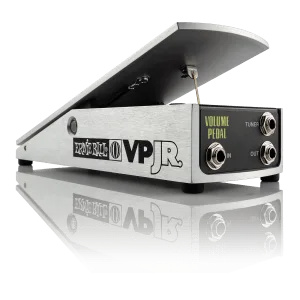
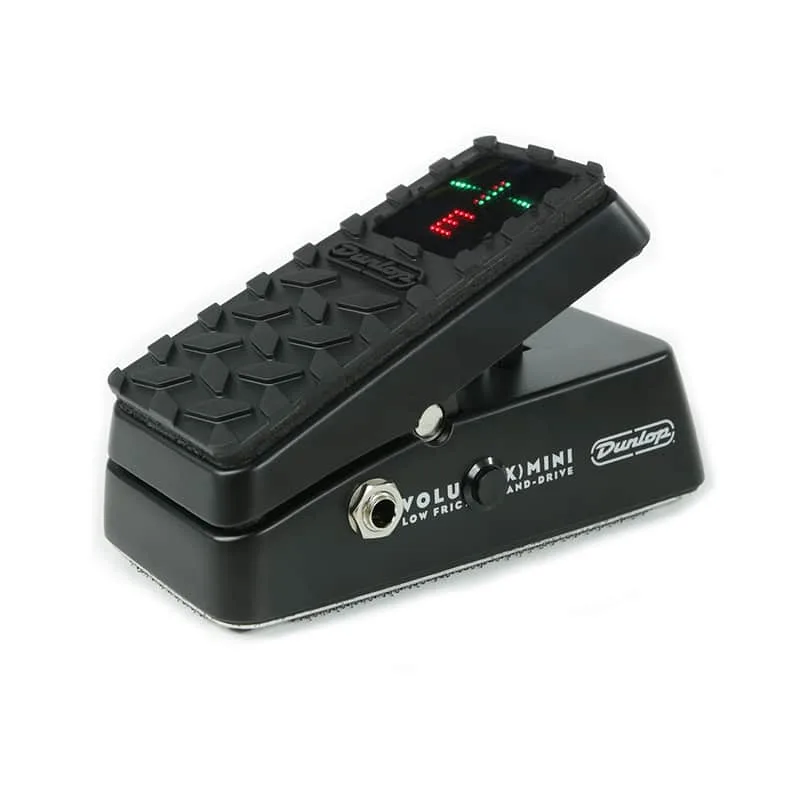
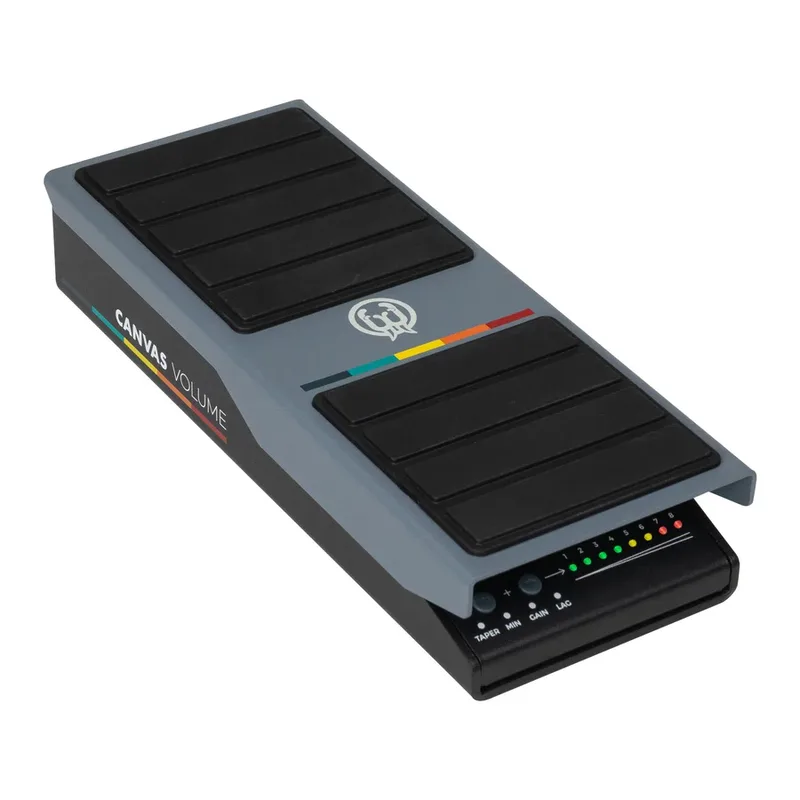
For players comparing options, the VPJR Tuner's pitch is combining two pedals in one. If you already own a passive Ernie Ball VP Jr 250K or a Dunlop Mini Volume + Tuner covers similar ground in a smaller format, while the Walrus Audio Canvas Volume is a modern active alternative.
Videos
Ernie Ball
ShortScaleGearDemos
Guitar Interactive Magazine
News
Questions
How accurate is the Ernie Ball VPJR Tuner?
Guitar World lists the chromatic tuner's accuracy at 0.1 cent, and MusicPlayers.com's reviewer found it spot on and quick for tuning, though players who prefer a strobe-style display may want that look instead. The tuner reads one string at a time and shows both color and needle readouts.
Can you change the reference pitch on the VPJR Tuner?
Yes. The pedal ships set to the standard 440 Hz, but reference pitches from 432 Hz to 447 Hz are available. While the tuner is displayed, double tap the lower half of the screen to open the pitch menu, then single tap any frequency to select it.
Is the Ernie Ball VPJR Tuner buffered?
Yes. It is an active pedal with a discrete buffer circuit that Ernie Ball describes as producing no tone loss through any signal chain. That sets it apart from the passive VPJR volume pedals, which third parties such as Griffin Effects sell buffer retrofit kits for.
What colors does the VPJR Tuner come in?
Four finishes: Gold, Black, Red, and White, as announced at NAMM 2019 and still listed on Ernie Ball's product page, which currently shows the Black version.
Does the VPJR Tuner work with active pickups?
Yes. The mono input jack accepts both passive and active mono audio signals, with 9 to 18 volts of headroom depending on the power supply used.
How does the VPJR switch between tuner and volume mode?
In heel-down position the touchscreen automatically enters tuner mode for silent tuning, and sweeping forward switches the screen to a graphic volume display. A double tap on the upper half of the screen selects volume only, tuning only, or volume plus tuning, and the switching threshold is adjustable and presettable on screen.
Sources (15)
- VPJR Tuner Pedal, Ernie Ball
- Ernie Ball VPJR Tuner Review, Premier Guitar, 2020-02-28
- NAMM 2019: Ernie Ball VPJR Tuner Pedal is here, gearnews.com, 2019-01-26
- Ernie Ball Unveils the VPJR Tuner Pedal, Guitar World, 2019-01-31
- Ernie Ball Introduces the VPJR Tuner Pedal, Premier Guitar, 2019-01-26
- Ernie Ball VPJR Tuner review, Guitar World, 2020-06-03
- Ernie Ball VPJR Tuner Pedal, MusicPlayers.com, 2020-03-02
- Ernie Ball Introduces VPJR Tuner Pedal, MusicPlayers.com, 2019-01-25
- Best volume pedals 2025: control your tone with these essential pedal picks, Guitar World, 2023-12-08
- Review: Ernie Ball VPJR Tuner, guitar.com, 2021-01-18
- VPJR Volume Buffer Retrofit Kit, Griffin Effects
- HOW TO USE A VOLUME PEDAL, JHS Pedals
- NAMM 2019: Ernie Ball teases VPJR tuner, Guitar.com, 2019-01-24
- Ernie Ball Launches Expression Overdrive and Ambient Delay Pedals, Guitar World, 2016-09-13
- Walrus Audio Canvas Volume review, Guitar World, 2026-03-19