

The Eventide MicroPitch Delay is a stereo stompbox that puts Eventide's MicroPitch Delay digital signal processing algorithm into a standalone pedal, the second pedal in the company's dot9 family following the 2020 Blackhole reverb1. It combines dual pitch-shifters with fine-resolution de-tuning, delay and modulation, including new positive envelope and negative envelope modulation sources1. Players have long used the algorithm to make guitars sound huge, make lead tones jump out of the mix, and add dimension to vocals, keyboards, guitars and drums2.
The range of sounds runs from subtle tone thickening, to a rich stereo spread, to creative sound design special effects3. It ships in a rugged, gig-ready red enclosure, and launched at $279 MSRP1.
What the MicroPitch Delay does
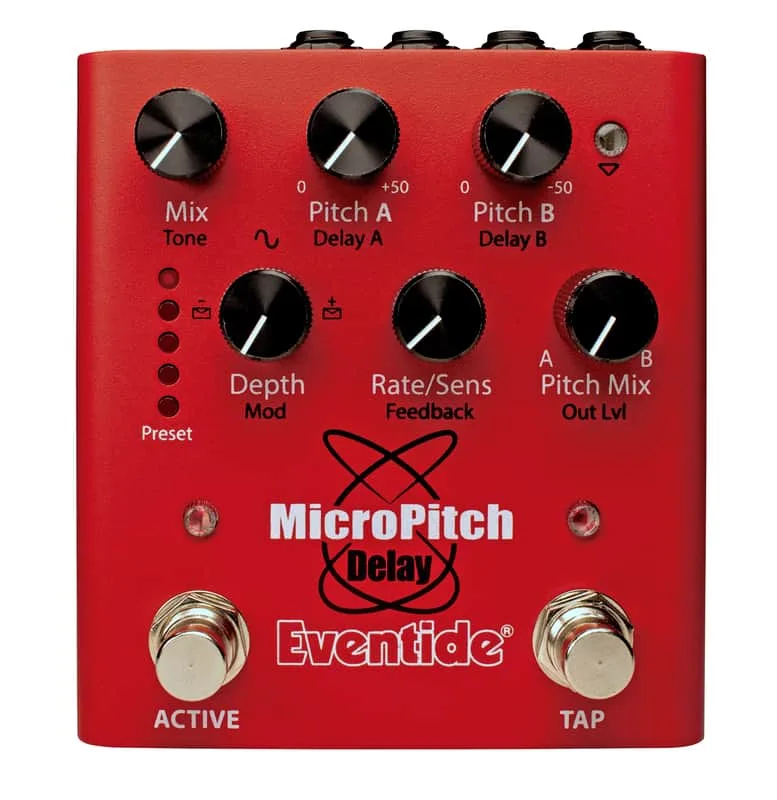
The pedal takes a mono or stereo input and splits the wet signal into two pitch-shifted delay voices: Pitch A and Delay A go to output 1, and the second voice to output 2, so a mono rig can run everything out of output 1 while a stereo rig gets a wide spread7. The modulation side offers three types of pitch modulation: via LFO, via envelope to raise pitch, and via envelope to lower pitch6.
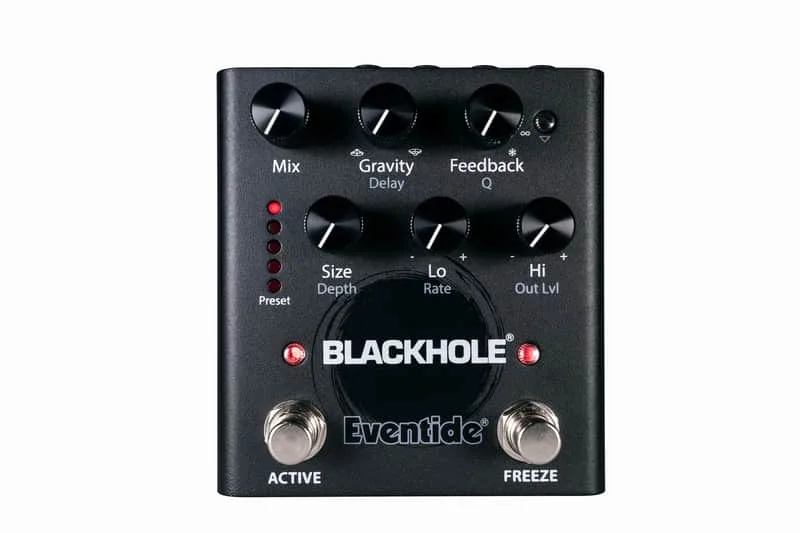
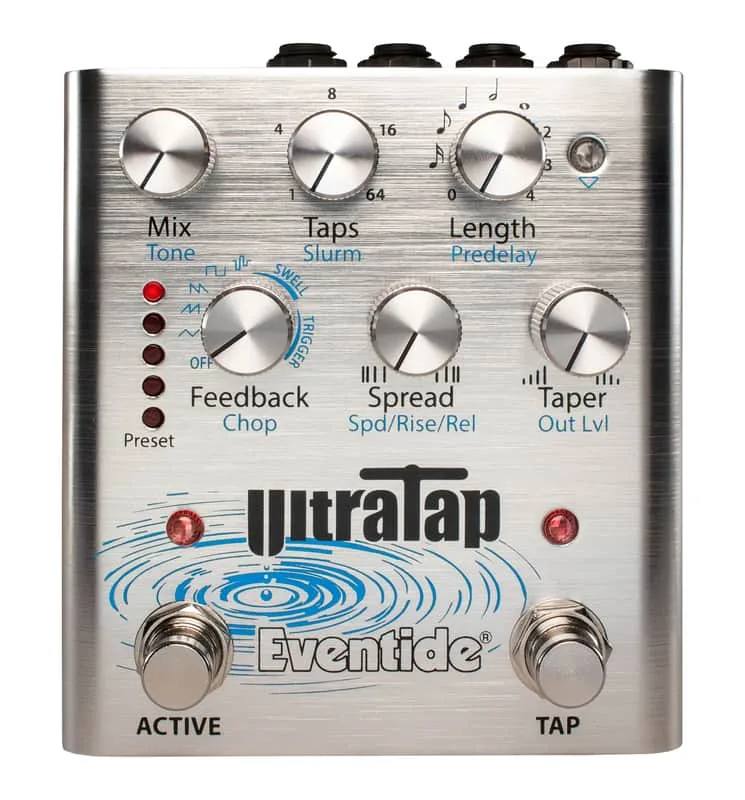
Its layout follows Eventide's other recent compact pedals, the Blackhole and the UltraTap, which Premier Guitar noted share the same arrangement8.
The controls
The pedal carries six knobs, each with a primary and secondary function selected by a Primary/Secondary Parameter LED button9. The six knobs' primary functions start with mix (dry/wet)6.
| Control | Function |
|---|---|
| Mix/Tone | Dry/wet mix (primary); tone (secondary)9 |
| Pitch A/Delay A | Pitch and delay for voice A9 |
| Pitch B/Delay B | Pitch and delay for voice B9 |
| Depth/Mod | Modulation depth and source9 |
| Rate, Sens/Feedback | Modulation rate and sensitivity, or feedback9 |
| Tap (seconds or BPM) | Tap tempo, doubling as the Preset Select Mode LED button9 |
A single Aux switch can be deployed for tap tempo3. The Active Footswitch is a latching/momentary dual-action switch with a Catch-up mode, which helps players dial in their sound when toggling between presets and parameters1.
Presets, MIDI and expression
The pedal stores up to 127 presets in memory, with five loaded at a player's feet for immediate access1. Without MIDI, those five onboard presets, each represented by an LED down the left side of the unit, are what you can reach while playing10. A software editor connects via Mini USB to Eventide Device Manager5.
- MIDI: available over TRS (with a MIDI to TRS cable or converter box) or USB3
- Expression: any combination of MicroPitch Delay parameters can be mapped to an expression pedal3
- Bypass modes: Buffered, Relay, DSP+FX or Kill dry3
History: from the H910 and H949 Harmonizers
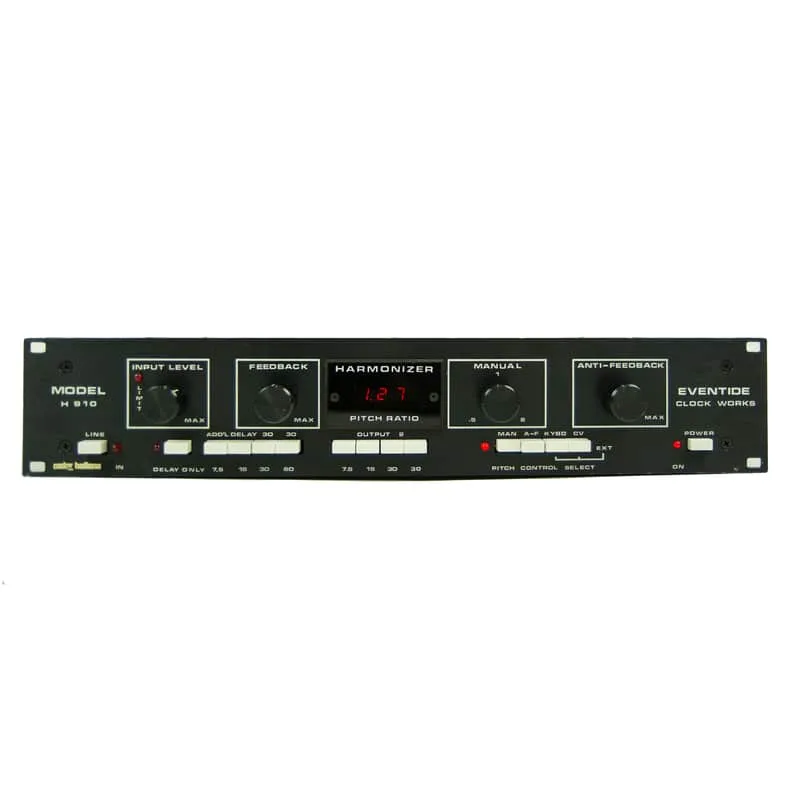
The MicroPitch effect began in the mid-1970s as an unintended consequence of the then-new Eventide H910 Harmonizer, whose clocking mechanism would flicker between two pitch ratios, creating micro-pitch shifting6. The H910's successor, the H949 Harmonizer, had improved clocking and used techniques to produce more precise deviations in pitch6. MusicRadar describes the H949 as embracing this by offering precise deviations in pitch and introducing MicroPitch shifting as a studio tool5.
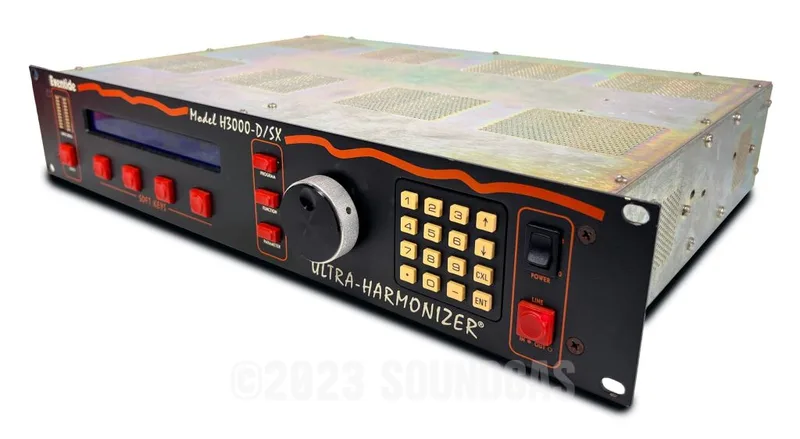
The MicroPitch Delay algorithm has been a mainstay of audio production and musical performance since it was first introduced within the H910 and H949 effects processors, and later in the H3000 Harmonizer3. The pedal itself is the stompbox rendition of a popular creative plugin by the same name, part of a series of Eventide pedals inspired by their pro audio plugins3. It was announced in March 2021 at a $279 preorder price4 and reported as newly released that November3.
What reviewers said
GuitarPlayer's reviewer found the quality of the effects outstanding, calling it "a great-sounding and versatile pedal" that was "richly deserving of the Editors' Pick Award overall"6.
"As you would expect from Eventide, the quality of the effects is outstanding. The little red box is awesome for delay"
MusicRadar lists it among its best delay pedals, noting its combination of dual pitch-shifters with fine-resolution de-tuning, delay and modulation, and calling it "a pedal with some pretty solid roots" inspired by the H910 and H949 Harmonizers9.
Eventide lists the pedal's dimensions as 178 (w) x 121 (d) x 71mm (h)5. The MicroPitch Delay carried a $279 price at launch, both as MSRP from Eventide dealers and as the street price quoted in reviews1.
Videos
Pete Thorn
Sweetwater
Eventide Audio
News
Questions
Is the Eventide MicroPitch Delay true bypass?
It offers four bypass modes rather than one fixed option: Buffered, Relay, DSP+FX or Kill dry. Relay bypass is the true-bypass-style option, while the other modes keep the processing or the dry signal path active in different ways, so a player can choose how the pedal behaves when switched off.
Does the MicroPitch Delay have tap tempo?
Yes. Tap tempo works in seconds or BPM, and a single Aux switch can be deployed for tapping. The Tap control doubles as a Preset Select Mode LED button on the pedal's face.
How many presets does the MicroPitch Delay hold?
The pedal stores up to 127 presets in memory, with five loaded at a player's feet for immediate access. Without MIDI, those five onboard presets, each with its own LED down the left side of the unit, are what you can reach while playing.
Can the MicroPitch Delay run in mono?
Yes. It takes a mono or stereo input through a TS/TRS jack and has two outputs, Pitch A and Delay A on output 1 and the second voice on output 2. A mono rig can run everything out of output 1.
What power supply does the MicroPitch Delay need?
It runs on 9V DC at 200mA, and Eventide includes a nine-volt power supply in the box. There is no battery option; the rear panel has a jack for the included adaptor.
Sources (10)
- Eventide Makes It Big with New MicroPitch Delay Pedal, MusicPlayers.com, 2021-03-11
- Eventide MicroPitch Delay, Pedal of the Day, 2021-03-11
- Eventide MicroPitch Delay, Delicious Audio, 2021-11-26
- Eventide makes its classic tones compact with the MicroPitch Delay pedal, MusicRadar, 2021-03-11
- Eventide MicroPitch Delay pedal review, MusicRadar, 2021-12-31
- Eventide MicroPitch Delay Review, GuitarPlayer.com, 2021-09-22
- Eventide MicroPitch Delay review, Guitar World, 2021-06-28
- The Tone-Fattening Marvel That Turned EVH’s Head, Premier Guitar, 2021-05-24
- Best delay pedals: add extra dimension to your tone, MusicRadar, 2022-05-17
- Eventide MicroPitch Delay: A feature-rich pedal with dual pitch-shifted delays, gearnews.com, 2021-03-11