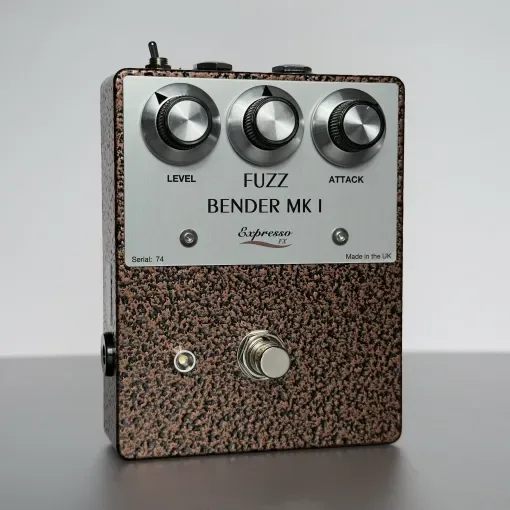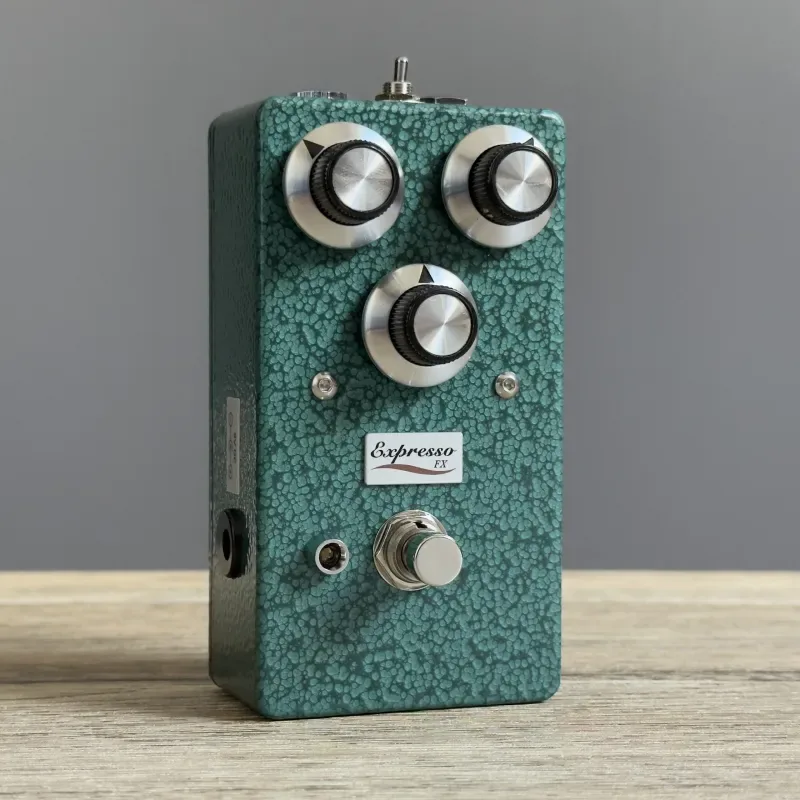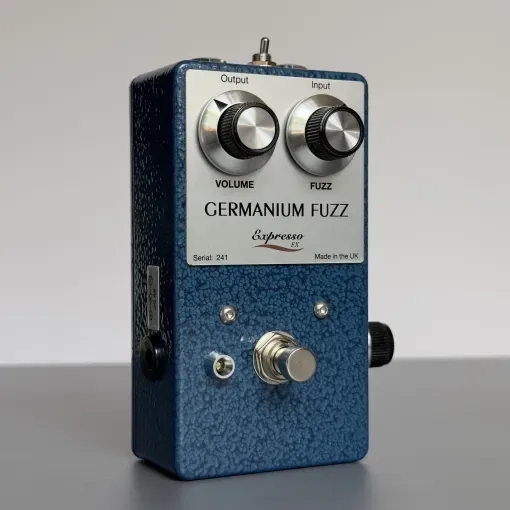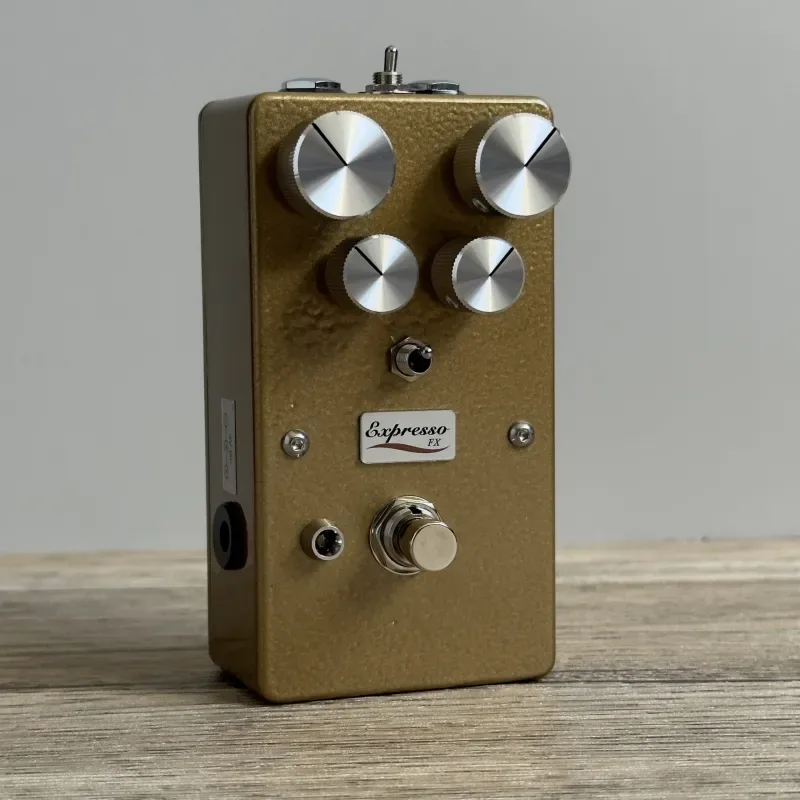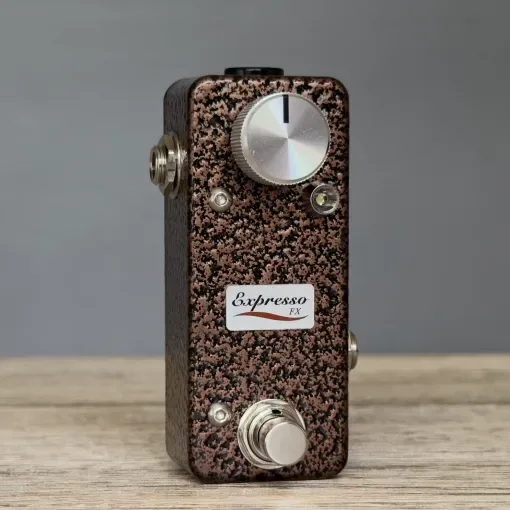
The Expresso FX Fuzz Bender Mk I.V "Mini" is a germanium fuzz pedal and a compact version of the full-size Fuzz Bender Mk I.V. Expresso FX describes it as a mini version of that pedal "with exactly the same components and same classic tone," squeezed into a smaller enclosure for players who need board space1.
The circuit it replicates is the dual-transistor Tone Bender, often referred to as the Tone Bender Mk1.5, one of the classic British fuzz designs of the 1960s. The full-size Fuzz Bender Mk I.V is an accurate replica of that circuit, and the Mini carries the same build2. For a player, that means the pedal sits in the same family as the other Mk1.5-style benders on the market, distinguished here by its mini enclosure and its menu of NOS germanium transistor pairs.
Transistor options and components
The Mini is built with hand-selected NOS germanium transistors, and Expresso FX offers a choice of pairs. Because germanium transistors from the 1960s vary widely from unit to unit, the choice of pair is one of the main decisions a buyer makes with this pedal, and Expresso FX describes each option in its own words31:
| Transistor pair | Expresso FX's description |
|---|---|
| Matched pair of Mullard OC42 | "very nice. articulate transistors with good cleanup"3 |
| Mullard OC75 & Mullard OC76 | "excellent pairing for this circuit, with a raw and cutting tone"3 |
"Cleanup" here refers to how the fuzz responds when the guitar's volume is rolled back: a pair with good cleanup lets a player thin the effect out from the instrument rather than reaching for the pedal. The OC75 and OC76 pairing sits at the other end of the spectrum, with a raw and cutting tone1.
The listed price of £229.00 (2025) does not include transistor upgrades, so choosing a pair other than the standard fit costs extra3.
Around the transistors, the component list is vintage throughout:
- NOS Allen Bradley carbon composition resistors3
- NOS Mullard C296 "Mustard" polyester capacitor3
- Philips/BC electrolytic capacitors2
- Bourns trimpots3
- Alpha 16mm potentiometer3
- Switchcraft jacks3
- Alpha footswitch3
- Premium 22 AWG solid core silver-plated copper wire with Teflon insulation3
- Lead-free, silver-based solder3
The wiring itself is point-to-point construction, with no circuit board. Expresso FX frames this as part of the pedal's vintage character: the components are soldered directly to one another and to the controls, the way the original 1960s units were built, rather than mounted on a PCB1. The Bourns trimpots are the internal bias adjustments a builder uses to set up the germanium transistors, which need individual setup because their gain and leakage vary from unit to unit.
Build and finishes
Expresso FX calls the Mini "a very vintage-inspired pedal with a selection to top-drawer NOS components and point-to-point construction" despite its smaller size1. The circuit sits in a Hammond aluminum enclosure, powder-coated, measuring 92.5 x 38.5 x 31 mm. At that size it takes up roughly the footprint of a common mini pedal, small enough to tuck into a tight pedalboard row where the full-size Mk I.V would not fit.
The pedal is offered in four finishes3:
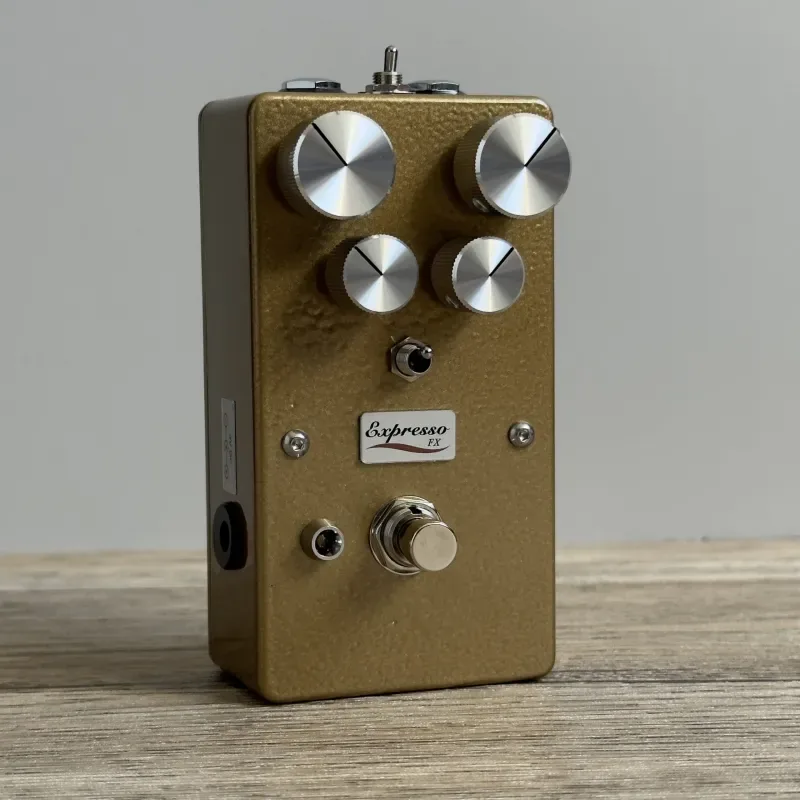
- Antique Copper Hammertone
- Blue Hammertone
- Gray Hammertone
- Translucent Copper
The DC socket is wired for standard center-negative polarity power, matching the convention of most modern pedal power supplies1. Like the full-size Mk I.V, the Mini is true bypass, so it leaves the dry signal alone when switched off1. It carries a 3-year warranty1.
How it relates to other Expresso FX fuzzes
The Mini shares its circuit with the Fuzz Bender Mk I.V, whose manual describes the same hand-selected NOS germanium transistor approach and Philips/BC electrolytic capacitors2. The difference between the two is physical rather than electrical: same components, same tone, smaller box1.
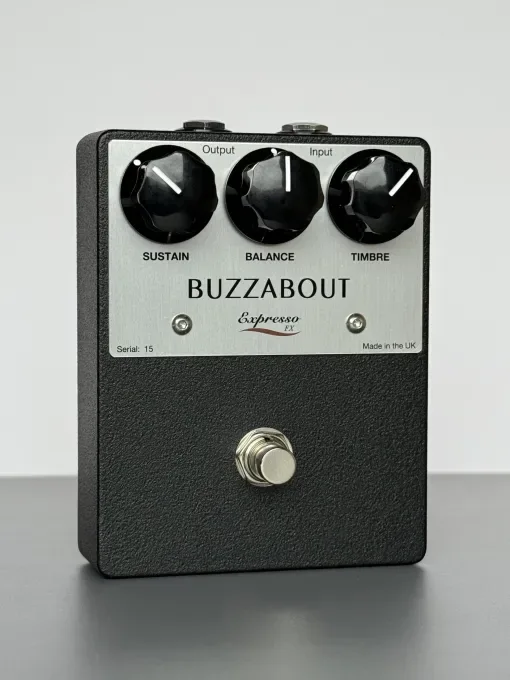
Expresso FX also builds the Fuzz Bender MkII, a recreation of the earliest three-transistor circuit from the Bender family, and a range of other germanium and silicon fuzzes including the Germanium Fuzz, the Silicon Fuzz and the Buzzabout. A player comparing benders within the maker's own range is choosing between the Mk1.5-style dual-transistor circuit of the Mk I.V and Mini, and the earlier three-transistor MkII circuit, with the Mini as the board-space-saving option among them214.
Videos
Edge of Breakup 🎥 Guitars, Pickups, Amps & Pedals
Questions
Is the Fuzz Bender Mk I.V Mini true bypass?
Yes. Expresso FX lists the Fuzz Bender Mk I.V Mini as true bypass, the same as the full-size Fuzz Bender Mk I.V. The pedal uses an Alpha footswitch, and the circuit is wired point-to-point with NOS components throughout.
What is the difference between the Fuzz Bender Mk I.V and the Mini?
The Mini is a smaller version of the Fuzz Bender Mk I.V. According to Expresso FX, it uses exactly the same components and delivers the same classic tone, but the circuit sits in a smaller powder-coated Hammond aluminium enclosure measuring 92.5 x 38.5 x 31 mm, which saves pedalboard space.
Does the Fuzz Bender Mini use center-negative power?
Yes. Expresso FX states that the DC socket is wired for standard center-negative polarity power, so it works with the common 9V DC supplies most pedalboards already use. No voltage or current draw figures are published for it.
What germanium transistors are in the Fuzz Bender Mini?
It uses hand-selected NOS germanium transistors. Expresso FX offers options including a matched pair of Mullard OC42, described as articulate with good cleanup, and a Mullard OC75 paired with an OC76, described as a raw and cutting combination. Transistor upgrades cost extra beyond the base price.
Sources (4)
- Fuzz Bender Mk I.V “Mini”, Expresso FX, 2024-05-17
- Fuzz-Bender-Mk-I.V-Manual.pdf, Expresso FX, 2019
- Fuzz Bender Mk I.V “Mini”, Expresso FX, 2024-05-17
- Fuzz Bender Mk I | Expresso FX, Expresso FX, 2018-08-31