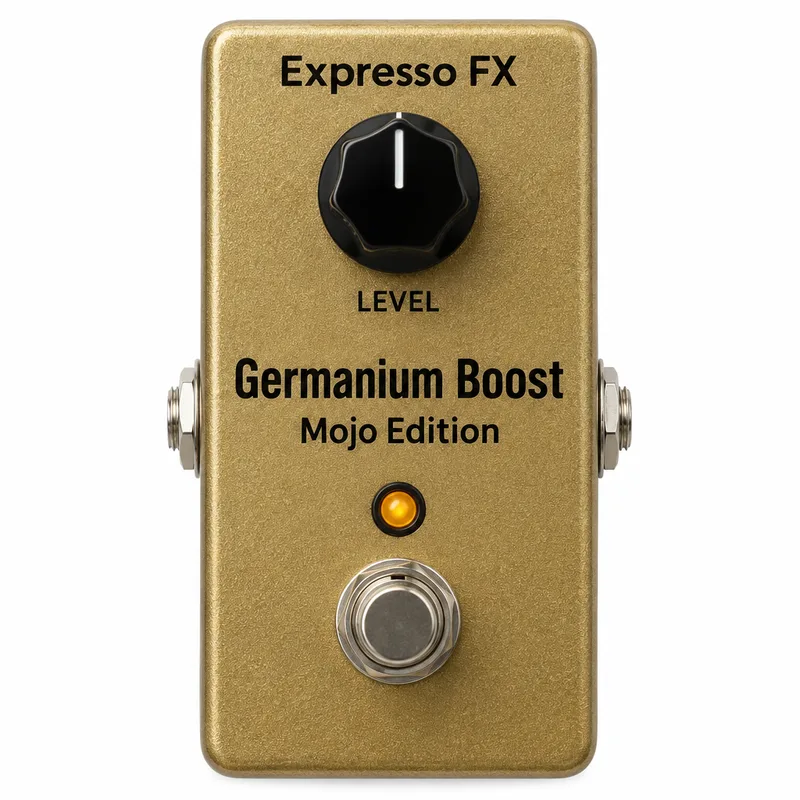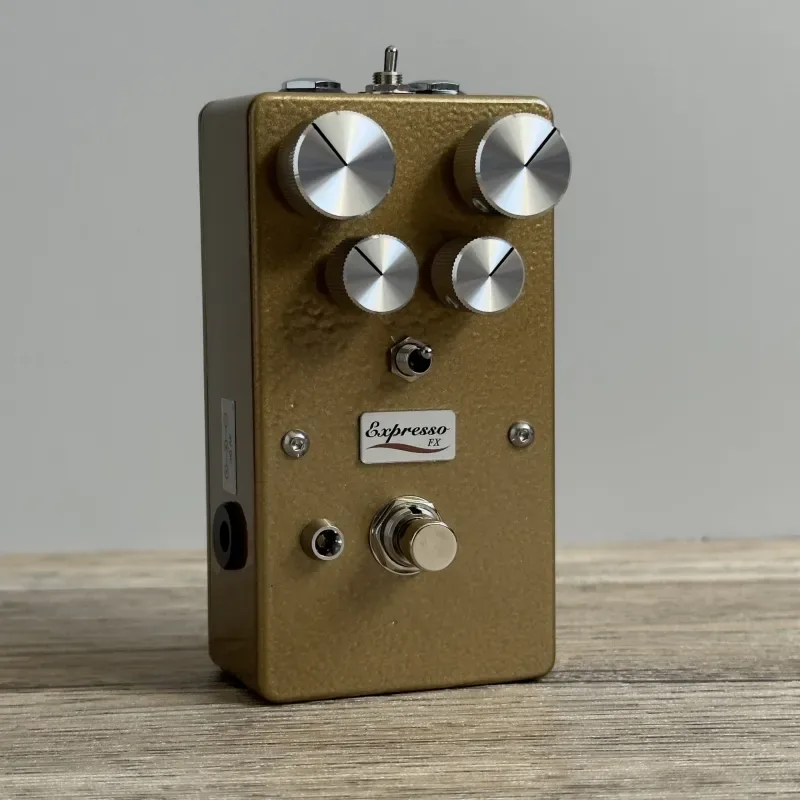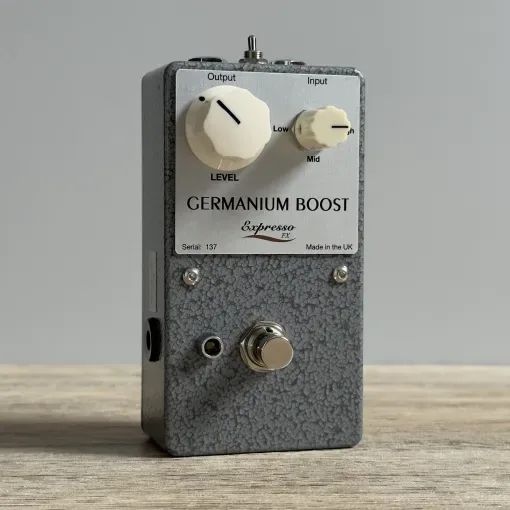


The Expresso FX Germanium Boost Mini is a compact boost pedal built around a single hand-selected NOS germanium transistor. Expresso FX positions it as a mini version of the company's full-size Germanium Boost, "but with exactly the same components and same tone with just a little less" in the way of controls: where the full-size pedal uses a 7-step rotary tone switch, the Mini carries a 3-way toggle instead1. Like its bigger sibling, it aims, in the maker's words, to take you "ever so close to the mojo of vintage germanium boosters units, but with a few improvements"2.
The pedal is fully hand wired and built from new-old-stock (NOS) parts throughout: Mullard "Tropical Fish" C280 polyester capacitors, Allen Bradley carbon comp resistors, Alpha 16mm potentiometers, Bourns trimpots, and Switchcraft jacks, all in a genuine Hammond aluminum enclosure, powder-coated, with lead-free silver-based solder and 22 AWG silver-plated copper wire with Teflon insulation1. Expresso FX describes it as "a very vintage-inspired pedal with a selection to top-drawer NOS components"1.
What it does and how it is controlled
A germanium boost sits in the same family as the vintage booster units the maker references: it pushes the front of your amp with a single transistor stage, and the character of that push depends heavily on the transistor. The Mini's single control surface is its 3-way toggle switch, which selects a treble, mid, or low (bass) boost voicing1. That is the main simplification from the full-size Germanium Boost, whose seven voicings, ranging from bass-focused to mid-focused to treble-focused, are accessed through a stepped rotary switch4. Pedal of the Day, reviewing the full-size pedal in 2018, noted that this switch "gives you the opportunity to enjoy and experiment with seven distinctive voices"5; the Mini trades that range for a smaller footprint.
The Mini is true bypass, so with the pedal off your signal passes through without the circuit in the way1.
Transistor options: OC141 or OC42
The transistor is chosen at checkout, and some options carry a surcharge1. The two standard choices come from the same Mullard and Philips lineage:
| Option | Transistor | Maker's description | Polarity |
|---|---|---|---|
| OC141 | Philips/Mullard OC141 germanium | "creamy with a well balanced overall sound" | NPN, negative ground1 |
| OC42 | Mullard OC42 germanium | "a little brighter than OC141, but also well balanced" | PNP1 |
Pedal of the Day's 2018 review of the full-size pedal echoed the maker's characterization, calling the OC141 transistors "creamy and well-balanced" and noting that the OC42s in its review unit were "a bit brighter overall, but remain balanced as well"5.
Power and polarity
The transistor choice has a practical consequence for your pedalboard power. Because the OC42 is a PNP transistor, the Mini in that configuration "will require reverse polarity power if a DC socket is added"1. The OC141 version is the easier one to live with on a shared supply: because it is NPN with a negative ground, "the DC socket does not require reverse polarity power and hence you can daisy chain it with standard pedals"1.
If you run a shared supply or a daisy chain, the OC141 version is the one that plays nicely with standard center-negative pedals. The OC42 version needs reverse polarity power if a DC socket is fitted, which rules out a standard daisy chain.
Finishes and ordering
The Mini is offered in six powder-coated finishes: Antique Copper Hammertone, Dark Gray Sparkle, Forest Green, Gold, Gray Hammertone, and Midnight Blue Sparkle3. The full-size Germanium Boost offers a wider palette of eight finishes, including Emerald Sparkle, Matt Black, and Matt Red Copper4. Expresso FX asks buyers to allow 3 to 4 days for shipping, and the pedal carries a 3-year warranty1.
Related Expresso FX pedals
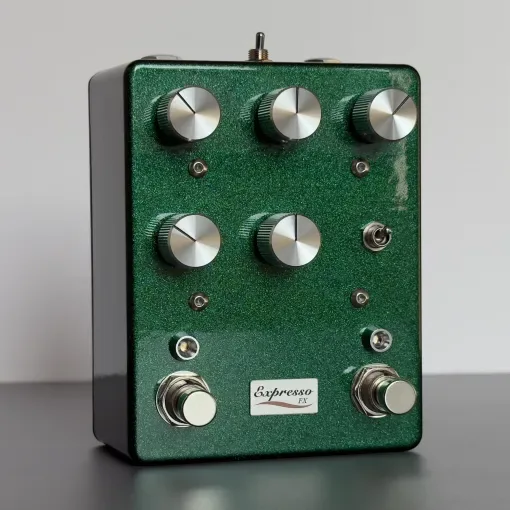
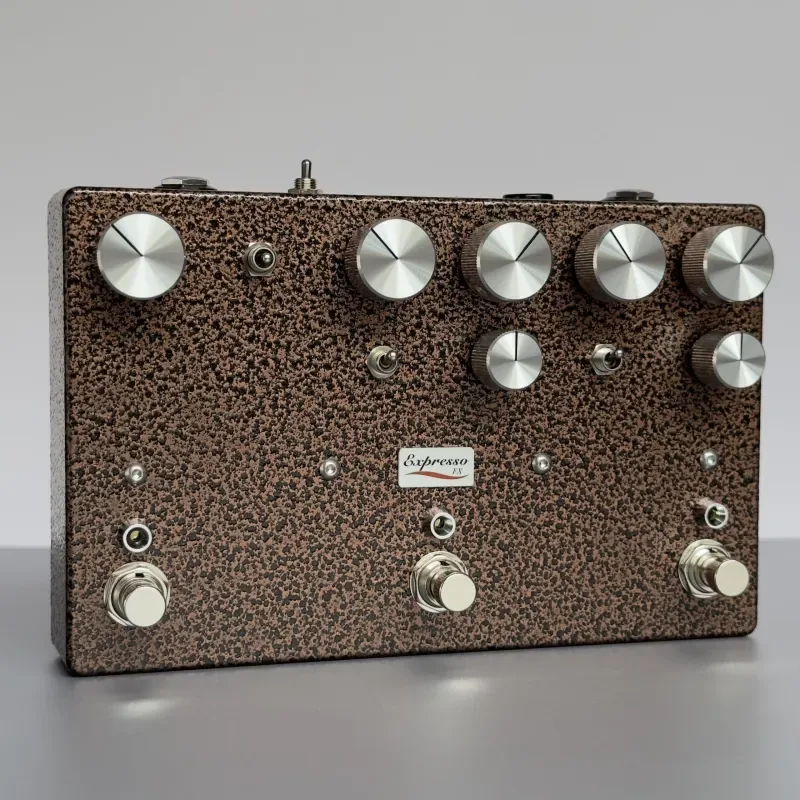
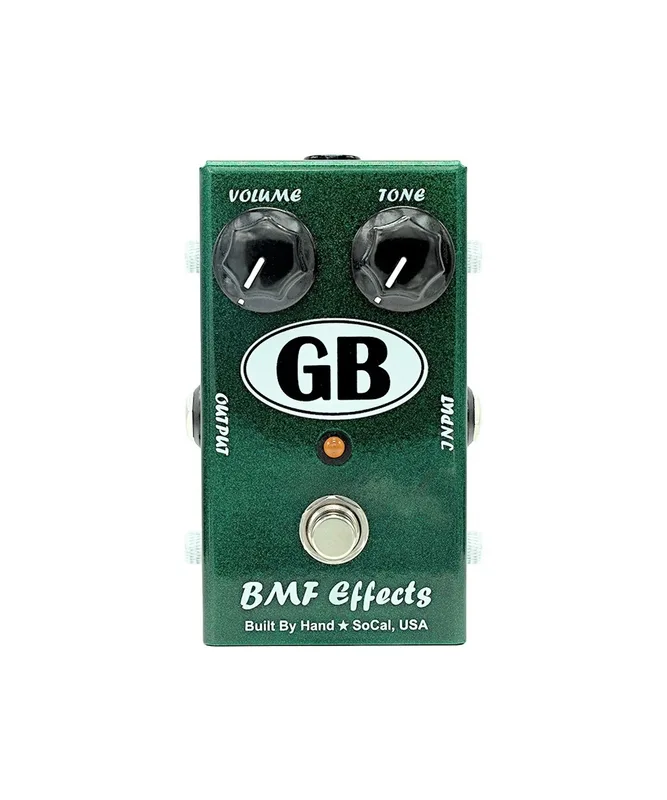
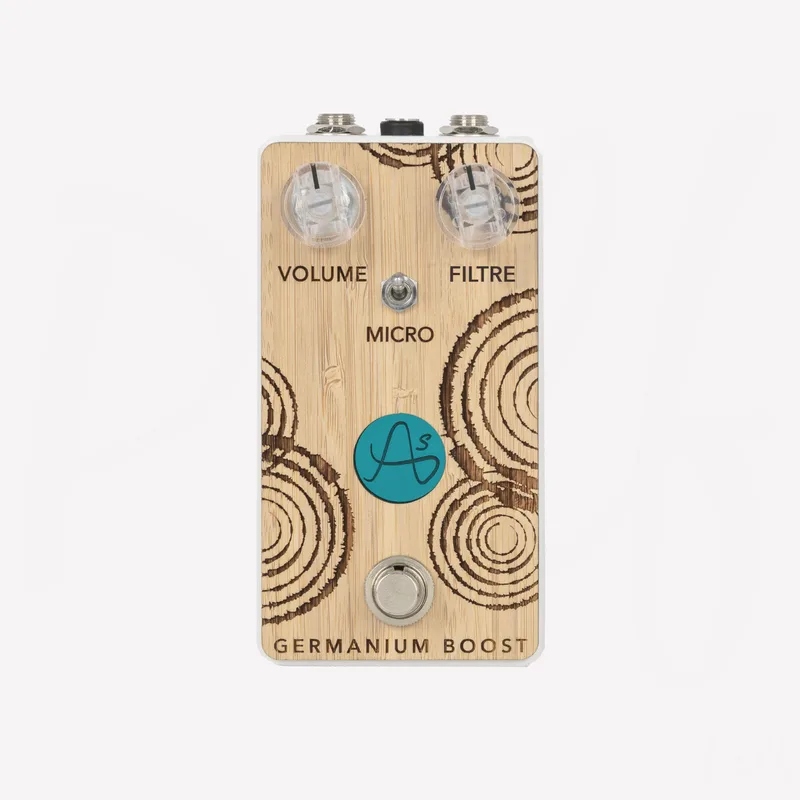
Expresso FX builds the Germanium Boost circuit into several of its other offerings, including the Expresso FX Germanium Boost "Mojo Edition", the Expresso FX Custom Ge Fuzz / Ge Boost / Octave Up, the Expresso FX Custom Dual Ge/Si Fuzz & Ge Boost, and the Expresso FX Custom Fuzz Station. Other makers' takes on the germanium boost idea include the BMF Effects GB Boost Germanium Booster and the Anasounds Germanium Boost.
Videos
HarryAndAGuitar
Brett Kingman
Pedals Fusion
Questions
Does the Expresso FX Germanium Boost Mini need reverse polarity power?
It depends on the transistor option. The OC42 version uses PNP transistors, so the pedal requires reverse polarity power if a DC socket is added. The OC141 version is NPN with a negative ground, so its DC socket does not require reverse polarity and can be daisy chained with standard pedals.
Is the Germanium Boost Mini true bypass?
Yes. Expresso FX lists true bypass for the Germanium Boost Mini, the same as the full-size Germanium Boost it is derived from.
What is the difference between the OC141 and OC42 versions?
The OC141 option uses Philips/Mullard OC141 germanium transistors, which Expresso FX describes as creamy with a well balanced overall sound. The OC42 option uses Mullard OC42 transistors, described as a little brighter than the OC141 but also well balanced. The OC141 is NPN with a negative ground; the OC42 is PNP.
What finishes does the Germanium Boost Mini come in?
Expresso FX offers the Mini in six powder-coated Hammond enclosure finishes: Antique Copper Hammertone, Dark Grey Sparkle, Forest Green, Gold, Grey Hammertone, and Midnight Blue Sparkle.
Sources (5)
- Germanium Boost “Mini”, Expresso FX, 2024-06-14
- Germanium Boost, Expresso FX, 2018-08-15
- Germanium Boost “Mini”, Expresso FX, 2024-06-14
- Germanium Boost, Expresso FX, 2018-08-15
- Expresso FX Germanium Boost, Pedal of the Day, 2018-04-04