

The Fairfield Circuitry Four Eyes, also reviewed as the Four Eyes Crossover Fuzz, is a fuzz pedal from Canadian maker Fairfield Circuitry that takes a different approach from a conventional fuzz. Instead of clipping the whole signal at once, it splits your guitar into three frequency bands and runs each band through its own fuzz circuit12. A voltage controlled state variable filter with resonance control and a mu-amp input stage drives the whole thing2.
The pedal is discontinued. Guitar World referred to it as "the company's discontinued Four Eyes fuzz" when covering the launch of its successor in 20213, and Fairfield Circuitry's own page for the ~900 says that pedal traces "its lineage back to our discontinued Four Eyes Fuzz"43.
Three JFET fuzzes split by a filter
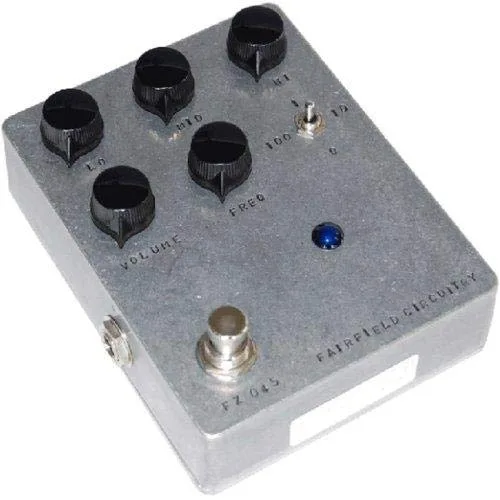
The core idea is the crossover: the filter divides the signal into low pass, high pass and band pass outputs, and each of those outputs has its own fuzz circuit fed by a drive pot2. All three circuits are controlled by the state variable filter, and the sweep of that filter is regulated by a resonance control1. The fuzz circuits themselves are JFET based25.
For a player, this means the character of the fuzz changes depending on where the filter sits and how hard each band is driven. Delicious Audio's Ed Gross described the range as "everything from classic fat sputtery tones to burpy synth-like textures to cocked-wah filtered noise"1. Rather than a single tone knob shaping one clipped signal, you are balancing three of them.
Controls
| Control | What it does |
|---|---|
| LO | Drives the fuzz circuit of the low frequency band2 |
| MID | Drives the fuzz circuit of the mid frequency band2 |
| HI | Drives the fuzz circuit of the high frequency band2 |
| FREQ | Sets the cutoff/center frequency of the filter circuits2 |
| Resonance switch | 3-way, with values of 1 (mild), 10 (Spicy) and 100 (Suicide)2 |
| VOLUME | Sets output volume2 |
| Bypass footswitch | Engages and bypasses the pedal2 |
The Volume control has plenty of range. Pedal of the Day's reviewer wrote that "there is LOADS on tap, certifying that your fuzzy voice will be heard throughout the club or stadium"5.
The resonance switch and expression control
The resonance switch sets how hard the filter resonates at its three fixed values, from mild at 1 to what Fairfield's labeling calls Suicide at 1002. Higher resonance makes the filter's sweep a more prominent part of the sound, which is what pushes the pedal toward those cocked-wah and synth-like textures1.
The filter frequency is not stuck under your foot only as a knob. There is an expression pedal/CV input for controlling the FREQ setting2, and Delicious Audio noted you can "even control the interaction between the resonance and the filter with an expression pedal if you need to get weirder"1. Pedal of the Day highlighted the same practical use, calling the expression input a way "to control the resonance on the fly, allowing even more spontaneous creativity and setting switching in mere seconds"5.
What reviewers said
Reviewers across the pedal's life agreed it is not a conventional fuzz. Pedal of the Day's Mike B put it plainly: "this is not your grandpa's fuzz"5, and concluded that the pedal "did not disappoint"5. Delicious Audio's Gus Green found the fuzz circuits themselves "top notch quality and sound extremely organic and creamy"2.
On versatility, Green's verdict was that "the wide operating range of the frequency control, switchable resonance and the three drive pots allow this pedal to go from extreme to relatively subtle; from super thin to ridiculously fat"2. So yes, it can work as a subtle fuzz, not just an extreme one.
Gross's earlier review of the Crossover Fuzz pointed out that the three-band control is deep enough that many players may never explore its full range: "Using my single coil Tele and cranking the Mid and Lo circuits, I could easily dial in a fat fuzz tone that would be at home on a Black Keys album"1.
"Fairfield Circuitry's Four-Eyes Crossover Fuzz is one nerd that fights back with an innovative design."
Where it came from and what followed
The Four Eyes appeared in the early 2010s, reviewed by Delicious Audio in 2011 as the Four-Eyes Crossover Fuzz1 and again in 20131, with Pedal of the Day reviewing a unit sent by Fairfield Circuitry in January 20161. Fairfield Circuitry had already built a reputation for experimental pedals by then, including the Unpleasant Surprise fuzz/gate pedal announced in 2012.
After the Four Eyes was discontinued, its circuit ideas carried forward. In September 2021 Fairfield Circuitry launched the ~900, a four-knob fuzz with two cascading JFET gain stages that Guitar World described as inspired by the discontinued Four Eyes3, and which Fairfield Circuitry itself links directly to the Four Eyes Fuzz lineage4. Players looking for a current Fairfield Circuitry fuzz will find it there.
Videos
ProGuitarShopDemos
Fairfield Circuitry
Pedals and Effects
News
Questions
Is the Fairfield Circuitry Four Eyes discontinued?
Yes. Guitar World described the Four Eyes as discontinued when Fairfield Circuitry introduced the ~900 in 2021, and Fairfield Circuitry's own product page for the ~900 traces its lineage back to the discontinued Four Eyes Fuzz. The Four Eyes itself is no longer in the maker's lineup.
What does the resonance switch on the Four Eyes do?
It is a 3-way switch that sets how much resonance the state variable filter has, with values of 1 (mild), 10 (Spicy) and 100 (Suicide). Higher settings make the filter's sweep more pronounced, pushing the pedal toward filtered, synth-like sounds rather than straightforward fuzz.
Can you control the Four Eyes filter frequency with an expression pedal or CV?
Yes. The Four Eyes has an expression pedal/CV input for controlling the FREQ knob, which sets the cutoff and center frequency of the filter circuits. Delicious Audio's reviewer noted you can also control the interaction between the resonance and the filter with an expression pedal.
Does the Four Eyes work as a subtle fuzz?
Yes. Delicious Audio found that the wide frequency control, switchable resonance and three drive pots let the pedal go from extreme to relatively subtle, and from super thin to ridiculously fat. It is not limited to full-on destruction.
What do the Lo, Mid and Hi circuits do on the Four Eyes?
They are three separate fuzz circuits, one per frequency band. The filter splits the signal into low pass, high pass and band pass outputs, each with its own fuzz circuit fed by a drive pot, so you can push the lows hard while leaving the highs cleaner, or any other balance.
Sources (5)
- Fairfield Circuitry Four Eyes Crossover Fuzz, Delicious Audio, 2011-01-26
- Guitar Pedal Reviews: Fairfield Circuitry Four Eyes, Delicious Audio, 2013-06-19
- Fairfield Circuitry promises bountiful gain and "delicious" harmonics with its new ~900 fuzz pedal, Guitar World, 2021-09-09
- ~900 - Fairfield Circuitry, Fairfield Circuitry
- Fairfield Circuitry Four Eyes Fuzz, pedal-of-the-day.com, 2016-01-24