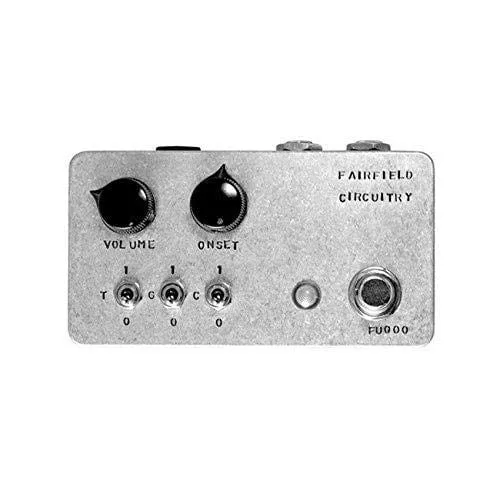


The Unpleasant Surprise is an experimental fuzz and gate pedal from the Canadian builder Fairfield Circuitry, first announced in September 201212. Where a conventional fuzz pedal aims at a fixed voicing, this one is built around a gate that reacts to your playing dynamics, so the sound can range from sustained fuzz to sputtering, velcro-ripping artifacts depending on how hard you play and where the controls sit1.
Fairfield describes the circuit on its product page as the fruit of an oddball circuit, hanging there awkwardly by some parasitic effect, tweaked, bended and shoe-horned to optimize its stench and unpleasance3. As of October 2026 the pedal is listed as sold out on the maker's site at a regular price of $310 CAD3.
What it does to your sound
The pedal is marketed as a fuzz pedal, but Delicious Audio's reviewer Shane O'Connor noted that with so many strange possibilities he would not put it alongside classic fuzzes like the Big Muff or Fuzz Face4. At the launch, Premier Guitar's press release summed up its range:
"The Unpleasant Surprise offers a distortion palette ranging from seemingly infinite sustain to sputtery farts; from velcro-like, ripping fuzz to ear-wrenching compression."
The gate is what makes that range possible. O'Connor found it possible to create wild growling fuzz distortions with gated dynamic reactions, where the pedal responds to how hard you dig in rather than simply clipping everything the same way4. Fairfield itself frames the pedal as something that turns dynamics to waste while still feeling natural to play3.
Controls and how to use them
The pedal has two knobs and three toggle switches1. The knobs are continuous controls for output level and gate threshold, and the switches shape the tone, gain and compression character.
| Control | What it does |
|---|---|
| Volume | Continuous control of output level1 |
| Onset | Sets the gate threshold and the fuzz gain together. Clockwise increases the fuzz element, making it sustained and playable; counterclockwise mixes in spitting gate artifacts41 |
| Tone (treble cut) | Cuts treble, allowing a more useful fuzz sound at higher gain settings, and pairs well with the compressor engaged4 |
| Gain (amplifier bias) | Toggles between "open" and "saturated". Saturated aids wild settings, open allows a more functional fuzz4 |
| Crush (compression) | Pinches the high end in a way that might cut through the mix in certain situations, but could come off as overbearing in a sparse arrangement. Its threshold is controlled by the Onset knob4 |
Because Onset sets both the gate threshold and the fuzz gain at once, the two functions are linked: back off the knob and the gate closes more aggressively while the fuzz gets spittier; push it forward and the fuzz sustains while the gate opens up4.
The gate in practice
The gate is not a switchable extra, it is part of the pedal's character, and it behaves differently from unit to unit. Fairfield's own support article explains that each pedal is different and that there is a careful balancing act at calibration, because the two "G" settings can sound different enough to cause a high gating threshold5. The practical consequence:
With the Onset knob below 12 o'clock, lower output guitars can have a hard time pushing through the gate, since the gating threshold can be pretty high at those settings5.
Fairfield's suggested remedy is to feed the pedal a stronger signal:
"One remedy is to hit the Unpleasant Surprise with a stronger/louder signal. This can be done by placing something like a clean boost, compressor, or anything with a master volume really, before the Unpleasant."
In other words, a boost or compressor in front of the Unpleasant Surprise changes how the gate behaves, which is worth knowing before you conclude a low-output guitar simply cannot drive the pedal.
Where the circuit came from
The Unpleasant Surprise is not based on a classic fuzz topology. O'Connor describes it as the fruit of an oddball circuit, hanging there awkwardly by some parasitic effect, tweaked, bended and shoe-horned to optimize its stench and unpleasance4. That parasitic behavior is what gives the pedal its gated, dynamic character: the gate is a side effect of the circuit itself rather than a bolted-on noise reduction stage.
He also placed it in the context of Fairfield's lineup, calling it "the druggie stepbrother to the functional and dependable Barbershop"4, which captures the split in the maker's range between practical overdrive-style pedals and more experimental boxes.
Release and availability
Fairfield Circuitry announced the Unpleasant Surprise in September 2012 as the newest addition to its collection of what Premier Guitar called robust and unique sound modifiers1. Guitar Interactive Magazine covered the announcement the same month, describing the Canadian maker's ever growing arsenal of wacky and bizarre effects units2. At launch the pedal carried a retail price of $175 and was available through participating dealers or directly through fairfieldcircuitry.com1.
As of October 2026, the maker's product page lists the pedal at a regular price of $310 CAD and shows it as sold out3.
What reviewers said
Delicious Audio's Shane O'Connor reviewed the pedal in February 2024 and found it capable of wild growling fuzz distortions with gated dynamic reactions4. His take on the individual controls was mixed in a telling way:
- The treble cut "allows for a more useful fuzz sound at higher gain settings" and pairs well with the compressor engaged4.
- The compressor pinches the high end, which might cut through a mix but could be overbearing in a sparse arrangement4.
- The amplifier bias he found to be "the least useful control on the pedal, but only because it was less extreme"4.
That last point is a fair summary of the pedal's appeal: the bias switch is the most conventional control on it, and it feels least useful precisely because the rest of the pedal is so far outside normal fuzz territory4.
Powering and placing it
The pedal takes a typical 9V input, is true bypass, and has high input and low output impedance for optimal interfacing with other pedals1. The high input impedance means it responds well first in a chain, and the low output impedance means it drives long cable runs and later pedals without loading issues. Given the gate's sensitivity to input level, its position in the chain matters more than on most fuzzes: anything with a master volume placed before it will change the gate threshold the Onset knob is working against5.
Videos
Fairfield Circuitry
Robert Renman's Master Guitar Academy
Noise Generator
Questions
Is the Fairfield Circuitry Unpleasant Surprise still available?
As of October 2026 the pedal is listed as sold out on the maker's own product page, at a regular price of $310 CAD. When it launched in September 2012 it carried a retail price of $175 and was sold through participating dealers and directly from fairfieldcircuitry.com. Check the maker's site for current availability.
What does the onset knob do on the Unpleasant Surprise?
Onset controls the threshold of the gating function and the gain of the fuzz at the same time. Turned clockwise it increases the fuzz element, making the sound sustained and playable. Turned counterclockwise it mixes in spitting gate artifacts, so the pedal breaks up and stutters as the gate clamps down.
What does the amplifier bias switch do on the Unpleasant Surprise?
The amplifier bias toggle switches between an open setting and a saturated setting. Saturated helps at wilder settings, while open gives a more functional, conventional fuzz. Delicious Audio's reviewer found it the least useful control on the pedal, but only because it was less extreme than the rest.
What kind of circuit is the Unpleasant Surprise based on?
It is based on an oddball circuit that hangs together by a parasitic effect, which Fairfield Circuitry tweaked, bended and shoe-horned to optimize what the maker calls its stench and unpleasance. It is not a classic fuzz design like a Big Muff or Fuzz Face, and reviewers treat it as its own thing.
Does the Unpleasant Surprise have a built-in gate?
Yes. The gate is a core part of the design, not an add-on. The Onset knob sets the gate threshold, and at lower positions the threshold can be high enough that lower output guitars have a hard time pushing through it. Fairfield suggests hitting the pedal with a stronger signal from a boost or compressor placed before it.
Is the Fairfield Unpleasant Surprise true bypass?
Yes. Both the 2012 launch press release and Guitar Interactive Magazine's news coverage list true bypass among the pedal's features. It also has high input and low output impedance for optimal interfacing with the rest of a pedalboard.
Sources (5)
- Fairfield Unveils New Experimental Fuzz/Gate Pedal, Premier Guitar, 2012-09-09
- Fairfield Circuitry Releases The Unpleasant Surprise Experimental Fuzz/Gate, Guitar Interactive Magazine, 2012-09-10
- The Unpleasant Surprise, Fairfield Circuitry
- Fairfield Circuitry Unpleasant Surprise, Delicious Audio, 2024-02-01
- FAQ - Fairfield Circuitry, Fairfield Circuitry