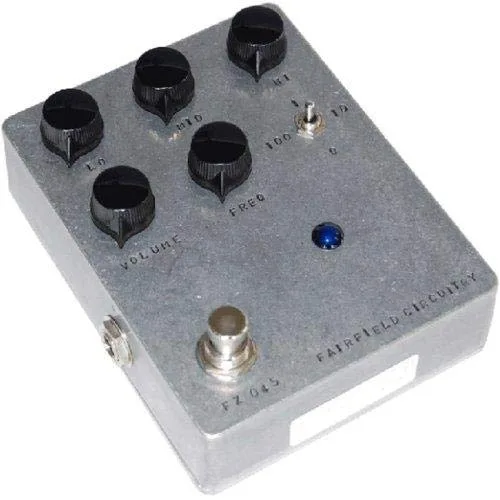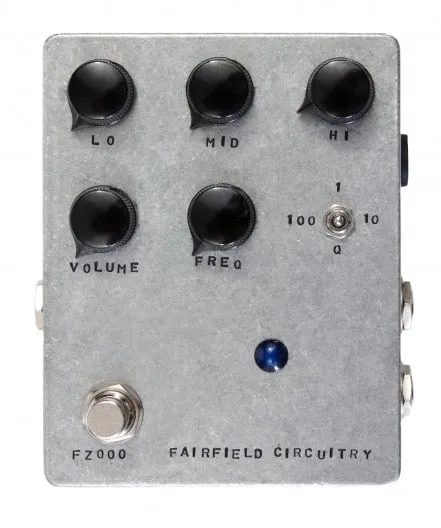


The Fairfield Circuitry Four Eyes Crossover Fuzz is a fuzz pedal that splits your signal into three frequency bands and fuzzes each one separately, then puts it back together. Instead of a tone knob, the whole circuit is shaped by a voltage controlled state variable filter with a resonance control, which is what gives the pedal its range: Delicious Audio described it as "yielding everything from classic fat sputtery tones to burpy synth-like textures to cocked-wah filtered noise"1.
How the crossover design works
Most fuzz pedals hit the whole signal with one fuzz circuit. The Four Eyes instead runs the signal through low pass, band pass and high pass filters, and each of the three outputs feeds its own fuzz circuit through a drive pot2. That means the amount of fuzz applied to the lows, mids and highs can be set independently, which is where the pedal's range of sounds comes from.
The three circuits are then governed by a state variable filter rather than a tone knob, with the filter's sweep regulated by a resonance knob1. Delicious Audio's Gus Green summed up the circuit this way in his 2013 review:
"consisting of three parallel JFET fuzz circuits driven by a voltage controlled state variable filter with resonance control and mu-amp input stage"
On the sound of the fuzz circuits themselves, Green found them "extremely organic and creamy"2.
The controls
| Control | What it does |
|---|---|
| LO | Drives the fuzz circuit of the low frequency band2 |
| MID | Drives the fuzz circuit of the mid frequency band2 |
| HI | Drives the fuzz circuit of the high frequency band2 |
| FREQ | Sets the cutoff or center frequency of the filter circuits2 |
| Resonance | Regulates the sweep of the state variable filter that controls all three circuits1 |
| Footswitch | Bypass2 |
Pedal of the Day's review describes the same three knobs as driving "the fuzz circuits of three filters (Low Pass, Band Pass and High Pass)"3, which lines up with Delicious Audio's account of the band split.
The expression input
The Four Eyes has an expression pedal or CV input for controlling the FREQ control2. Delicious Audio's earlier review also noted that "You can even control the interaction between the resonance and the filter with an expression pedal"1, and Pedal of the Day described an expression pedal input that can be used to control the resonance on the fly3. For a player, that means the filter sweep can be performed live rather than set and left, which is a large part of what separates this from a conventional fuzz pedal.
What reviewers said
Delicious Audio's Ed Gross found the pedal extremely tweakable, with a lot of control available from the three circuits, and noted that dialing in a fat fuzz tone with the Mid and Lo circuits while leaving the resonance alone may be as far as many users need to go1. Gus Green's verdict was stronger still: he wrote that Fairfield "took an overdone pedal genre like fuzz and made one of the most exciting pedals I've had the pleasure of using in a long time," and felt that overall everyone could find a use for it2.
Pedal of the Day, reviewing the pedal in 2016 under the Four Eyes Fuzz name, called it "not your grandpa's fuzz" and praised its versatility, saying it lets you "dial in a plethora of differing fuzz sounds for all kinds of musical genres"3.
Four Eyes Fuzz and the ~900
Videos
ProGuitarShopDemos
Fairfield Circuitry
Pedals and Effects
Questions
Is the Fairfield Circuitry Four Eyes discontinued?
Yes. Fairfield Circuitry's own product page for the ~900 describes that pedal as tracing its lineage back to the discontinued Four Eyes Fuzz, and Guitar World likewise referred to the Four Eyes fuzz as discontinued when the ~900 was announced in 2021. The pedal is no longer in production, so players looking for one today are dealing with a used or NOS market.
Can you use an expression pedal with the Four Eyes?
Yes. Delicious Audio's review describes an expression pedal or CV input for controlling the FREQ control, and notes that you can control the interaction between the resonance and the filter with an expression pedal. Pedal of the Day's review of the Four Eyes Fuzz likewise mentions an expression pedal input that can be used to control the resonance on the fly.
What do the Lo, Mid and Hi circuits do on the Four Eyes?
The Four Eyes splits the signal into three frequency bands, low pass, band pass and high pass, and each band feeds its own fuzz circuit. The LO, MID and HI knobs drive the fuzz circuit of their respective frequency bands, so you can set how much fuzz each band gets independently rather than fuzzing the whole signal at once.
Are the Four Eyes Fuzz and the Four Eyes Crossover Fuzz the same pedal?
The names refer to the same discontinued Fairfield Circuitry pedal. Reviews of the period call it the Four Eyes Crossover Fuzz, while later coverage, including Pedal of the Day in 2016 and Fairfield Circuitry's own page for the ~900, calls it the Four Eyes Fuzz. Both describe the same crossover fuzz design with three parallel fuzz circuits.
Sources (3)
- Fairfield Circuitry Four Eyes Crossover Fuzz, Delicious Audio, 2011-01-26
- Guitar Pedal Reviews: Fairfield Circuitry Four Eyes, Delicious Audio, 2013-06-19
- Fairfield Circuitry Four Eyes Fuzz, Pedal of the Day, 2016-01-24