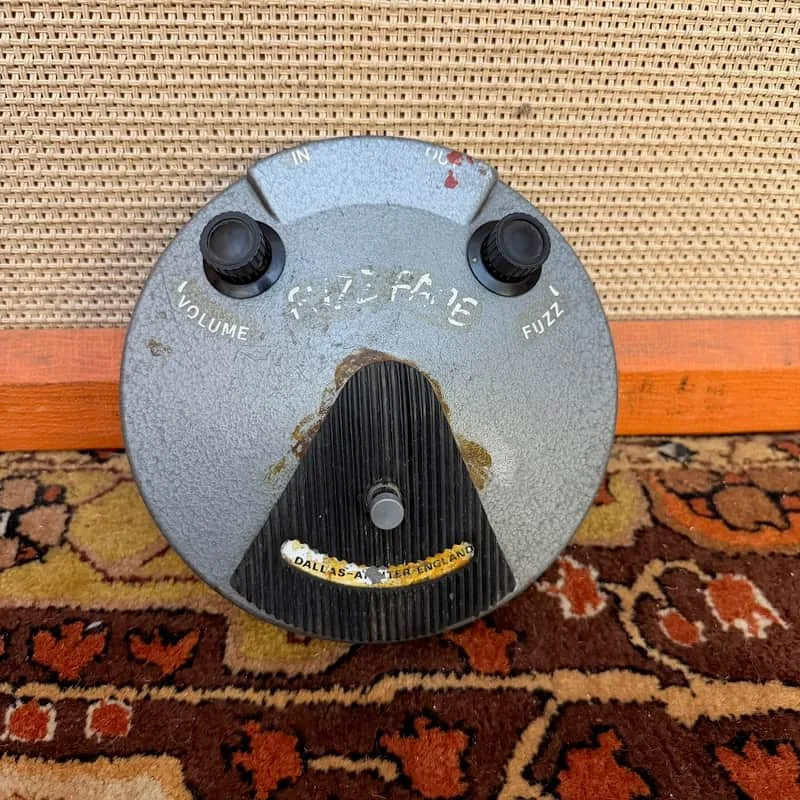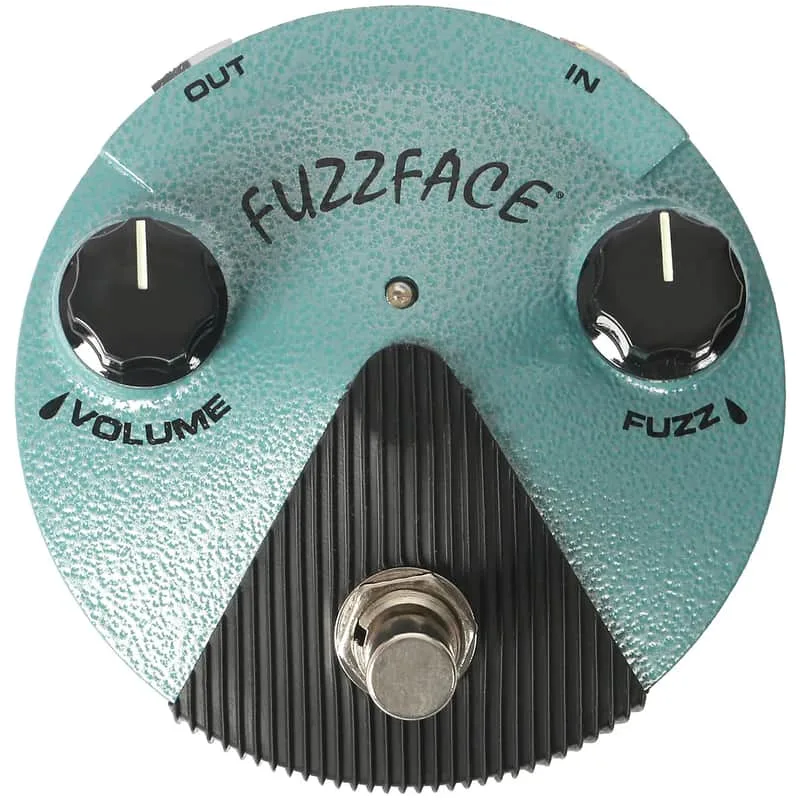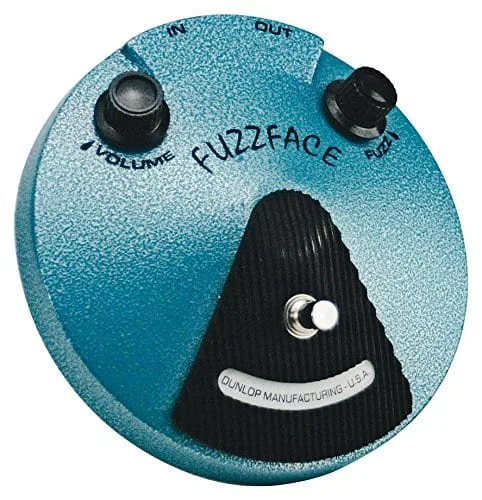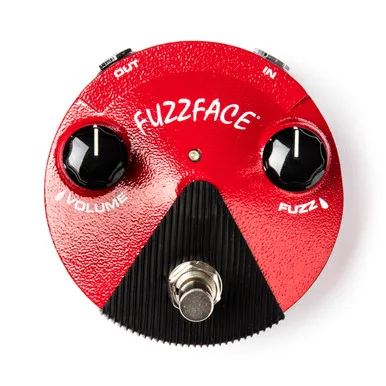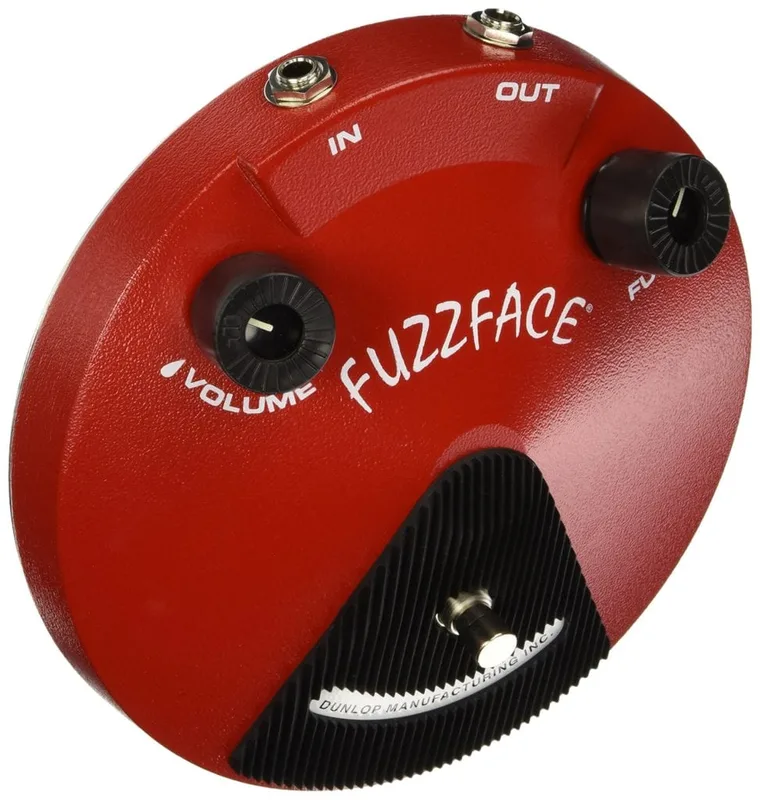


The Dunlop Fuzz Face is a fuzz/distortion pedal built to the exact specs of the original Dallas-Arbiter Fuzz Face, the round, face-shaped stompbox first made available in 196612. The current JDF2 model is constructed to vintage specs around the original Germanium PNP transistor design, which Dunlop describes as giving "a rich, creamy fuzz sound"3. In stompbox lore, as Dunlop's own page puts it, "the Fuzz Face Distortion sits among the icons"3.
The circuit behind it is one of the simplest fuzz designs ever sold: two transistors, where competitors like the Maestro Fuzz Tone and Sola Sound Tone Bender used three45. That simplicity is part of why it reacts so strongly to the guitar plugged into it. Animals Pedal describes the Fuzz Face as producing a thick, fat fuzz sound with "the expressive ability to change to sparkling clean using only the guitar's Volume"6.
What the Fuzz Face does
The Fuzz Face produces a characteristic high distorted sound called fuzz4. It was one of the first fuzz pedals, arriving in the mid to late 1960s when there were not many distortion pedals around at all, and it became very popular because Jimi Hendrix played it84. JHS Pedals claims that since the early days of rock and roll, "no other pedal has made its way on more recordings, stages, and rigs than the classic Fuzz Face"9.
The circuit works by driving two transistors into clipping. In the original design the input stage's theoretical gain of about 49 dB is reduced to roughly 18.6 dB by the feedback network, and the 2.2uF input capacitor blocks any DC level, removing hum and protecting both pedal and guitar4. The 33KΩ resistor at the input sets the main stage parameters: voltage gain, bias points, and maximum collector current4. A 20uF bypass capacitor is large enough that almost all frequencies get full amplification4.
A practical point for pedalboard builders: the original round housing is big. Guitar World noted that using right-angle plugs, you can fit all three Fuzz Face Minis into a space only a little larger than the footprint of one original Fuzz Face10.
The controls: Volume and Fuzz
There are only two knobs, and Dunlop's manual describes them plainly1:
| Control | What it does |
|---|---|
| VOLUME | Controls overall effect volume1 |
| FUZZ | Controls the amount of fuzz1 |
| FOOTSWITCH | Toggles the effect on and bypass1 |
The original circuit used a 1KΩ linear Fuzz pot and a 500KΩ audio-taper Volume pot4. One quirk carried over from the originals: the 1K linear "Fuzz" pot put almost all of its action into the last 25% of the rotation, so most of the change happens right at the top of the knob's travel11. On the Joe Bonamassa signature version, the Volume pot is a log pot whose resistance drops aggressively rotating counterclockwise from full, so the pedal gets quiet quickly when you lower it12.
Dunlop's directions for use are as simple as the controls: run a cable from your guitar to the Fuzz Face's Input jack, and another from its Output jack to your amplifier1.
The standard JDF2 Fuzz Face runs on one 9-volt battery only, with no adapter jack; you remove the bottom plate to install it31. If you need adapter power, the Fuzz Face Mini line adds an AC power jack and a battery door10.
Germanium and silicon versions
The Fuzz Face story is really two circuits. The original units used PNP germanium transistors (the AC128 in the first releases), and production later switched to the cheaper, temperature-stable NPN silicon types such as the BC108C and BC109C42. Germanium fully gave way to silicon by 1969, and Arbiter never looked back13. Dunlop has released both germanium and silicon transistor versions to cater to different preferences14.
The two types behave differently, and players describe the difference consistently:
- Germanium: claimed to have a warmer, creamier, smoother sound4; Guitar World's reviewer found the Germanium Mini "sounds sweeter and darker"10
- Silicon: higher gain, a bit harsher with some more high end4; Analog Man describes the silicon versions as fuzzier and brighter than germaniums15
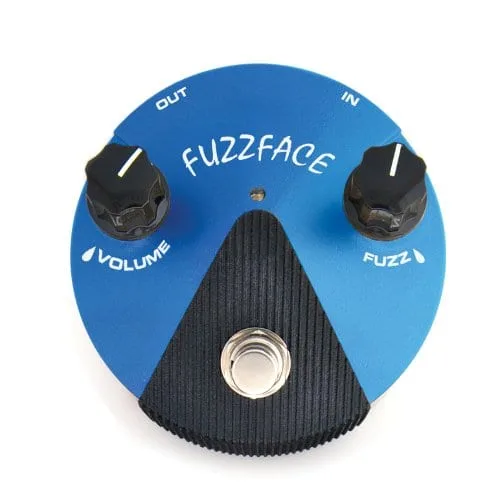
Dunlop's current lineup splits along these lines. The JDF2 standard model uses the Germanium PNP design3. The JHF1 Jimi Hendrix model is built around the BC108 silicon transistor7. The FFM2 Germanium Mini is based on the '66 to '68 era pre-silicon Fuzz Faces, "famous for warm vintage fuzz tones provided by slightly mismatched germanium transistors"1617. The FFM1 Silicon Mini is spec'd from a 1970 Fuzz Face in Dunlop's own collection, prized for its bright and aggressive sound from matched BC108 silicon transistors18.
| Model | Transistors | Basis |
|---|---|---|
| JDF2 Fuzz Face | Germanium PNP3 | Exact specs of the original Dallas-Arbiter Fuzz Face1 |
| Jimi Hendrix Fuzz Face | BC108 silicon192021 | 1969 to 1970 Dallas Arbiter Fuzz Face2022 |
| FFM2 Germanium Mini | Slightly mismatched germanium17 | '66 to '68 era pre-silicon Fuzz Faces16 |
| FFM1 Silicon Mini | Matched BC108 silicon18 | A 1970 Fuzz Face in Dunlop's collection18 |
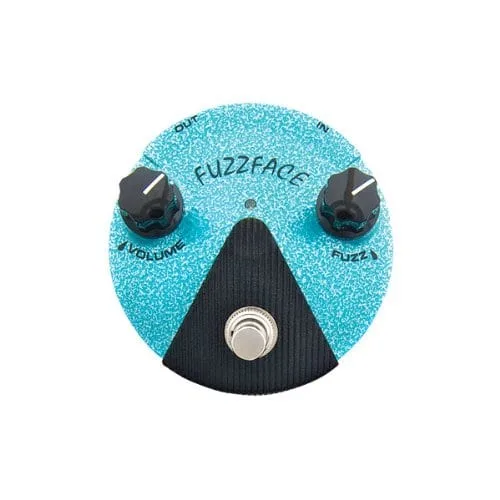
| FFM3 Jimi Hendrix Mini | Same tones as the JHF123 | Thick, smooth Fuzz Face tone Hendrix made famous24 |
Guitar World noted in 2014 that Dunlop offers three flavors of the Fuzz Face Mini, Germanium, Silicon and Jimi Hendrix, in red, blue and turquoise cases respectively, all with volume and fuzz controls, true-bypass switching, a status LED, an AC power jack and an easy-access battery door, in a housing less than one-third the overall size of the original10.
History: from Arbiter to Dunlop
The Fuzz Face was created in 1966 by Arbiter Electronics in London14. The designer was Ivor Arbiter, a salesman who saw the rising British rock scene demanding fuzz; after seeing the circular base of a mic stand, he put the effect in a similar round enclosure and gave it a face, with two eyes made of knobs, a footswitch nose, and a brand label mouth13. Around 1966 several fuzz boxes appeared on the market, including the Dallas Arbiter Fuzz Face, all featuring a two-transistor circuit5.
Arbiter Electronics manufactured the pedal from 1966 to 1975, Dallas Music Industries did a final batch in 1975 to 1977, and after that production stopped419. The pedal was re-issued from 1986 to 2000, and Dunlop Guitar Accessories reissued it in the early 1990s42.
Dunlop's own reissue history is uneven, and Analog Man tracked it in detail. The 1993 version "was not good sounding when it came out in '93," using reproduction NKT-275 transistors with a very thin, stuttery sound15. By 1997 Dunlop used different transistors in the high-gain position, and they sounded pretty good15. By 1998 Dunlop was back to two NKT-275 transistors that sounded pretty decent, made to work by adding an extra resistor on the back of the board15. The 2000 version mounted the switch to the board with several circuit changes and two trim pots15.
What reviewers said
Guitar World reviewed the three Fuzz Face Minis in 2014 and concluded that "the three Fuzz Face Mini pedals provide three distinct classic fuzz flavors that deserve spots on your pedal board"10. The same review found the Germanium version "sounds sweeter and darker" than its siblings10.
Of the Joe Bonamassa signature JBF-3, a tweaked positive-ground Fuzz Face using Russian germanium transistors, a builder who cloned the circuit reported: "The circuit sounds great. It's especially good in front of a dirty amp like a Vox AC-15 or a Marshall"212. The same builder found that with lower gain transistors it is "nice, not so over the top. circuit definitely works as it should"12. The JBF-3 is voiced specifically for Bonamassa's humbucker-driven tone, adding sustain and thickness12.
A known issue with silicon versions: silicon Fuzz Faces are prone to oscillation, and the JBF-3 adds a 10r resistor between the Fuzz 2 pot and the 22u cap to prevent oscillation when the Fuzz pot is fully clockwise12.
Who uses it
Jimi Hendrix is the player the Fuzz Face is most associated with. Dunlop's JHF1 reproduces the 1969 to 1970 Dallas Arbiter Fuzz Face he used on classic albums such as Electric Ladyland2022, and the Stompbox Book identifies it as the pedal he used on "Foxy Lady"25. Dunlop's Authentic Hendrix '68 Shrine Series model is built to capture both the aggressive silicon-based crunch of his later career and the warm, smooth germanium saturation of his early years26.
Beyond Hendrix, JHS Pedals names Jack White, Eric Clapton, David Gilmour, and Eric Johnson as players who have used the circuit on countless albums13. General Guitar Gadgets notes that Eric Johnson is known to use a silicon transistor version with excellent tone results27.
Related pedals
Dunlop's Fuzz Face family extends beyond the standard and Mini models. The Band of Gypsys Fuzz Face Mini (FFM6) targets the aggressive, biting fuzz tone Hendrix used at some of his most iconic live performances, in a mini housing with a status LED, AC power jack and battery door28. The Jimi Hendrix '69 Psych Series model adds a SI/GE switch that engages the warm, smooth germanium saturation of his early years26. The Authentic Hendrix '68 Shrine Series edition features buffered bypass switching for a greater range of tones and full cooperation with wah pedals such as the Jimi Hendrix Cry Baby, with a Buffer switch that allows true bypass for tonal purists26.
Videos
News
Questions
Does the Dunlop Fuzz Face take a power supply or only a battery?
The standard Dunlop Fuzz Face Distortion (JDF2) can only be powered by one 9-volt battery, which is not included. You remove the bottom plate to install it. The Fuzz Face Mini pedals are different: they take a 9-volt battery through an easy-access door, or a Dunlop ECB003 9-volt adapter, or a DC Brick power supply.
Why does my Fuzz Face squeal with a wah pedal?
Silicon Fuzz Faces are prone to oscillation, and the interaction with a wah in front of them can set it off. Dunlop addressed this in the Authentic Hendrix '68 Shrine Series Fuzz Face by using buffered bypass switching, which the maker says gives full cooperation with wah pedals such as the Jimi Hendrix Cry Baby, with a Buffer switch for true bypass if you prefer.
Where should a Fuzz Face go in the signal chain?
Dunlop's own directions are to run a cable from your guitar straight to the Fuzz Face's Input jack, and another from its Output jack to your amplifier, so it sits first in the chain, directly after the guitar. Fuzz Face circuits are sensitive to what feeds them, which is why the maker puts it that simply.
Why does the Fuzz Face clean up when I roll back my guitar volume?
The Fuzz Face is known for its expressive ability to change from thick fuzz to sparkling clean using only the guitar's Volume knob. The circuit's input stage gain is set low by its feedback network, so a weaker signal from rolled-back volume pushes the transistors less, and the fuzz backs off with it.
Did Jimi Hendrix use a germanium or silicon Fuzz Face?
Both. Dunlop says the Jimi Hendrix Fuzz Face Distortion reproduces the 1969 to 1970 Dallas Arbiter Fuzz Face he used on albums such as Electric Ladyland, and that pedal is built around the BC108 silicon transistor. Dunlop also notes he used germanium-based fuzz in his early years and silicon later in his career.
Why do vintage Fuzz Faces sound different from each other?
Germanium transistors varied widely from unit to unit, and Dallas Arbiter used whatever was available. The best-sounding original units pair a low-gain transistor in the first stage with a high-gain one in the second, and Dunlop's germanium Mini uses slightly mismatched transistors on purpose to get that vintage variation.
Sources (28)
- JDF2.pdf, Dunlop Manufacturing, Inc., 2019
- Microsoft Word, Georgia Institute of Technology (hosted at guitarpcb.com), 2006-05
- FUZZ FACE® DISTORTION, Dunlop (www.jimdunlop.com)
- Fuzz Face Analysis, GuitarPCB
- Tone Bender History, British Pedal Company
- Custom Illustrated ABFF アカサカハル #06, Animals Pedal
- JHF1.pdf, Dunlop Manufacturing, Inc., 2019
- SFNPNManual-Germ, analogman.com, 2026-08
- POLLINATOR HAND PAINT, JHS Pedals
- Review: Dunlop Fuzz Face Mini Pedals, Guitar World, 2014-04-15
- You Can Build the Perfect Germanium Fuzz, GuitarPCB
- Guitar FX Layouts: Dunlop JBF-3 Joe Bonamassa Fuzz Face, tagboardeffects.blogspot.com (Guitar FX Layouts), 2014-07-14
- SMILEY - JHS Pedals, JHS Pedals
- The guitar pedal that changed the world the Fuzz Face, Tru-Fi (tru-fi.com)
- Analog Man Sun Face and Fuzz Face Page, Analog Man (www.analogman.com), 2026
- GERMANIUM FUZZ FACE® MINI DISTORTION, Dunlop (www.jimdunlop.com)
- FFM2.pdf, Dunlop Manufacturing, Inc., 2019
- SILICON FUZZ FACE® MINI DISTORTION, Dunlop (jimdunlop.com)
- IN PRAISE OF: Fuzz Face, MusicRadar, 2012-12-05
- JIMI HENDRIX® FUZZ FACE® DISTORTION, Dunlop (jimdunlop.com)
- Zero to Sixties in Five Pedals: Five Modern Effects that Conjure Far-Out, Vintage Tones, Guitar World, 2015-06-29
- Arbiter Fuzz Face • Fuzzboxes, fuzzboxes.org, 2021-05-12
- JIMI HENDRIX® FUZZ FACE® MINI DISTORTION, Dunlop (jimdunlop.com)
- FFM3.pdf, Dunlop Manufacturing, Inc., 2019
- Stompbox 101, For Real: Learning to Build Pedals the Classy Way at Roberto-Venn, Stompbox Book, 2019-04-18
- AUTHENTIC HENDRIX™ '68 SHRINE SERIES FUZZ FACE® DISTORTION, Jim Dunlop (jimdunlop.com)
- Fuzz Face™ Clone Kit: Germanium or Silicon, Five Versions, General Guitar Gadgets, 2014-05-14
- BAND OF GYPSYS™ FUZZ FACE® MINI DISTORTION, Dunlop (jimdunlop.com)