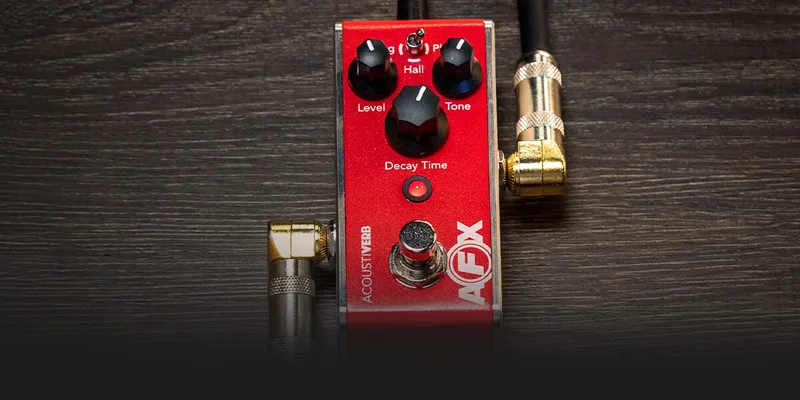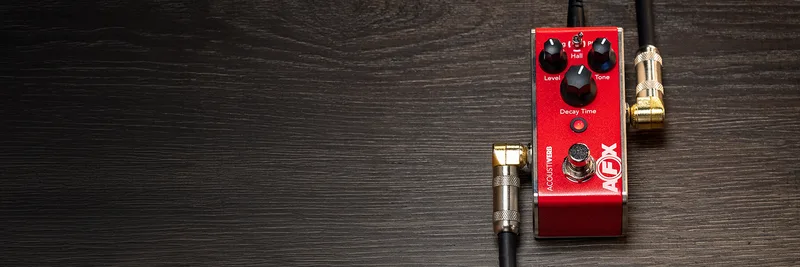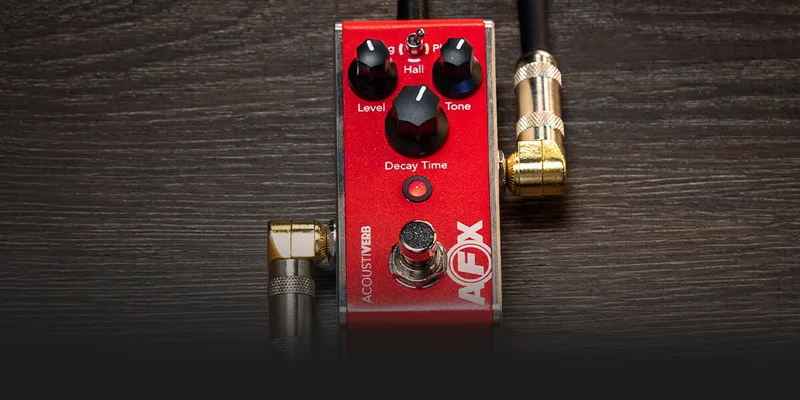


The Fishman AFX AcoustiVerb Mini is a reverb pedal built for acoustic instruments, with a Decay Time control that determines how quickly the reverb tail decays into silence1. It sits in a durable aluminum enclosure measuring 1.9 inches wide by 3.8 inches deep by 1.92 inches high, and it uses digital DSP with an analog signal path1. Its 1/4 inch TRS input and output enable Dual Path functionality1.
Three reverbs, one small box
The pedal's reverb types cover the three shapes acoustic players reach for most. A mini-switch on the unit toggles between them2.
| Mode | What Fishman says it does |
|---|---|
| Spring | Recreates the classic sound of a spring reverb found in many electric guitar amplifiers1 |
| Hall | An all-around reverb with natural, resonant spaces capable of replicating rooms both small and large, with long reverb decay times1 |
| Plate | Recreates the dense reflections and metallic characteristics of mechanical plate reverbs used throughout the 50's, 60's and 70's1 |
RockBoard's PedalPedia entry for the full-size AcoustiVerb notes that all three studio-grade reverb patches were precisely tweaked by Fishman for the acoustic-electric guitarist3. For a broader look at the effect category, see reverb pedals.
The controls
The control set is deliberately small. There is a mini-switch to toggle between the reverbs, along with level and tone knobs positioned left and right, and a larger knob to control decay time2. The controls only manipulate the affected sound, not the direct audio2. RockBoard calls the three-knob design, comprised of Level, Tone, and Decay Time, a straightforward operation that is easy to quickly tweak onstage3.
| Control | What it does |
|---|---|
| Reverb Select switch | Quick access to the three reverb effects: Spring, Hall and Plate1 |
| Level | Adjusts the effect level so you can balance it against your bypass volume1 |
| Reverb Time | Controls how long you hear the effect, ranging from short to very large spaces; it determines how quickly the reverb tail decays into silence1 |
| Tone | Adds brightness or warmth to the sound of the effect without altering your direct sound1 |
| Audio Path switch | Chooses the audio path on which the effect is processed1 |
A point that matters for acoustic players: the controls only manipulate the affected sound, not the direct audio, as Leslie noted in his review2. Your dry acoustic signal passes through untouched while the knobs shape only the reverb.
True bypass, buffered bypass and spillover
The AcoustiVerb Mini lets you choose its bypass behavior. In true bypass, the pedal's electronics are literally removed from the signal chain; for players who prefer a buffered bypass, a switch changes it over14. The choice has a practical consequence. When the pedal is in buffered mode and you press the footswitch to bypass the effect, the reverb continues to decay naturally instead of cutting off dead1. As Leslie put it in GuitarPlayer:
"the pedal lets the reverb spill over even after you hit the bypass button when it's in buffered mode"2
If you would rather have a full mute, holding the footswitch while applying power changes the spillover behavior1.
Power and connections
The pedal requires external 9V power; there is no battery option. Fishman specifies its 910-R (120VAC) or 910-U (230VAC) adapter, sold separately, or a suitable filtered and regulated supply with a 5.5mm outer diameter, 2.1mm inner diameter barrel connector, center negative. Typical current draw is 53mA1. RockBoard's spec listing confirms the same 9V, center negative, 53mA figures3.
Connections are a single 1/4 inch TRS input and a 1/4 inch TRS output, and the TRS wiring is what enables the Dual Path functionality selected by the Audio Path switch1.
The 53mA draw and the requirement for a filtered, regulated supply mean the pedal should be powered from a proper isolated or regulated supply rather than a simple daisy chain, and it cannot run on a battery.
Specifications
| Specification | Value |
|---|---|
| Signal processing | 32-bit1 |
| A/D, D/A conversion | 24-bit1 |
| Input impedance | 10M Ohm1 |
| Output impedance | 1k Ohm1 |
| Signal-to-noise | -100dB1 |
| Dynamic range | 100dB1 |
| Dimensions | 1.9" W x 3.8" D x 1.92" H (49mm W x 97mm D x 49mm H)1 |
| Enclosure | Durable aluminum1 |
Part of the AFX Mini series
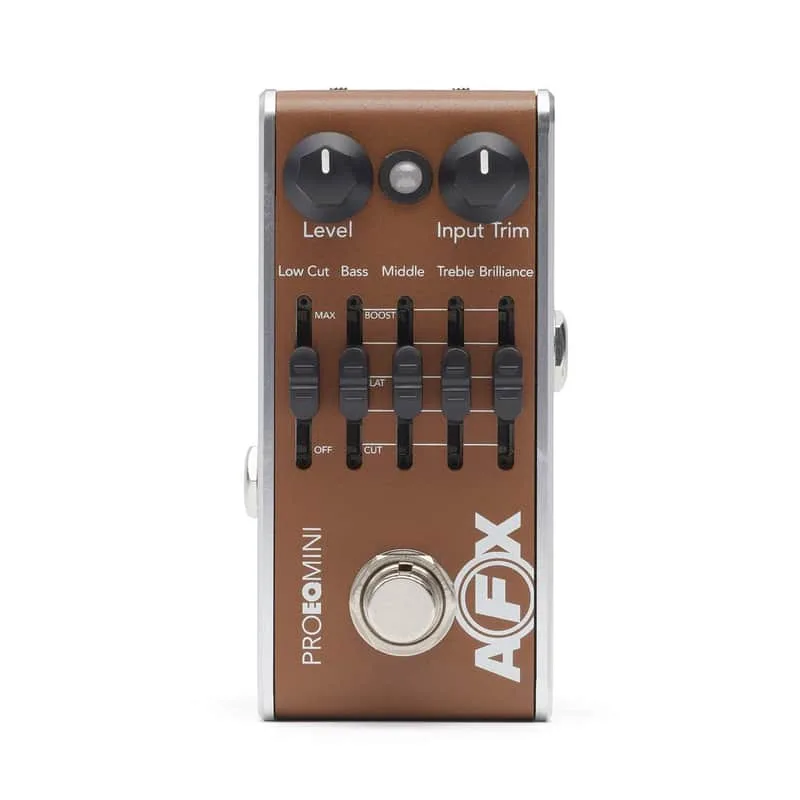
The AcoustiVerb Mini belongs to the Fishman AFX Mini Series, alongside the Pro EQ and Broken Record pedals5. The series was demoed together in a video titled "Fishman AFX Mini Series: AcoustiVerb, Pro EQ & Broken Record Demos"5.
Videos
Fishman Music
Fishman Music
Fabian Holland
Questions
Does the Fishman AcoustiVerb Mini have reverb spillover?
Yes. When the pedal is in buffered bypass mode, the reverb tail continues to decay naturally after you press the footswitch, instead of cutting off abruptly. If you prefer a full mute, hold the footswitch while applying power to change the behavior. In true bypass mode the effect is removed from the signal chain entirely.
Is the Fishman AcoustiVerb Mini true bypass or buffered?
It is both. The default is true bypass, where the pedal's electronics are removed from the signal chain. A switch lets you choose buffered bypass instead, which also enables the reverb spillover feature where the tail decays naturally when you bypass the effect.
What does the Audio Path switch do on the AcoustiVerb Mini?
The Audio Path switch lets you choose the audio path on which the effect is processed. The pedal has a 1/4 inch TRS input and output, and the TRS wiring enables Dual Path functionality, so you can route the effect differently depending on how your signal chain is wired.
Does the Fishman AcoustiVerb Mini take a battery?
No. The pedal requires external 9V power and has no battery option. Fishman recommends its 910-R or 910-U adapter, sold separately, or a filtered and regulated supply with a 5.5mm outer diameter, 2.1mm inner diameter barrel connector, center negative. Typical current draw is 53mA.
Can I use the AcoustiVerb Mini with an electric guitar?
The pedal is designed from the ground up for acoustic-electric guitar, with the three reverbs blended in parallel with your direct sound while preserving your acoustic tone. Its spring mode specifically recreates the spring reverb sound of electric guitar amplifiers, but Fishman positions the pedal for acoustic players.
Sources (5)
- AFX AcoustiVerb Mini Acoustic Guitar Reverb Pedal, Fishman
- Fishman AFX Mini Acoustic Pro EQ Mini, Broken Record, AcoustiVerb and Pocket Blender Effects Pedal Reviews, GuitarPlayer, 2023-08-18
- AFX AcoustiVerb by Fishman, RockBoard PedalPedia, 2026
- Fishman AFX Pedals True Bypass, Fishman
- Fishman AFX AcoustiVerb Review, Premier Guitar, 2023-10-16