

The Flattley DG Fuzz is a fuzz pedal from UK builder Flattley Guitar Pedals, part of the company's hand-painted Platinum Range. Its core is a well established two-transistor silicon fuzz arrangement from the early 1970s, using BC108 transistors, and it is inspired by the fuzz sounds Pink Floyd's David Gilmour adopted in the early 1970s12. What sets it apart from a vintage-style fuzz is the buffer and preamp in front of that core, which protects the fuzz circuit from input loading and adds a fourth control, Grunt, that shapes the signal before it is distorted2.
Delicious Audio describes the resulting sound as having "a warm tone and a big bottom end to it"2.
The controls: Volume, Fuzz, Tone and Grunt
The pedal carries four knobs plus a bypass footswitch. Guitar.com's reviewer Richard Purvis noted that "the first three look pretty self-explanatory, but it's the last one that promises something a little different"4.
| Control | What it does |
|---|---|
| Volume | Sets the output level1 |
| Fuzz | Sets the amount of fuzz, from drive sounds to fully saturated1 |
| Tone | At minimum, allows all frequencies through; turning it clockwise rolls off the bottom end and makes the top end more dominant1 |
| Grunt | Part of the internal buffer; works on the input signal before it hits the fuzz section, beefing up the signal that drives the fuzz1 |
The Grunt knob is the pedal's distinguishing control. Guitar World's reviewer Trevor Curwen explains that it "is part of the internal buffer and works on the input signal before it hits the fuzz section; basically," beefing up the signal that drives the fuzz1. Flattley's own description, quoted by Guitar.com, says it "allows the input signal frequency response to be varied before it is distorted by the fuzz section"4. In practice this means you can tune how the fuzz reacts to your guitar before the distortion happens, something an original Fuzz Face or Tone Bender never offered4.
Circuit and placement
The fuzz core is a two-transistor arrangement with roots in the Fuzz Face circuit of the late 1960s12. With BC108 transistors, Guitar World describes it as giving "a taste of that silicon Fuzz Face experience from drive sounds to fully saturated" fuzz1. The buffer and preamp sit in front of that core, protecting it from external input loading2.
Because the pedal includes an internal buffer, it does not have to sit first in your signal chain the way many vintage-style fuzz pedals do. Guitar World notes that "the inclusion of a buffer also means the pedal's placement in a chain can be more flexible"1.
The pedal is buffered rather than true bypass2. Power comes from a 9V DC adaptor, not supplied, drawing 50mA1.
History and versions
Flattley announced the DG Fuzz on 24 May 2023 as a dual pedal, pairing a fuzz with a simplified version of the company's The Ace booster, priced at £259 in the UK3. Guitar World's later review describes the current version in the same terms: "The brand says this new version of its DG Fuzz is effectively a double pedal," incorporating a simplified version of The Ace1.
The fuzz side's lineage is older. Guitar.com's review puts it plainly: "The roots of this pedal lie in the best fuzz pedals of the 1960s, but with a distinctly modern twist," namely the four-control layout that an original Fuzz Face or Tone Bender never had4.
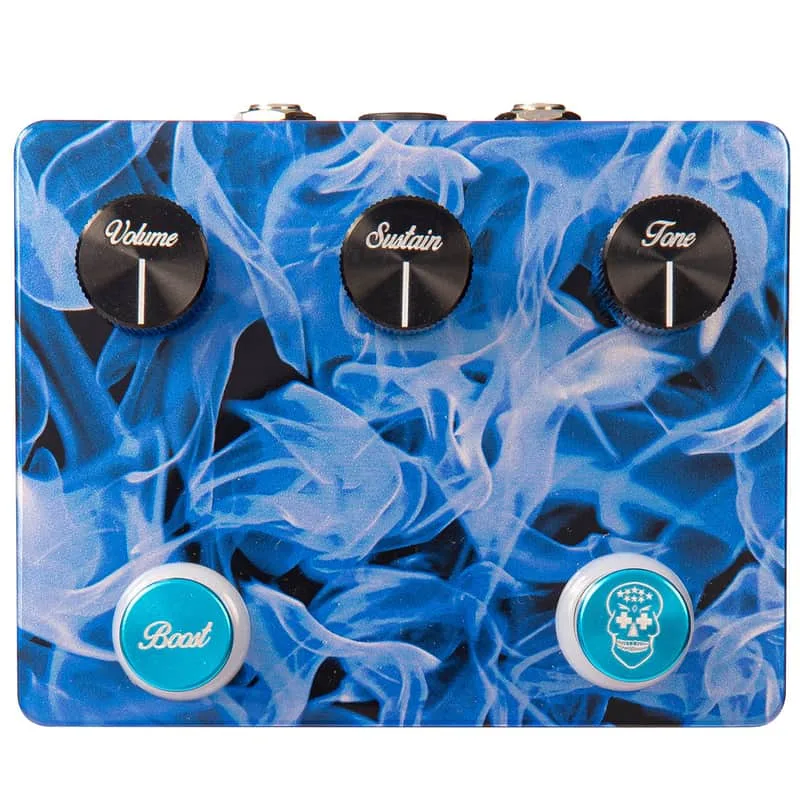
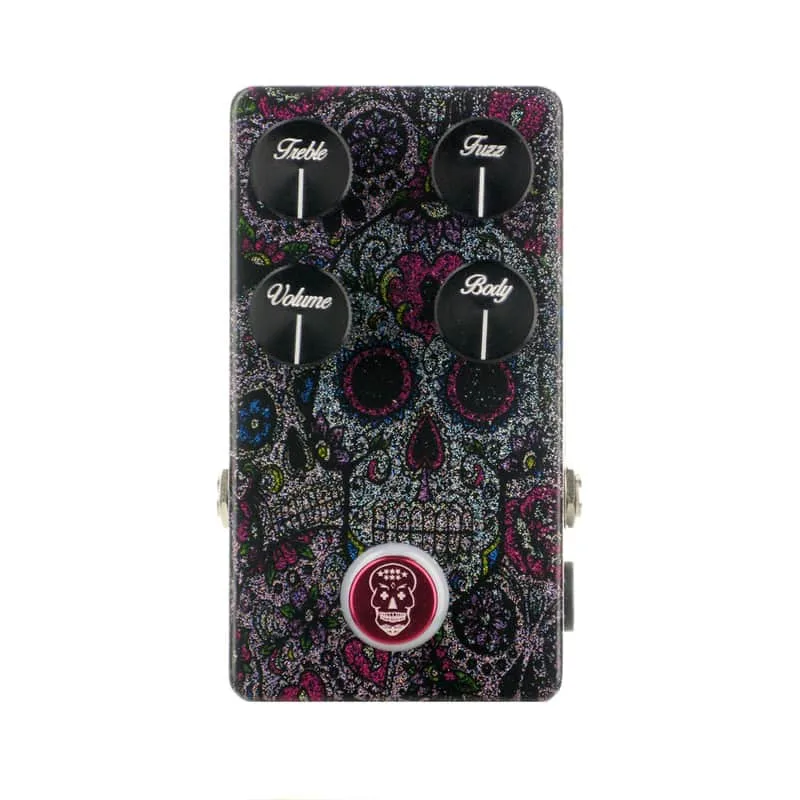
Like Flattley's other Platinum Range pedals, the DG Fuzz features a hand-painted process3. Delicious Audio details the finish: etch primer, base coats, metallic holographic chrome flake, hydro dipped graphics, three or more wet-sanded lacquer coats, and hand polishing to a high gloss2. The pedal also carries a blue halo light ring, which diffuses light when playing live so you are not blinded by a standard LED, and gives you a larger area to locate the pedal on a darkened stage2.
Flattley's fuzz line also includes the Flattley Solaris Pro, a Big Muff-style fuzz with an added boost footswitch, and the Flattley JK Fuzz. For more on the effect type generally, see fuzz pedals.
What reviewers said
The DG Fuzz is built in the UK and priced at £2591. Flattley fits it with a blue halo light ring that diffuses the light when playing live, so a player is not blinded by a standard LED and can find the pedal more easily on a darkened stage2.
"The roots of this pedal lie in the best fuzz pedals of the 1960s, but with a distinctly modern twist"
Videos
Flattley Guitar Pedals
Happy Mag
Eirik Stordrange
Questions
What does the Grunt knob do on the Flattley DG Fuzz?
The Grunt knob is part of the pedal's internal buffer and works on the input signal before it reaches the fuzz section, beefing up the signal that drives the fuzz. Flattley describes it as varying the input signal's frequency response before it is distorted, which is a control an original Fuzz Face never had.
What transistors are in the Flattley DG Fuzz?
The fuzz section uses BC108 transistors, the silicon type associated with the late-1960s Fuzz Face circuit the pedal is based on. The overall design is a two-transistor arrangement with a buffer/preamp in front of it that protects the core from external input loading.
Does the Flattley DG Fuzz have to go first in the signal chain?
No. The pedal includes an internal buffer, and Guitar World's reviewer notes that this means its placement in a chain can be more flexible, so it does not have to sit first the way many vintage-style fuzz pedals do.
How much current does the Flattley DG Fuzz draw?
It draws 50mA, running from a 9V DC adaptor that is not supplied with the pedal. That draw is high enough that a battery is not part of the design.
Is the Flattley DG Fuzz true bypass?
No, it is a buffered pedal. The buffer is also what makes the Grunt control possible, since the Grunt knob works on the input signal inside that buffer before it hits the fuzz section.
Sources (4)
- Flattley DG Fuzz review, Guitar World, 2024-03-01
- Flattley DG Fuzz, Delicious Audio, 2020-09-16
- The UK's Flattley Guitar Pedals releases new DG Fuzz, MusicRadar, 2023-05-24
- Flattley DG Fuzz review: A top-quality noise machine, Guitar.com, 2023-11-27