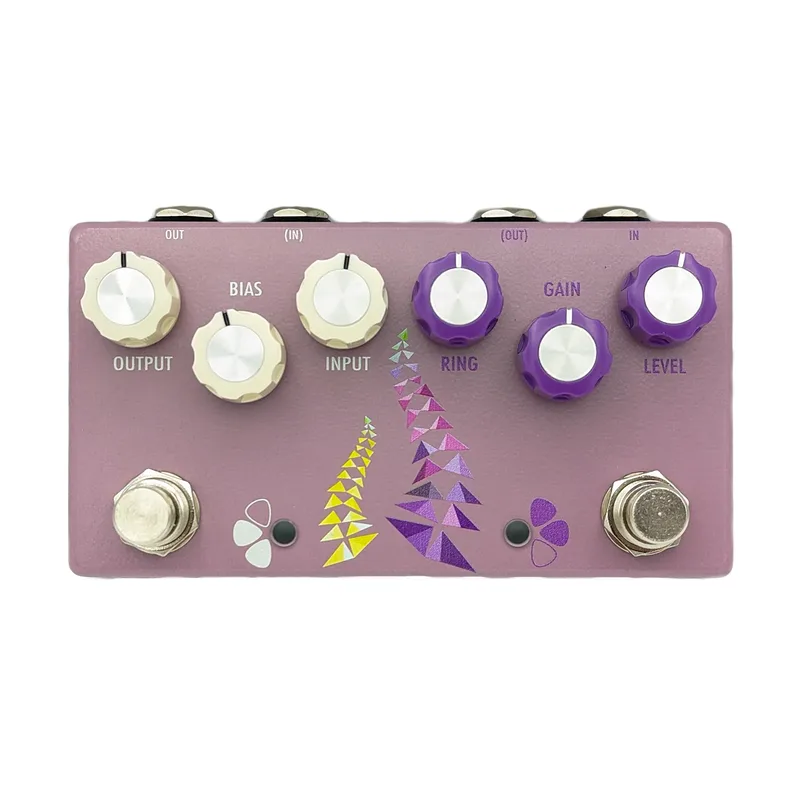



The Flower Pedals Lupine Dual Fuzz is a dual fuzz pedal that puts two distinct fuzz circuits in a single compact 125B enclosure: an analog octave-up fuzz on the Purple side and a JFET fuzz/overdrive on the Cream side1. Both circuits are analog, and the two sides can run together or separately, with extra jacks that let each one sit at a different point in your signal chain1. It is a current model with a list price of $199.00 USD1.
Two fuzzes in one box
The Purple side is an octave-up fuzz based on classic octave fuzz circuits. Flower Pedals describes it as delivering everything from sputtery, glitchy octave textures to piercing, full-bore octave fuzz1. The Cream side uses a JFET transistor topology and covers everything from light, amp-like overdrive to thick, compressed fuzz, so it reaches into overdrive territory as well as fuzz1. Each side also has its own page here: the Lupine Purple channel and the Lupine Cream channel.
Because the box carries two inputs and two outputs, the sides do not have to stay chained together internally. You can, for example, run one side early in the chain and the other after delay or modulation pedals, which is unusual for a dual fuzz1.
The controls
| Side | Control | What it does |
|---|---|---|
| Purple | Gain | New to this version; pushes the octave circuit from subtle shimmer to aggressive, harmonically rich saturation1 |
| Purple | Blend | Mixes between your clean signal and the octave circuit1 |
| Purple | Level | Sets the output volume1 |
| Cream | Input | Works like a guitar volume knob with treble bleed, controlling the signal hitting the gain stage1 |
| Cream | Bias | Sets the operating point of the main gain stage, from gated, sputtery fuzz to smooth, heavy saturation1 |
| Cream | Output | Controls the final level1 |
The Blend control is worth noting for bass players and anyone who wants to keep low end intact: it lets you dial the octave effect in against your clean signal rather than replacing it1.
Modes and footswitches
In its default arrangement the Lupine works as two independent fuzzes, each with its own footswitch. It also has a Single Fuzz mode: hold both footswitches at startup to use it as one pedal with an octave toggle1. In that mode, the left footswitch bypasses the entire pedal and the right footswitch toggles the octave circuit on and off1.
Power
Flower Pedals houses the Lupine in a 125B enclosure1. The maker's listing does not give a voltage or current draw for the pedal, so players pairing it with a shared supply should plan around that gap rather than assume a standard draw.
The Lupine draws under 100mA, so check the current available on your power supply's output before adding it to a daisy-chained or low-current slot.
Videos
Flower Pedals
60 Cycle Hum
collector//emitter
Questions
What power supply does the Flower Pedals Lupine need?
The Lupine runs on 9 to 18V DC center negative and draws less than 100mA, according to Flower Pedals. That wide voltage range means a standard 9V pedal supply works, and players who want more headroom can run it at higher voltages within that range. Because it draws under 100mA, most pedalboard power supplies with enough current on a given output can handle it.
Can I use the two sides of the Lupine in different places in my signal chain?
Yes. The Lupine has two inputs and two outputs, which Flower Pedals says are there for placing each side at different points in your signal chain. That means you could run the Cream side before other pedals and the Purple octave side after them, rather than keeping both fuzzes fixed in one order inside the box.
How do I turn on Single Fuzz mode on the Lupine?
Hold both footswitches at startup to put the Lupine into Single Fuzz mode, where it behaves as one pedal with an octave toggle. In that mode the left footswitch bypasses the entire pedal and the right footswitch toggles the octave circuit on and off, according to Flower Pedals.
Is the Lupine analog?
Yes. Flower Pedals lists the circuit type as analog, combining an octave-up fuzz with a JFET fuzz. Both sides are analog circuits in a single 125B enclosure.
What does the Bias knob do on the Cream side?
Bias sets the operating point of the Cream side's main gain stage. Flower Pedals describes its range as going from gated, sputtery fuzz to smooth, heavy saturation, so it shapes how the JFET circuit breaks up, from starved and choppy to thick and sustained.
What is new in this version of the Lupine?
The Gain control on the Purple side is new to this version. Flower Pedals says it lets you push the octave circuit from subtle shimmer to aggressive, harmonically rich saturation, adding a drive stage before the octave fuzz that earlier versions did not have.
Sources (1)
- Lupine Dual Fuzz, Flower Pedals