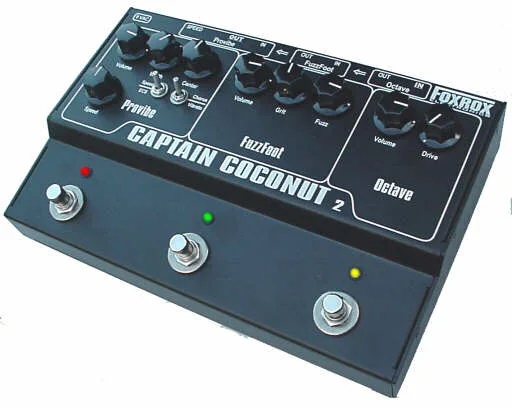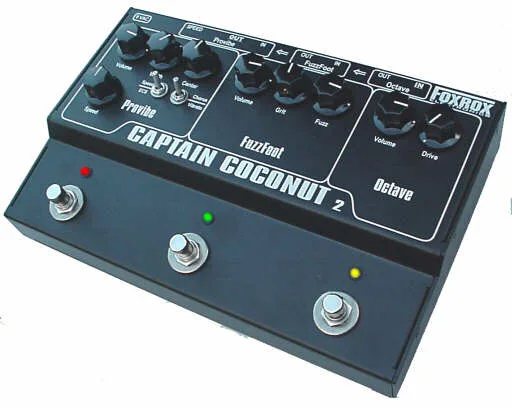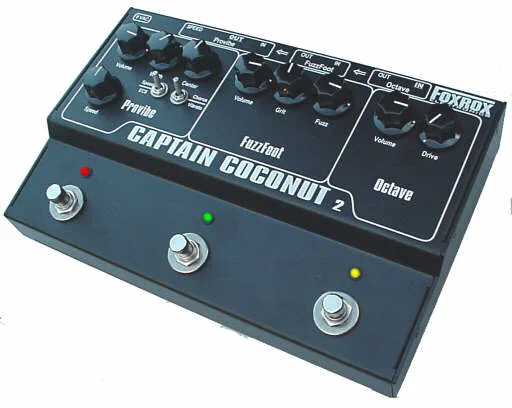

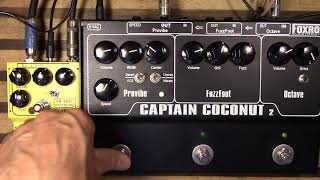
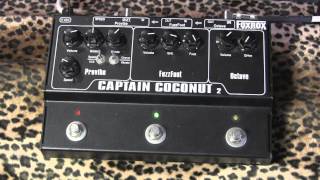
The Foxrox Captain Coconut 2 (CC2) is a three-in-one analog effects pedal that puts an Octavia, a Fuzz Face and a Uni-vibe in one box, delivering what its product page calls "the groovy sounds of Octave, Fuzz & Vibe"1. Designed by Dave Fox of Foxrox Electronics and sold through Analog Man, it duplicates three vintage circuits in a single unit: the original FuzzFace, the Tycobrahe Octavia and the Uni-vibe1. It is discontinued: Analog Man's page notes that as of August 2006 the pedals were no longer available because they were too much work to build1.
The CC2 is a big piece of steel. It measures 10" wide, 7" long and 3" tall, and weighs about 5 pounds1. It listed at $4001.
Octave, fuzz and vibe in one steel box
The idea behind the pedal, as the product page puts it, was "having three of my analog favorites: octavia, fuzz and univibe in one box"1. In a 2001 ToneQuest Report interview, Analog Mike described the Captain Coconut as "a 3 in 1 pedal -an Octavia, Univibe and Fuzz Face in one"2. The three sections carry their own names: the octave, fuzz and vibe circuits appear as the Octave, Fuzzfoot and Provibe sections1.
Vintage Guitar reviewed the original Captain Coconut in its February 2001 issue and described the circuits as faithful reproductions of the vintage originals3:
"incorporates faithful reproductions of the original circuits used in vintage effects like the Tycobrahe Octavia, Unicord"
The review noted the reproductions came with minor alterations to improve performance and cut noise3. The Fuzzfoot fuzz section carried three controls: Volume, Grit and Drive3.
The FuzzCard
The CC2's fuzz section is modular. The FuzzCard is a plug-in circuit board that contains all of the fuzz circuitry1. Rather than a fixed fuzz circuit, the card can be swapped, which distinguishes the CC2 from single-circuit fuzz pedals and from most multi-effects pedals.
Power: 9V AC, 500mA or more
The CC2 uses 9 volts AC, not DC, and cannot use a normal 9V DC power supply1. It needs an AC output of 500mA or more on a 2.5mm power plug1. Because the supply is AC, there is no polarity to observe1.
Each CC2 came with a 9VAC adapter for 120V USA power1, so players outside the US needed a suitable local AC adapter. The original Captain Coconut also operated on AC power only, as Vintage Guitar's review noted3. This rules out battery power and ordinary daisy chains built for 9V DC pedals.
Expression pedal control
Dave Fox made the CC2 easier to use than the original: it can use any control pedal, an expression pedal rather than a volume pedal, though a volume pedal can be used with a Y-cable1. The original Captain Coconut had a separate jack to plug in a pedal for external operation of the vibe's Speed control3.
From the original Captain Coconut to the CC2
Dave Fox's company, Foxrox, came to market with the original Captain Coconut, which Vintage Guitar reported on in early 20013. The first Captain Coconut appeared in around 20004. Fox made the original for about a year before the CC2 followed, with a new enclosure and a new circuit board carrying changes and enhancements1.
The original ran in small batches. The first batch of only ten units was black; a few more were made at the end of the production run in black, red and light blue, and the second batch was painted in a rich burgundy color1. Analog Man did not stock the pedals; delivery could take from one to four weeks depending on order volume2.
| Version | Notes |
|---|---|
| Captain Coconut (original) | Made for about a year; first batch of ten in black, later units in black, red and light blue, second batch in burgundy1 |
| Captain Coconut 2 | New enclosure and circuit board, changes and enhancements, FuzzCard fuzz, expression pedal control1 |
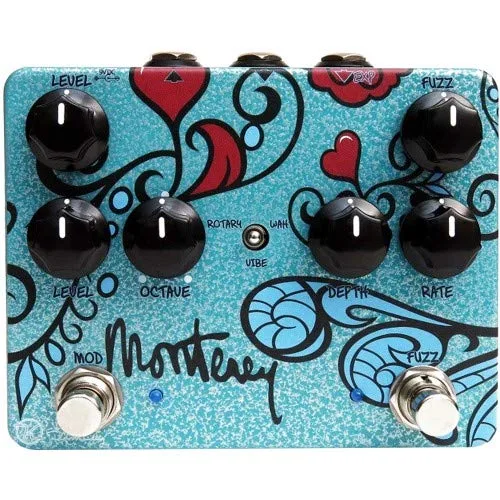
The CC2 was not the last pedal to gather these three effects in one box. Gearnews, writing about the Keeley Monterey in 2016, noted "the FoxRox Electronics Captain Coconut and Captain Coconut 2 boutique pedals that have done a similar thing in the past"51.
Videos
FoxroxElectronics
FoxroxElectronics
gearmanndude
Questions
Does the Foxrox Captain Coconut 2 run on a 9V DC adapter?
No. The CC2 uses 9 volts AC, not DC, and cannot run on a normal 9V DC power supply. It needs an AC adapter rated at 500mA or more with a 2.5mm power plug. Each unit shipped with a 9VAC adapter for 120V USA power, so players outside the US needed a suitable local adapter.
What circuits does the Captain Coconut 2 copy?
The original FuzzFace, Octavia (Tycobrahe) and Uni-vibe circuits are basically duplicated in the CC2, according to the maker's page. Vintage Guitar described the original Captain Coconut as faithful reproductions of the Tycobrahe Octavia, Unicord Univibe and Dallas-Arbiter FuzzFace circuits, with minor alterations to improve performance and cut noise.
What is the FuzzCard?
The FuzzCard is a plug-in circuit board that contains all of the fuzz circuitry in the Captain Coconut 2. Because the fuzz section lives on a swappable card, the pedal's fuzz is modular rather than fixed, which sets it apart from single-circuit fuzz pedals.
Who designed the Captain Coconut 2?
Dave Fox designed it. His company, Foxrox, first came to market with the original Captain Coconut pedal, and he followed it with the CC2, which moved to a new enclosure and a new circuit board with changes and enhancements. The pedals were sold through Analog Man.
Is the Captain Coconut 2 still made?
No. Analog Man's page notes that as of August 2006 the pedals were no longer available because they were too much work to build. They now appear only on the used market. The original Captain Coconut was made for about a year before the CC2 replaced it.
Can you use an expression pedal with the Captain Coconut 2?
Yes. Dave Fox made the CC2 easier to use by letting it take any control pedal, meaning an expression pedal rather than a volume pedal, though a volume pedal can be used with a Y-cable. The original Captain Coconut had a separate jack for a pedal to control the vibe's Speed setting externally.
Sources (5)
- Captain Coconut, from aNaLoG.MaN, aNaLoG.MaN (analogman.com), 2020
- http:, ToneQuest Report (republished on analogman.com), 2001-11
- Foxrox Captain Coconut, Vintage Guitar magazine, 2001-05-11
- Guitar Pedal X, Guitar Pedal X, 2024-06-03
- Keeley Monterey pedal, gearnews.com, 2016-03-27