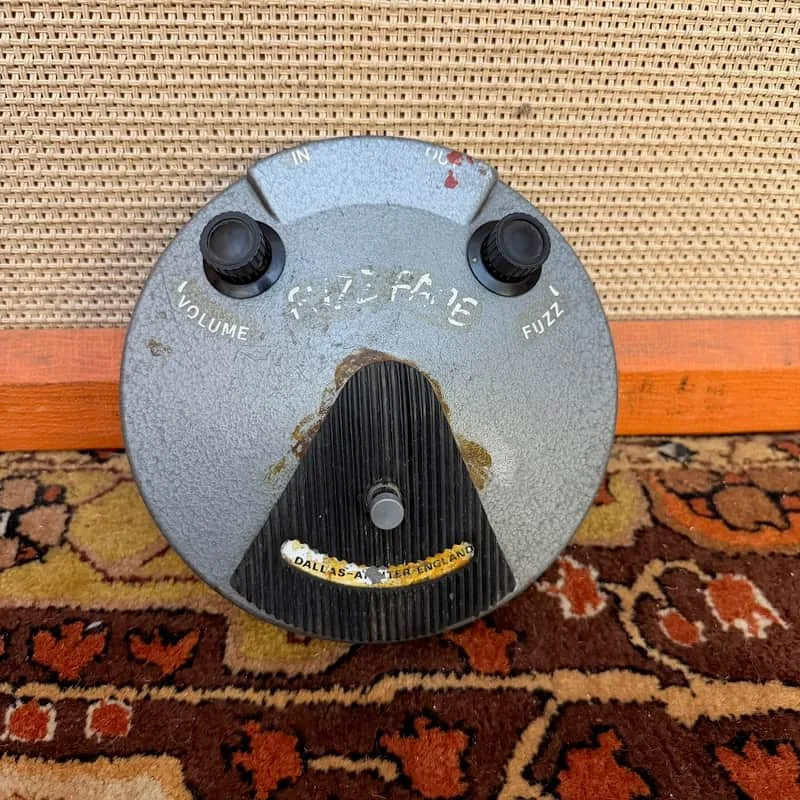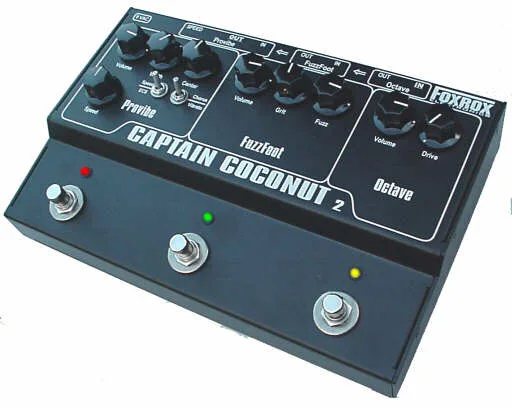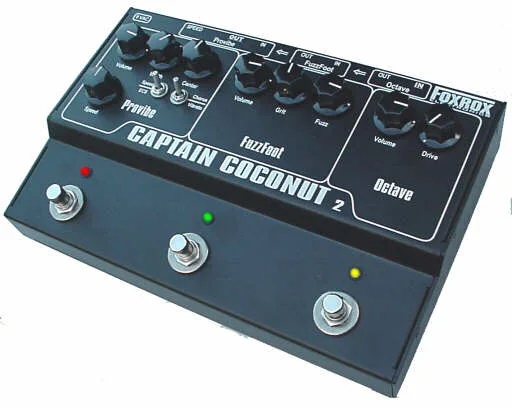


The Foxrox Captain Coconut is a three-in-one effects pedal: an Octavia, a Uni-Vibe and a Fuzz Face in one enclosure, designed by Dave Fox of Foxrox Electronics and sold through Analog Man1. It appeared around 2000, and Vintage Guitar magazine tested a recently-revised unit for its February 2001 issue, finding it considerably quieter than the original vintage pedals it reproduces23. The name comes from the last track on Jimi Hendrix's Crash Landing album2.
The pedal is totally analog, built around faithful reproductions of the original circuits used in vintage effects like the Tycobrahe Octavia, Unicord Uni-Vibe and Dallas-Arbiter Fuzz Face, with minor alterations to improve performance and cut noise2. Each of the three effects has its own true bypass on/off stomp switch, so you can run any combination of the three sections at once2.
The controls, section by section
The Captain Coconut is laid out as three separate effects in one box, each with its own controls and its own true bypass stomp switch2. Vintage Guitar's review breaks the control set down by section:
| Section | Controls | What it does |
|---|---|---|
| Octave | Volume, Drive | Octavia-style octave-up effect2 |
| FuzzFoot | Volume, Grit, Drive | Fuzz Face-style fuzz with an extra tone shaper2 |
| Provibe | Volume, Width, Center, Speed, Chorus/Vibrato switch | Uni-Vibe-style effect, the most controllable of the three2 |
The FuzzFoot's extra control is worth a note. Dave Fox describes "grit" as an additional tone shaper that is very interactive with the gain and volume knob, so small changes to the fuzz's drive and volume settings also change its character4.
The Provibe section offers the most control of the three. Its Center control works with the Width control to shape the sweep, and the Chorus/Vibrato switch selects between the two classic Uni-Vibe modes2. Fox also describes the shape knob on the vibe section as covering the different shades of vibe sound that other makers have molded their ideas around, with width and shape being very interactive4.
Power and connections
The pedal operates on AC power only, which rules out the standard 9V DC pedalboard supply most players use2. The follow-up Captain Coconut 2 moved to a 2.5mm power plug and shipped with a 9VAC adaptor for 120V USA power4.
For connections, the pedal has Master In and Out jacks for standard operation, but each effect also has its own individual input and output jacks, so the three sections can be used separately or reordered in a larger rig2.
There is also a jack on all Captain Coconut pedals for plugging in a speed control pedal for the vibe section, which replaces the Speed knob4. Vintage Guitar's review confirms a separate jack for external operation of the Speed control on the Provibe2. The CC1 needs a special control pedal like the original Uni-Vibe, built from a Dunlop wah or vibe control pedal with a dual 100K log pot and wiring; the CC2 was made easier to use and accepts any expression pedal, and a volume pedal can be used with a Y-cable4.
The circuits behind it and the original version
The original Fuzz Face, Octavia (Tycobrahe) and Uni-Vibe circuits are basically duplicated in the Captain Coconut, per Dave Fox's own description of the pedal4. Vintage Guitar's reviewer found the reproductions faithful, with minor alterations to improve performance and cut noise, and noted the distinct difference in noise levels between the original vintage pedals and the Captain Coconut, which is considerably quieter2.
The first Captain Coconut appeared in around 20003. Dave Fox had been building the original for about a year before introducing the Captain Coconut 2 as a follow-up with a new enclosure and a new circuit board with changes and enhancements4. The first batch of the original was tiny: only ten were made, in black, with a few more at the end of the production run in black, red and light blue; the second batch was painted in a rich burgundy color4.
Analog Man did not stock the pedal; ordering one meant a delivery wait of one to four weeks depending on order volume1. Analog Man also notes that a Teese RMC wah with the Foxrox Wah Retrofit, going into a Captain Coconut (1 or 2), delivers wah, fuzz, vibe and octave sounds, per the maker's note5.
Videos
FoxroxElectronics
Vintage Stompboxes
Robert DeVito
Questions
Where does the name Captain Coconut come from?
It is taken from the last track on Jimi Hendrix's Crash Landing album. Vintage Guitar magazine noted the name when it reviewed the pedal in its February 2001 issue.
Is the Foxrox Captain Coconut true bypass?
Yes. Vintage Guitar's review describes three individual true bypass on/off stomp switches, one for each effect, so each of the Octave, FuzzFoot and Provibe sections can be switched in and out independently.
Can the vibe speed be controlled with an expression pedal?
Yes. There is a jack for a speed control pedal that replaces the Speed knob. The CC1 needs a special control pedal like the original Uni-Vibe, built from a Dunlop wah or vibe control pedal with a dual 100K log pot, while the CC2 works with any standard expression pedal.
Is the Captain Coconut analog?
Yes. Vintage Guitar's reviewer described it as totally analog, built around faithful reproductions of the original Tycobrahe Octavia, Unicord Uni-Vibe and Dallas-Arbiter Fuzz Face circuits with minor alterations to improve performance and cut noise.
Can I still buy a Captain Coconut?
No. The original Captain Coconut was made for about a year starting around 2000, and the Captain Coconut 2 was discontinued in August 2006 because it was too much work to build. Both are long out of production.
Sources (5)
- http:, ToneQuest Report (republished on analogman.com), 2001-11
- Foxrox Captain Coconut, Vintage Guitar magazine, 2001-05-11
- Guitar Pedal X, Guitar Pedal X, 2024-06-03
- Captain Coconut, from aNaLoG.MaN, aNaLoG.MaN (analogman.com), 2020
- Foxrox Wah Retrofit, Analog Man (analogman.com), for Foxrox Electronics, 2015
 Mike Piera