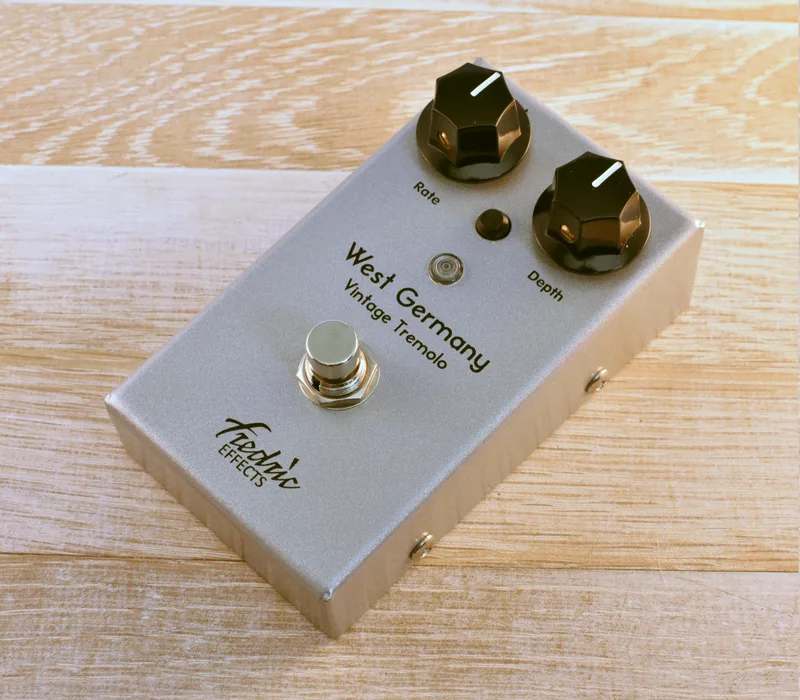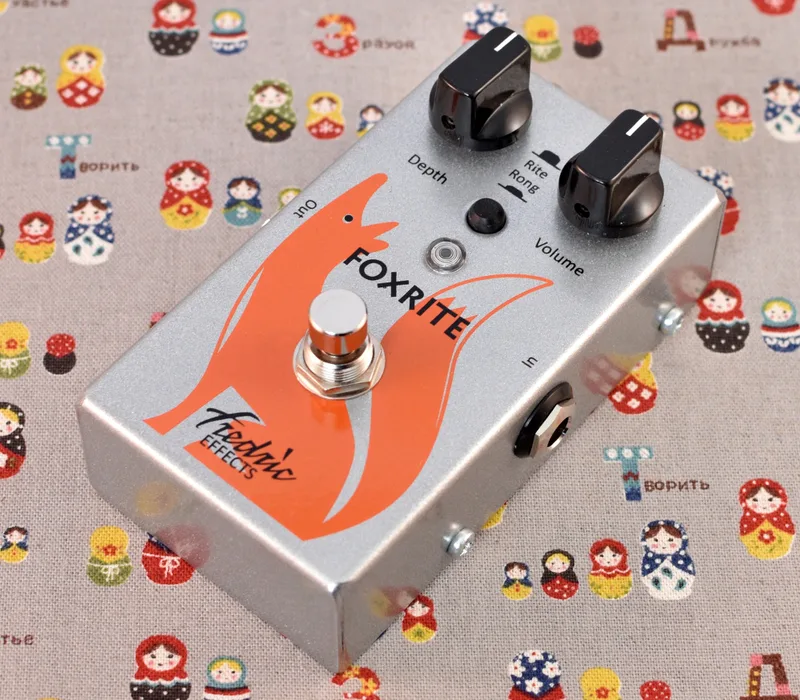


The Fredric Effects Foxrite is a fuzz pedal that recreates the late 60s silicon Mosrite Fuzzrite, a two-stage fuzz whose Depth knob blends in a second gain stage so it can move from trashy distortion to full fuzz12. Fredric Effects describes it as "an exact reconstruction of the original circuit, improved with the addition of a boost stage to bring the volume up to modern expectations"1. In the maker's words, it is "a uniquely abrasive effect - offering sounds from garagey distortion to full-on octavey, velcro-ripping fuzz"1.
The pedal is hand built in North London, in a folded metal enclosure custom made for Fredric Effects and powder coated with screen-printed artwork3. It is available direct from Fredric Effects and from selected shops and online retailers4.
A Fuzzrite clone with a boost stage
The original Mosrite Fuzzrite runs two gain stages, and its Depth knob blends in the second one. Delicious Audio's Griffin Jennings describes how "with its particular design that blends in a 2nd gain stage through the Depth knob, the Fuzzrite could go from trashy dis[tortion]" upward into heavier fuzz5. That single knob is what gives the circuit its range, from a rough, garage-style edge to a much denser fuzz.
Fredric Effects' reconstruction keeps that circuit intact but adds a boost stage, which the maker says brings the output volume "up to modern expectations"1. Vintage 60s fuzzes often run quieter than modern pedals, so the boost stage lets the Foxrite hold its level against the rest of a pedalboard. Premier Guitar's 2013 announcement of the original Foxrite described the same design: "It is a reconstruction of the original circuit, improved with the addition of a boost stage to bring the volume up to mo[dern levels]"2.
The components inside include a 2N3904 and two BC108A transistors, as noted in Guitar.com's review of the MkII3. Those are silicon transistors, matching the silicon version of the original Fuzzrite rather than the earlier germanium build.
The Rite/Rong switch
The Foxrite MkII features a central slider switch labeled "Rite" and "Rong"1. Guitar Interactive Magazine's Jonathan Graham reported at the MkII's announcement that the switch "adds greatly to the versatility of th[e effect]"4.
The two settings work like this:
| Setting | What it does |
|---|---|
| Rite | The vintage correct Fuzzrite circuit, as the original was built1 |
| Rong | A commonly used variation: the two gain stages stay in series, and the Depth control acts more like a conventional tone control, from doomy bass to raspy, spitting treble13 |
Guitar.com's reviewer found the second setting worthwhile:
"The rong setting adds great value, and makes the Foxrite more general-purpose without sacrificing sonic character"3
Guitar.com, on the Foxrite MkII3
In practice, Rite gives you the pedal as the 60s circuit behaved, while Rong trades some of that character for a more familiar tone-control sweep31.
History and versions: from Mosrite Fuzzrite to the MkII
The Mosrite Fuzzrite was designed by Ed Sanner and built between 1966 and 1968, with one version fitted with silicon transistors and the other with germanium components67. The silicon version seems to have been much more widespread, and it was also whitelabeled or cloned as the Orpheum Fuzz, the Guild Foxey Lady, and the Electro-Harmonix Axis Fuzz7. Premier Guitar's reviewer of a modern Fuzzrite recreation noted that "even among these sects, divisions over the merits of germanium and silicon versions persist" among fans of the circuit.
The original pedals went through several construction methods. Fuzzboxes' history of the Fuzzrite records that early versions were assembled on phenolic paper boards, with components soldered directly to one another "without the aid of any printed tracks, eyelets, or turrets," and that those pedals initially had red molded 100nF input, output and coupling capacitors8. Around 1967 to 1968 the Fuzzrites were assembled on a smaller eyelet board, and a 1968 version was built by Mosrite together with Sprague, with the circuits encased in orange Sprague "modules"8.
Fredric Effects released the original Foxrite in 2013, priced at £90 alongside the West Germany Vintage Tremolo2. The MkII followed, adding the Rite/Rong slider switch to the same circuit reconstruction and boost stage14. By 2015 the MkII carried a UK price of £953, and the maker's current listing prices it at £1401.
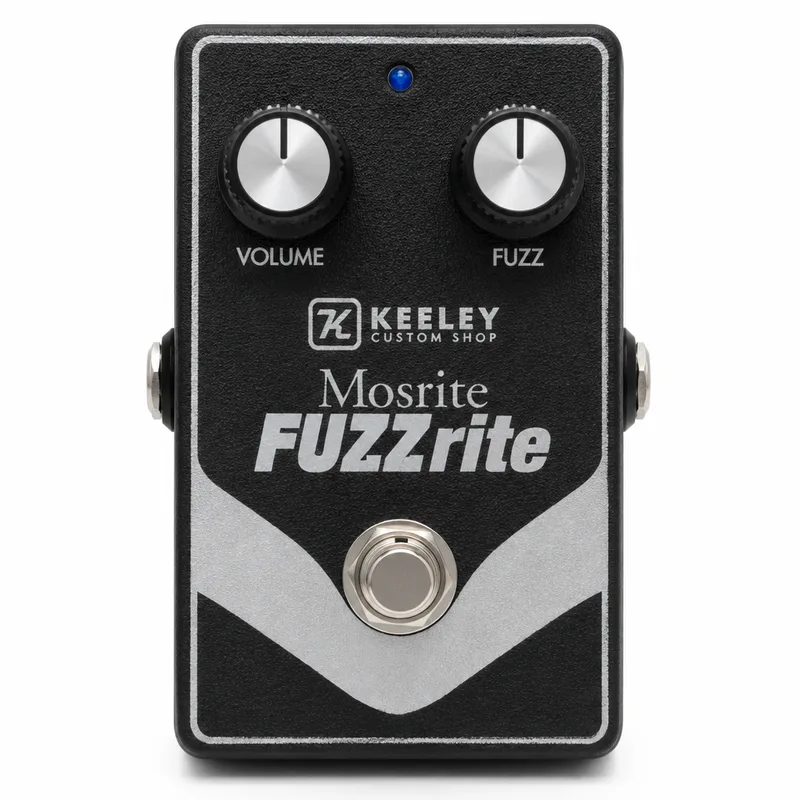
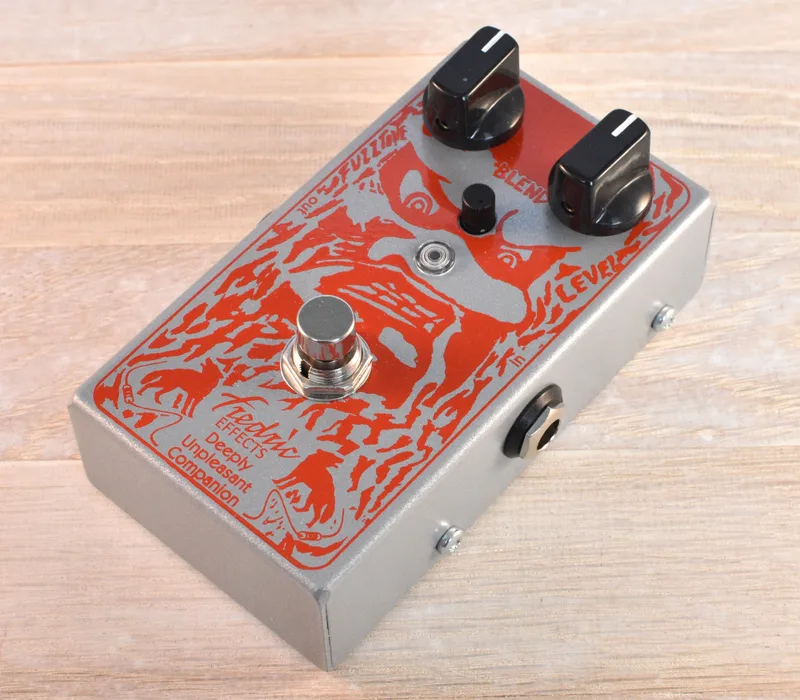
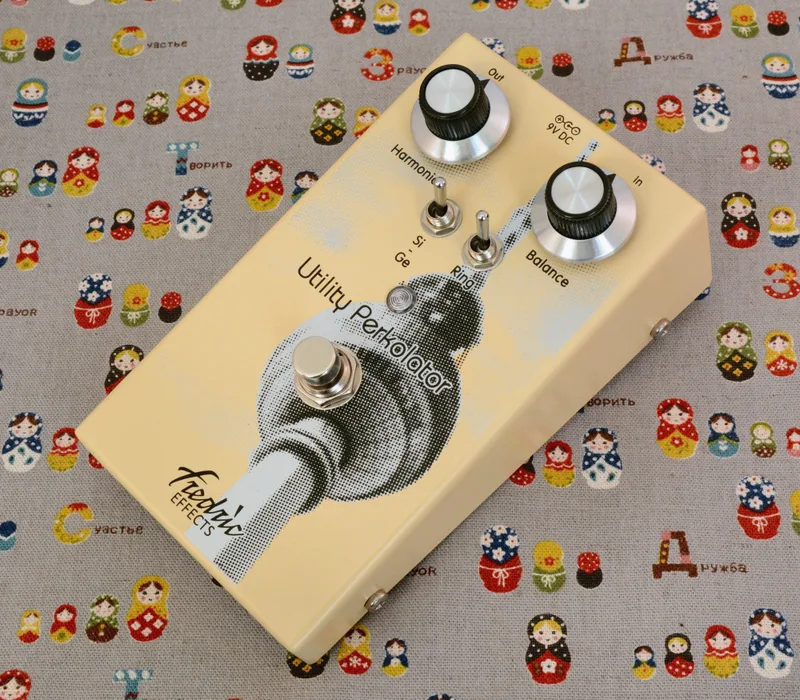
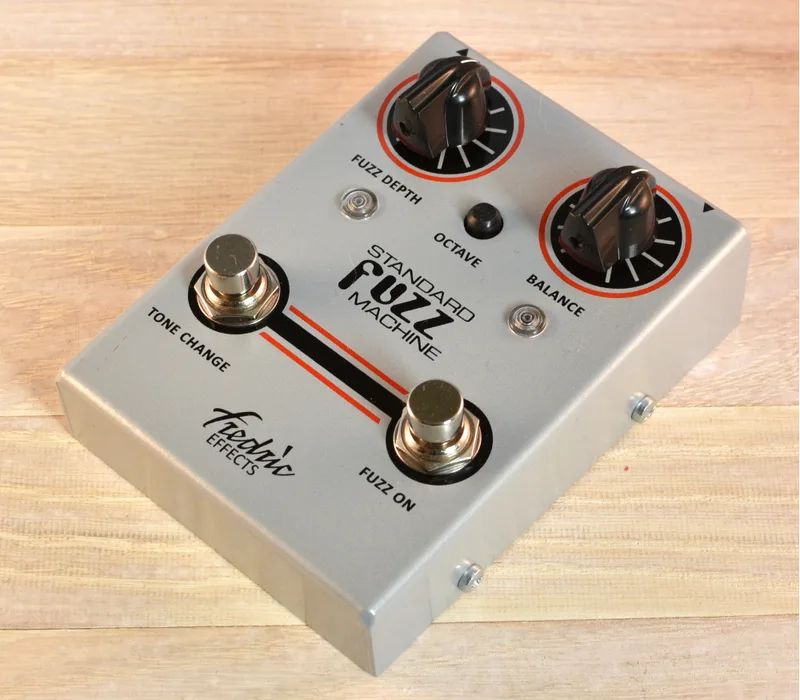
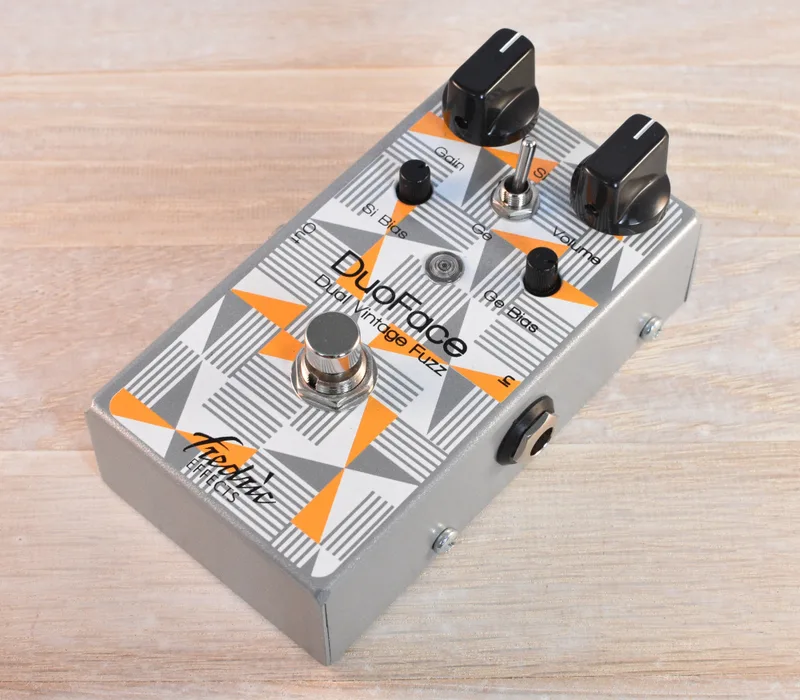
The Foxrite is not the only modern take on the circuit. Keeley's Custom Shop built a Mosrite FUZZrite recreation with a Boost Mode added to the original design9, and Fredric Effects itself has gone on to build a range of other vintage-circuit fuzzes, including the Deeply Unpleasant Companion, the Utility Perkolator MKII, the Standard Fuzz Machine and the DuoFace.
Videos
timhulio
timhulio
Gearaholics
Questions
What transistors are in the Fredric Effects Foxrite?
The Foxrite MkII uses a 2N3904 and two BC108A transistors, according to Guitar.com's review of the pedal. These are silicon transistors, matching the silicon version of the original late 60s Mosrite Fuzzrite circuit the pedal recreates.
What does the Rong setting on the Foxrite do?
Rong mode is a commonly used variation on the Fuzzrite circuit. The two gain stages of the circuit are kept in series, and the Depth control acts more like a conventional tone control, sweeping from doomy bass to raspy, spitting treble. Guitar.com's reviewer found it makes the pedal more general-purpose without sacrificing its sonic character.
Where is the Fredric Effects Foxrite made?
The Foxrite is hand built in North London by Fredric Effects. The folded metal enclosure is custom made for the builder and powder coated with screen-printed artwork. The pedal is available direct from Fredric Effects and from selected shops and online retailers.
What is the difference between the Foxrite and the Foxrite MkII?
The MkII adds a central slider switch labelled Rite and Rong. Rite is the vintage correct Fuzzrite circuit, while Rong selects a popular variation with the two gain stages in series and the Depth control working as a conventional tone control. Both versions share the same underlying circuit reconstruction and boost stage.
Sources (9)
- Foxrite 60s Silicon Fuzz, Fredric Effects
- Fredric Effects Launches New Fuzz & Tremolo Pedals, Premier Guitar, 2013-09-20
- Fredric Effects Foxrite MKII review, Guitar.com, 2015-09-10
- Fredric Effects Announce Foxrite MkII Fuzz Pedal, Guitar Interactive Magazine, 2015-05-20
- Best Fuzzrite Clones And Evolutions In 2023, Delicious Audio, 2022-08-10
- Catalinbread Fuzzrite Germanium: Rare '60s fuzz recreated, gearnews.com, 2022-08-11
- Orpheus Silicon Fuzz / Mosrite Fuzzrite, Aion FX, 2024-07-04
- Mosrite Fuzzrite: A detailed history • Fuzzboxes, Fuzzboxes (fuzzboxes.org), 2023-07-20
- Custom shop releases 60's Mosrite Fuzzrite recreation!, robertkeeley.com, 2012-01-25