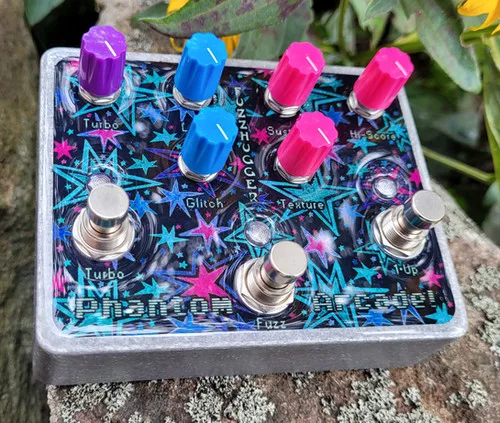


The FuzzHugger Phantom Arcade (II) is a multi-mode analog octave fuzz: one pedal that covers octave up and down fuzzes, filtered fuzz, interactive self-oscillation and arpeggio-style glitching, all selected with three footswitches1. FuzzHugger introduced the original Phantom Arcade in 2010, and fewer than 100 were made during that first run, when the maker says it was often a top-three seller1. Production was paused so this revision could be done, adding new controls and tones and a new layout with top-mounted jacks1.
As of 26 October 2026 the pedal is listed as a pre-order on FuzzHugger's site, shipping in 6 to 8 weeks1. A cosmetic sale version is also listed at $230.00 USD, with a clear coat that has a few tiny imperfections2.
What it does to your sound
Because the modes are switched by footswitch combinations, the Phantom Arcade (II) behaves like several fuzzes in one box. FuzzHugger describes Mode 1, the right footswitch, as a vintage analog octave up with frequency manipulation and overdrive, with input and output volume matching1. Mode 2, the middle footswitch, is a touch-sensitive fuzz with variable glitch, going from distortion to fuzz with glitch artifacts1. Mode 3, right plus middle, deactivates Mode 2's glitching for a smoother distortion with excited overtones, more drive and octave up1. Mode 4, all three footswitches together, is Turbo mode: self-oscillation, feedback, glitch, self-arpeggio and what the maker calls screaming filtered feedback1.
FuzzHugger also says Mode 1 "stacks fantastically into other dirt and fuzz, exciting the tone," which makes it a candidate to run into another fuzz or distortion pedal rather than replace them1. The maker sums up the revision as having "refined and new controls" that make the Phantom Arcade "more flexible and tweak-worthy than ever"1.
The modes at a glance
| Mode | Footswitches | What it does |
|---|---|---|
| Mode 1 | Right | Vintage analog octave up, frequency manipulation and overdrive, with input/output volume matching1 |
| Mode 2 | Middle | Touch-sensitive fuzz with variable glitch, distortion to fuzz with glitch artifacts1 |
| Mode 3 | Right + Middle | Deactivates Mode 2's glitching for smoother distortion with excited overtones, more drive and octave up1 |
| Mode 4 | Right + Middle + Left | Turbo mode: self-oscillation, feedback, glitch, self-arpeggio, screaming filtered feedback1 |
The knobs
Five knobs cover the tones across all four modes.
| Knob | What it does |
|---|---|
| High Score | Highs control; acts as the oscillation filter in Turbo Mode1 |
| 1-Up | Octave up bias1 |
| Sustain | Adjust for sustain or gated pop-in1 |
| Glitch | From distortion to glitching octave effects1 |
| Level | Mode 2/3/4 volume1 |
The High Score knob pulls double duty: it is the treble control in the fuzz modes and the filter for the self-oscillation in Turbo Mode, so it shapes how wild Mode 4 gets1. The Level knob only governs Modes 2, 3 and 4, which is worth knowing when setting levels against Mode 11.
Where it came from
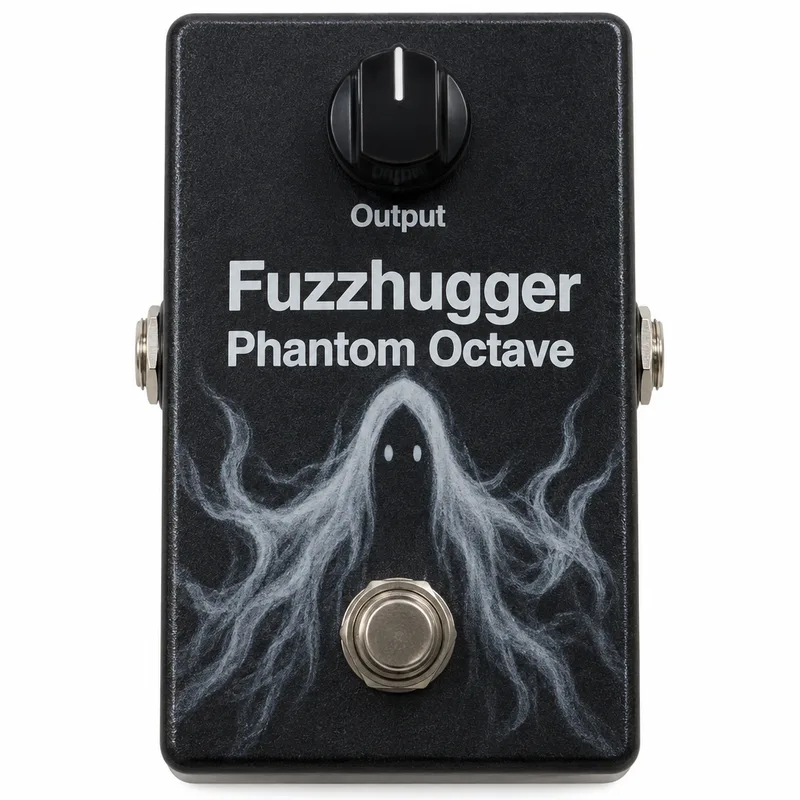
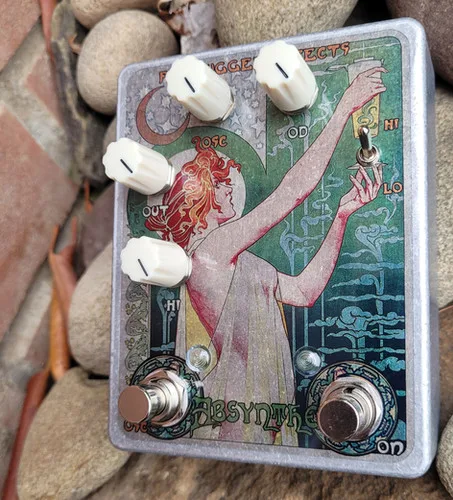
The original Phantom Arcade appeared in 2010 as one of FuzzHugger's wildest designs. Writing in Premier Guitar about the later Pocket Arcade, the reviewer described the Phantom Arcade as one of builder Tom Allen's wildest concoctions, "captures all of the above in a single unit," a larger fuzz pedal with footswitches31. The (II) revision added new controls and tones and moved the jacks to the top of the enclosure1. FuzzHugger also makes the related Phantom Octave and oscillating fuzzes like the Absynthe, alongside the Algal Bloom family.
Videos
FuzzHugger Effects
Brett Kingman
iRerror
Questions
Is the FuzzHugger Phantom Arcade (II) analog?
Yes. FuzzHugger describes the Phantom Arcade (II) as a multi-mode analog octave fuzz, covering octave up and down fuzzes, filtered fuzz, interactive self-oscillation and arpeggio-style glitching. All of its modes run on the analog circuit, with no digital processing involved.
How many modes does the Phantom Arcade (II) have?
The pedal has four modes, selected with combinations of its three footswitches. Mode 1 is the right footswitch, Mode 2 the middle, Mode 3 the right and middle together, and Mode 4, Turbo mode, all three at once. Each mode changes the character of the fuzz, from vintage octave up to full self-oscillation.
What does the Glitch knob do on the Phantom Arcade?
FuzzHugger describes the Glitch knob as taking you from distortion to glitching octave effects. It works together with Mode 2, which is a touch-sensitive fuzz with variable glitch, and Mode 3, which deactivates that glitching for a smoother distortion.
Where are the jacks on the Phantom Arcade (II)?
The Phantom Arcade (II) has a new layout with top-mounted jacks. That change was part of the revision: production of the original was paused so new controls, new tones and the top-jack layout could be added, which matters for fitting the pedal on a crowded board.
How many original Phantom Arcade pedals were made?
Fewer than 100 were made during the original's first run. FuzzHugger introduced the Phantom Arcade in 2010, and the maker says it was often a top-three seller for the company during that run before the revision.
Sources (3)
- Pre-Order: FuzzHugger Phantom Arcade (II), FuzzHugger Effects, 2010
- FuzzHugger Phantom Arcade (II), FuzzHugger Effects (fuzzhugger.com)
- FuzzHugger(fx) Pocket Arcade Pedal Review, Premier Guitar, 2013-01-02