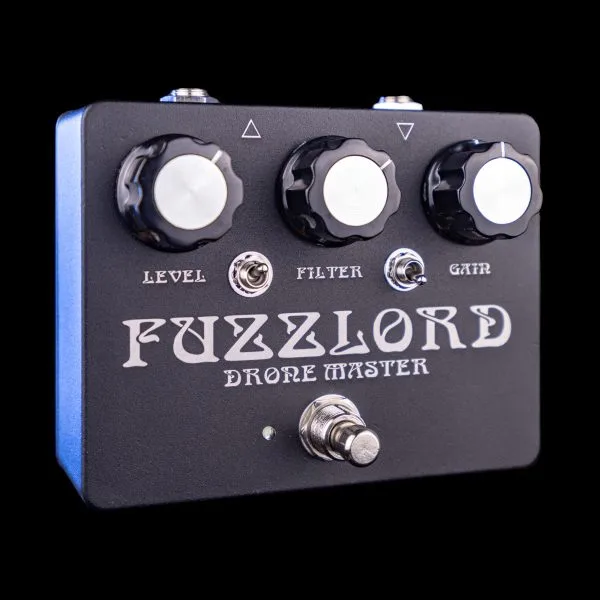


The Fuzzlord Drone Master is a high-gain distortion pedal from Fuzzlord Effects, built around the classic LM308 Rat circuit and aimed squarely at players who tune down. Fuzzlord describes it as made for "guitarists and bassists who demand seismic tone, crushing weight, and uncompromising clarity in the lowest tunings," and says it is voiced to retain low-end integrity at those settings12. Where the original Rat is a general-purpose op-amp distortion, the Drone Master extends the circuit with selectable clipping diodes and a midrange toggle, giving four distinct modes from two switches1.
The Fuzzlord store lists the Drone Master at $215.00 USD1. The maker recommends an isolated 9V center negative power supply, so plan on a proper pedalboard power supply rather than a daisy chain1.
A Rat circuit for low tunings
The Drone Master is based on the classic LM308 Rat circuit, the op-amp distortion design Fuzzlord says was "made famous by countless bands over the decades"4. Delicious Audio's write-up likewise calls it "Based on the classic LM308 RAT circuit"2. But Fuzzlord frames the pedal as a mutation of that design rather than a clone: the maker's product page says it is "Inspired by the legendary Rat circuit, but mutated far beyond its origins," harnessing "the raw power of classic op-amp distortion"1.
What separates it from a stock Rat is the voicing and the switching. Fuzzlord says the Drone Master is "meticulously voiced to retain low-end integrity, slice through walls of sound," which is the pitch to players in drop tunings and to bassists1. The older maker page describes it as "brutally high gain, different clipping options, and added mid scoop/boost toggle" in one package4. Delicious Audio's Paolo De Gregorio called it a drone-filled take on the Rat circuit, suited to heavy styles2.
The controls and four modes
Three knobs set the basic shape of the sound, and two toggles multiply the options into four modes14.
| Control | What it does |
|---|---|
| Gain | Sets the amount of gain in the circuit, from a pure clean boost to drone-laden distortion; counter-clockwise gives overdrive-like tones, clockwise "all out sonic destruction"12 |
| Filter | A treble-cut tone control; clockwise is unfiltered, counter-clockwise cuts more top end to tame harshness12 |
| Level | Overall output volume, counter-clockwise for less, clockwise for more12 |
The Filter control works like the Rat's: it is a treble cut rather than a conventional tone knob, so turning it down darkens the pedal rather than boosting highs2.
Toggle 1 (midrange): up gives a Hyperfuzz-inspired mid scoop, down gives a classic Rat-style mid boost, which is the stock setting1. Delicious Audio describes the choice as "a mid scoop or a mid boost akin to the classic Hyperfuzz"2. In practice this is the toggle that decides whether the pedal sits dark and scooped for doom-style walls of sound, or pushes its mids forward to cut through a dense mix.
Toggle 2 (clipping): down selects silicon diode clipping, the stock mode; up selects LED clipping4. Fuzzlord describes the two as "aggressive LED clipping or razor-sharp silicon diodes for full control over compression, saturation"1. Both the maker and Delicious Audio note that the LED mode is much louder and more compressed than the silicon mode, and that it provides a volume boost24. That boost is worth knowing about before you flip the switch mid-song.
With two toggles, each with two positions, the pedal offers four distinct tonal modes in total14.
Power and connections
The Drone Master runs on a 9V DC center negative supply with a 2.1mm plug, drawing 40mA1. RockBoard's PedalPedia listing confirms the same 9V DC center negative specification and 40mA current draw5. Fuzzlord recommends an isolated supply for optimal performance, a recommendation Delicious Audio repeats12. There is no battery option in the maker's specifications, so this is a pedalboard power supply pedal.
The enclosure measures 120 x 94 x 42.5 mm, which Fuzzlord calls compact and pedalboard-friendly1. Switching is true bypass with soft switching, which the maker describes as giving seamless transitions between engaged and bypassed states1. Delicious Audio also calls it "a perfect addition to any pedalboard"2.
Where it sits in the Fuzzlord range
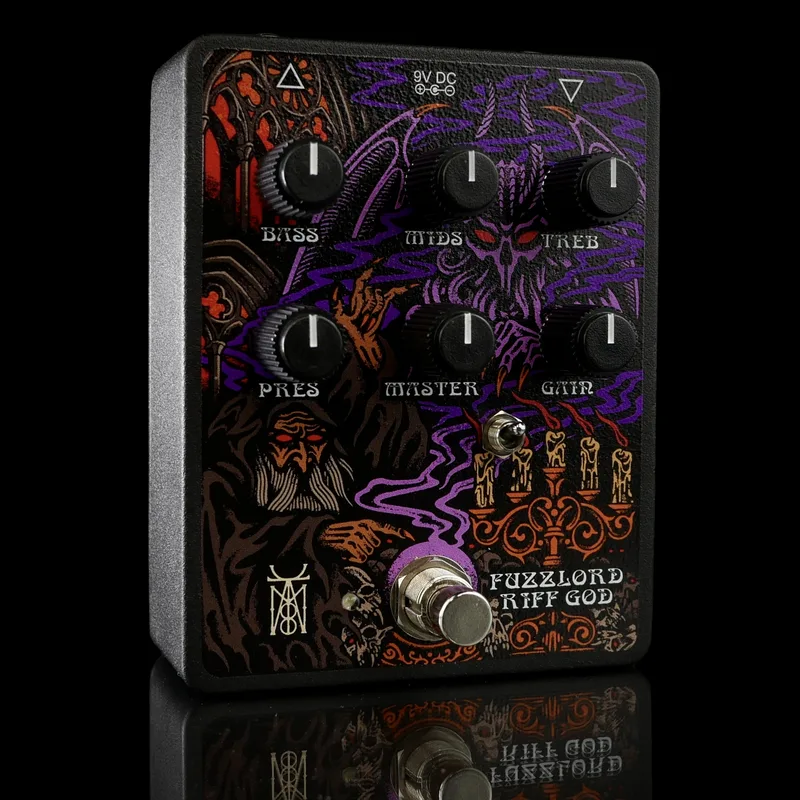
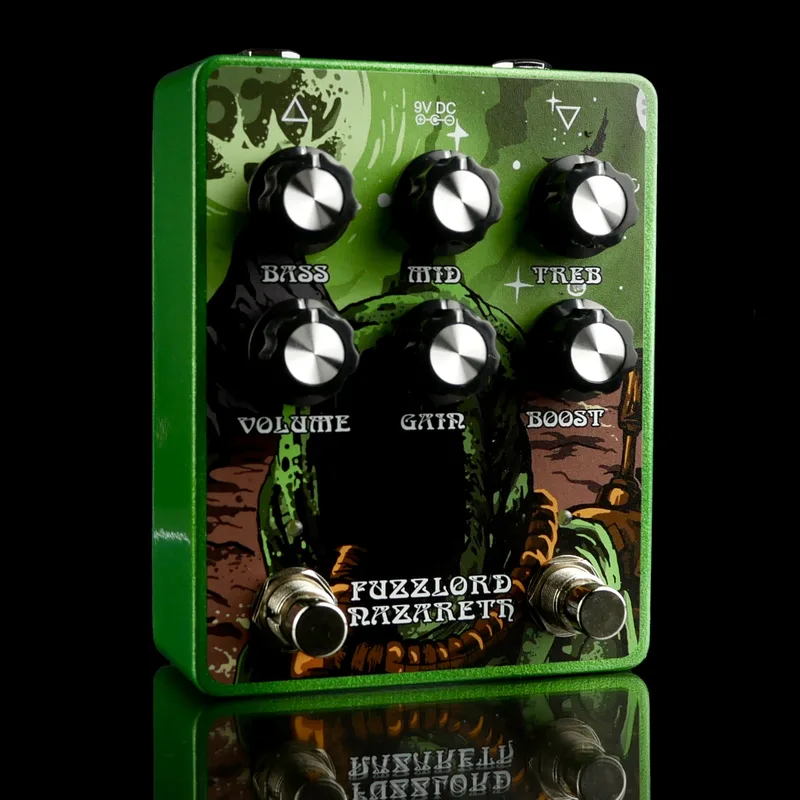
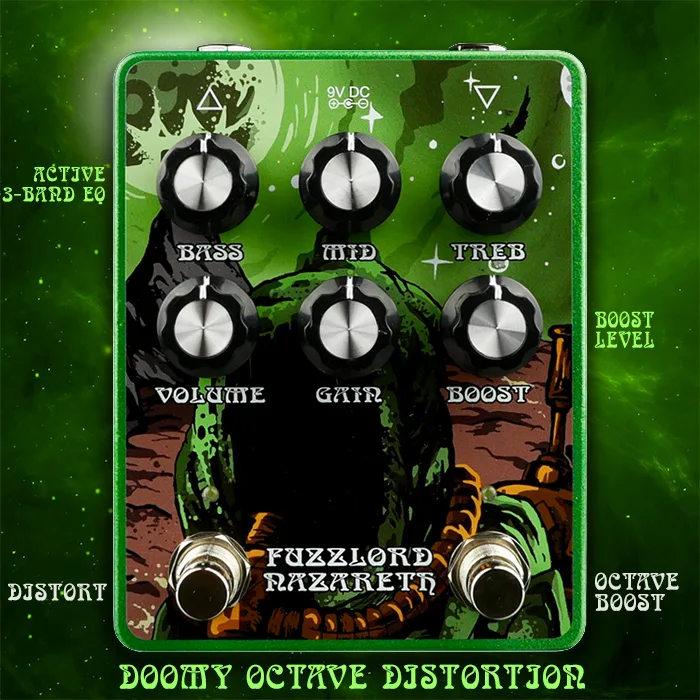
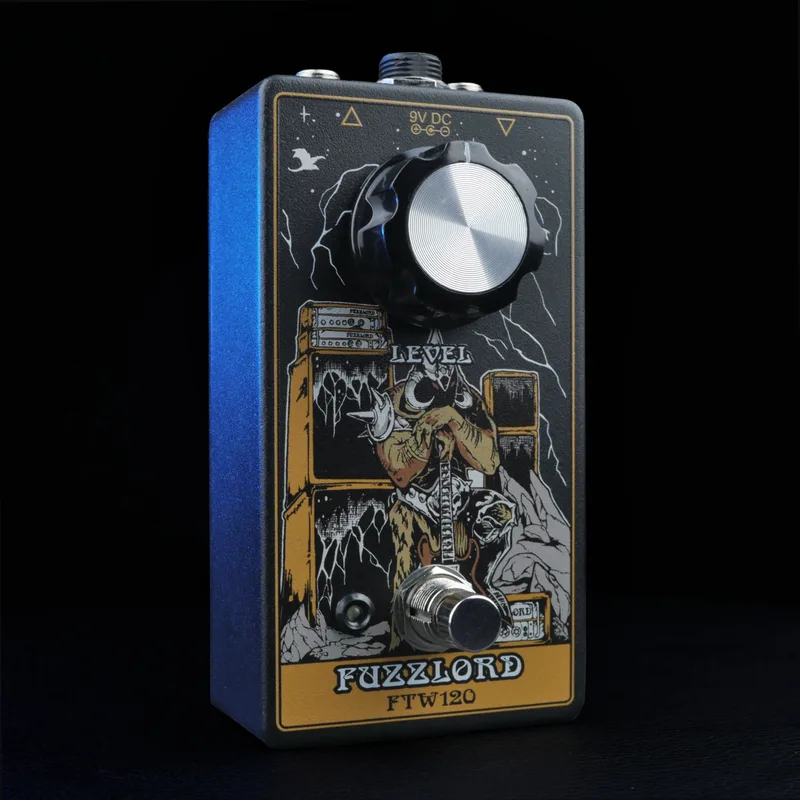
Fuzzlord Effects makes a range of heavy distortion pedals alongside the Drone Master, including the Riff God, the Nazareth Octave Distortion, the Nazareth Doomy Octave Distortion, and the FTW120. RockBoard's PedalPedia entry for the Drone Master also lists a demo video by AndyDemos5.
Videos
AndyDemos
R.J. Ronquillo
Xander Raymond Charles
Questions
Is the Fuzzlord Drone Master based on the Rat?
Yes. Fuzzlord describes the Drone Master as based on the classic LM308 Rat circuit, an op-amp distortion design, but voiced and modified for heavy, low-tuned playing rather than copied straight from the original.
What does the mid toggle on the Drone Master do?
Toggle 1 sets the midrange character. Toggle up for a Hyperfuzz-inspired mid scoop, or down for a classic Rat-style mid boost, which is the stock setting. This lets you cut through a mix or sit darker depending on the band context.
Is the LED clipping mode louder than silicon?
Yes. The stock setting uses silicon diode clipping. The LED clipping mode is described by both Fuzzlord and Delicious Audio as much louder and more compressed, and it provides a volume boost.
Does the Fuzzlord Drone Master work on bass?
Yes. Fuzzlord builds the Drone Master for guitarists and bassists in the lowest tunings, and says it is voiced to retain low-end integrity, so it is intended for bass as well as guitar.
Is the Fuzzlord Drone Master true bypass?
Yes. Fuzzlord lists the Drone Master with true bypass soft switching, which the maker describes as giving seamless transitions when the pedal is engaged or bypassed.
Sources (5)
- Drone Master Distortion, Fuzzlord Effects, 2024-05-19
- Fuzzlord Drone Master Distortion, Delicious Audio, 2023-04-10
- Dark Master Echo, Fuzzlord Effects, 2026-05-27
- Drone Master, Fuzzlord Effects, 2018-10-27
- Drone Master by Fuzzlord Effects, RockBoard PedalPedia, 2026