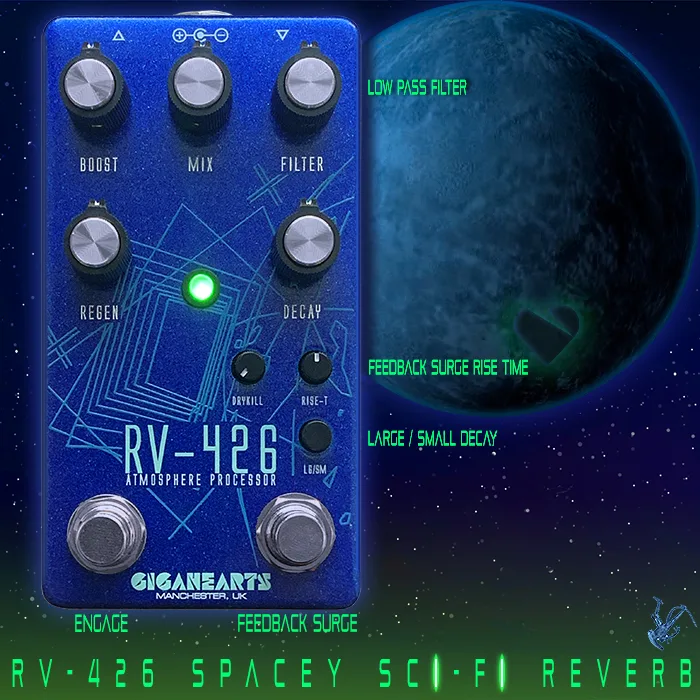

The Gigahearts RV-426 Atmosphere Processor Reverb is a mono digital reverb pedal built for ambient and atmospheric playing. Guitar Pedal X's Stefan Karlsson, reviewing it in March 2026, described it as "a mono atmospheric reverb with a Brian Neunaber style Belton Brick Reverb at the heart of that circuit", and summed it up as "a superb Spacey Atmospheric Effect". The name is a nod to the film Aliens: Karlsson notes that "Aliens fans will instantly know what 'RV-426' is derived from", and the pedal's sound takes its inspiration from the film's ethereal ambient tones1.
The Belton Brick circuit at its heart
The circuit's lineage matters to players who know the Belton Brick module. Karlsson explains that "The PT2399-derived Belton Brick was originally created to generate Spring Reverb sounds in particular", and the RV-426 builds on that foundation for atmospheric reverb instead1. If you are new to the effect itself, the site's Reverb Pedals page covers the wider field.
Controls and footswitches
The front panel carries eight controls. Karlsson shared his preferred settings in a later piece, which gives a practical read on what each does2:
| Control | What it does | Karlsson's preferred setting |
|---|---|---|
| Boost | Level up | @ Noon |
| Mix | Wet/dry blend | @ Max |
| Filter | Tone shaping | @ 9 o'clock |
| Regen | Feedback amount | @ 3 o'clock |
| Decay | Reverb length | @ Max |
| Dry-Kill | Mutes the dry signal | Fully counter-clockwise (Off) |
| Rise-T | Rise-Time | - |
| Decay Size | Decay timing range | - |
Two footswitches sit below the panel: the left is Engage, and the right is Feedback Surge, which Karlsson notes works additively with the Regen dial1.
Decay and Rise-Time
The Decay control switches between two timing ranges, and the Rise-Time control adds a slow bloom on top1:
- Decay, Short: 0.8 to 2.3 seconds
- Decay, Long: 2.5 to 5 seconds
- Rise-Time: up to 10 seconds, interactive with the position of the Regen dial
With his preferred settings, Karlsson reported "this fantastic eerie atmospheric whirring sound - which is the modulation component of the reverb", the character the Aliens inspiration points toward1.
Power and connections
The RV-426 runs on 9V DC, center negative, and draws 250mA1. That is a heavier draw than many single pedals, so a daisy chain or a low-output supply position may not keep up; a dedicated supply output is the safer pairing. Connections are mono throughout: one 1/4" TS input and one 1/4" TS output, with no stereo jacks1.
What reviewers said
Guitar Pedal X's verdict was positive across the board. Karlsson called it "a superb Spacey Atmospheric Effect" and "excellent and highly emotive overall"1. The pedal was listed at £160 GBP on the Gigahearts webstore at the time of the March 2026 review1.
Videos
GIGAHEARTS FX
Questions
Is the Gigahearts RV-426 stereo?
No. Guitar Pedal X describes the RV-426 as a mono pedal, with a single 1/4-inch TS mono input and a single 1/4-inch TS mono output. Players wanting stereo reverb routing would need to look elsewhere or pair it with other mono pedals in a wider rig.
How much current does the Gigahearts RV-426 draw?
Guitar Pedal X lists the RV-426 at 9V DC, center negative, drawing 250mA. That is a relatively high draw for a single pedal, so it is worth checking what your power supply can deliver on each output before adding it to a board.
What does the Regen footswitch do on the RV-426?
The right footswitch is the Feedback Surge switch, and Guitar Pedal X notes that it works additively with the Regen dial. In practice it pushes the reverb's feedback beyond where the knob is set, for surging, self-sustaining washes on demand.
How long is the decay on the RV-426?
The Decay control switches between two timing ranges: Short runs from 0.8 to 2.3 seconds, and Long runs from 2.5 to 5 seconds. The Rise-Time control adds up to 10 seconds of slow bloom on top, interacting with the Regen dial position.
Why is it called the RV-426?
The name comes from the film Aliens. Guitar Pedal X notes that fans of the film will instantly recognise what RV-426 is derived from, and the pedal's eerie, spacey character is deliberately inspired by the film's ethereal ambient sound.
Sources (2)
- Guitar Pedal X, Guitar Pedal X, 2026-03-27
- Guitar Pedal X, Guitar Pedal X, 2026-06-18