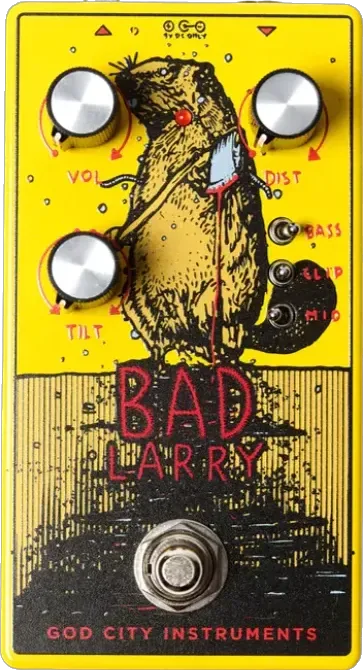

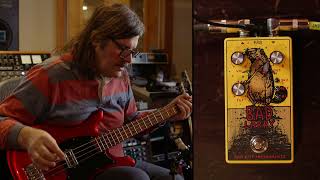
The God City Instruments Bad Larry is an analog distortion pedal built around a new old stock LF351 op-amp, described by RockBoard's PedalPedia as inspired by Rat and Muff circuits1. That lineage points at two of the most familiar dirt designs in the pedal world, and the Bad Larry reworks them with a set of switches that change how the clipping and tone stages behave. God City Instruments describes its character in colorful terms: "Bad Larry forges its own path through a forest of daggers into a putrid sea of grime. A favorite around the studio for clanky bass, it's also fun for thick, saggy fuzz tones."1
What Bad Larry does
The Bad Larry sits in the distortion lane, but the maker's description points to a range that runs from clanky bass sounds to thick, saggy fuzz tones1. The three switches are what give it that spread, letting you reshape the clipping stage and the tone stack rather than just turning gain up and down. If you want to hear how it compares with the wider field, see Distortion Pedals, Fuzz Pedals and Bass Pedals.
Controls
| Control | What it does |
|---|---|
| Clip switch | Changes between hard clipping, boost, and bass boost modes1 |
| Bass switch | Affects how much low end is allowed into the clipping stage1 |
| Mid switch | Affects the character of the Muff-style tone stack, allowing for the traditional mid cut sound, as well as flat and boosted mid responses1 |
The Clip switch is the core of the pedal's flexibility: hard clipping gives the distortion voice, while the boost and bass boost modes change how the circuit pushes1. The Bass switch works with it, since the amount of low end fed into the clipping stage changes how the distortion behaves1. The Mid switch then shapes the Muff-style tone stack, so you can go from the traditional mid cut associated with that kind of circuit to flat or boosted mids1.
Power
The Bad Larry runs on 9V DC, center negative, the standard arrangement for pedalboard power supplies1.
Related pedals from God City Instruments
God City Instruments also makes the Bad Larry, a fuzz the maker describes as forging "its own path through a forest of daggers into a putrid sea of grime," with a Clip switch offering hard clipping, boost, and bass boost modes2.
Videos
God City Music
God City Music
Questions
What circuits is the God City Instruments Bad Larry based on?
God City Instruments describes the Bad Larry as inspired by Rat and Muff circuits, with a new old stock LF351 op-amp at its heart. That puts it in the family of op-amp-driven dirt pedals that take cues from the ProCo Rat and the Electro-Harmonix Big Muff, while the maker says it forges its own path.
What does the Clip switch do on Bad Larry?
The Clip switch changes between hard clipping, boost, and bass boost modes. Hard clipping gives the pedal its distortion character, while the boost and bass boost modes let you push the circuit or add low end, which the maker says makes it a favorite for clanky bass tones.
What power does Bad Larry take?
The Bad Larry runs on 9V DC, center negative, the standard pedalboard power arrangement. As with most modern pedals, use a regulated 9V DC supply with the correct polarity.
Is Bad Larry an analog pedal?
Yes. The Bad Larry is an analog circuit, listed as such on the maker's product page.
What does the Mid switch do on Bad Larry?
The Mid switch affects the character of the Muff-style tone stack. It allows the traditional mid cut sound, as well as flat and boosted mid responses, so you can move from a scooped fuzz-like voice to a fuller, more present midrange.
Sources (2)
- Bad Larry by God City Instruments, RockBoard (PedalPedia), 2026
- Guitar Pedal X, Guitar Pedal X