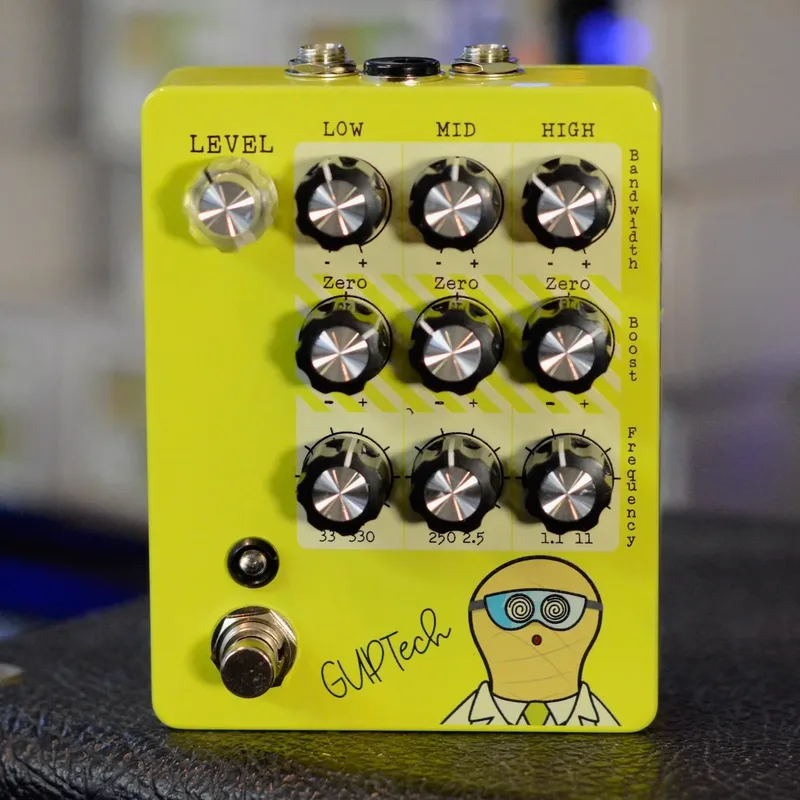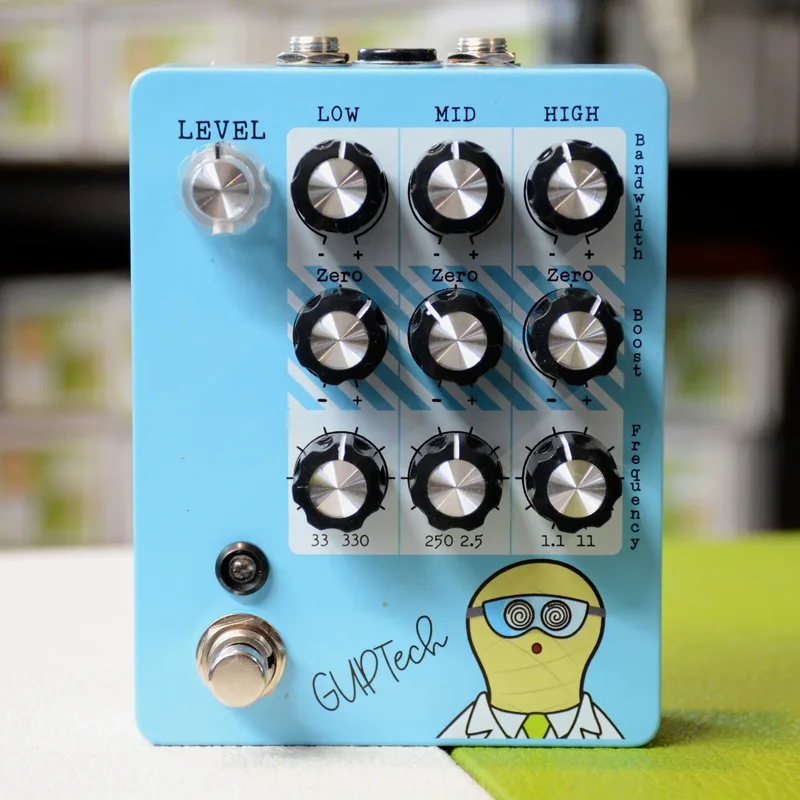


The GUPtech pPTSD is a three-band parametric EQ pedal with an integrated clean boost, made by hand in Saguenay, Quebec, Canada. GUPtech calls it "a professional-grade parametric guitar EQ pedal with integrated clean boost", and positions it for tone shaping in an amplifier's effects loop, where a player can sculpt frequencies after distortion rather than before it1. The full name behind the abbreviation is the "prof Pinotte Tone Shaping Device"1.
What it does and how it is controlled
A parametric EQ differs from a simple graphic EQ in that each band lets you choose not only how much to boost or cut, but which frequency to center on. The pPTSD carries three such bands, each with its own frequency range, plus an adjustable Q (bandwidth) control for precise frequency targeting2. GUPtech describes the result as "surgical precision for guitar tone shaping in your amplifier's effects loop"1.
| Band | Frequency range | What it covers |
|---|---|---|
| Low | 33 to 330Hz | Bass end, from sub-bass rumble through low guitar fundamentals |
| Mid | 250 to 2.5kHz | The midrange where body, honk and pickup character live |
| High | 1.1k to 11kHz | Presence, bite and top-end sparkle |
The mid band's range is where the two versions of the pedal differ: on the pPTSD Douche Edition, GUPtech lists the Mid band as 250 to 2.2kHz rather than 250 to 2.5kHz, while the Low and High bands match the original21. On the Douche Edition, each band offers ±12dB of boost or cut2.
The integrated clean boost sits alongside the EQ. GUPtech suggests the Douche Edition for "Metal and high-gain guitar tones requiring frequency sculpting", as a clean boost for solos, as an effects loop EQ, and for recording studios and live performance2. For players who want a boost without the EQ section, GUPtech's range also includes the GUPtech Peeps Clean Boost and the GUPTech FrAG Boost; the GUPtech Le Chiou EQ-Boost and GUPtech Slime Mid-Boost sit closer to the pPTSD's shaping role. More broadly, the pPTSD belongs among Equalization Pedals, with its boost side touching the Boost Pedals family.
Power, bypass and signal path
The pPTSD runs on 9V DC center negative and draws 48mA1. That is a meaningful draw for a small pedal, so a daisy-chain supply shared with several other pedals may not have the headroom for it; a dedicated output on a pedalboard supply is the straightforward arrangement.
The pPTSD's 48mA current draw is higher than many compact EQ or boost pedals need. Plan your power supply budget accordingly.
Two specifications matter for how the pedal sits on a board. First, it is true bypass: GUPtech states that "True bypass switching preserves signal when disengaged", so when the pedal is off, your guitar's signal does not run through the EQ circuitry1. Second, the signal path is fully analog. GUPtech says the "Full analog signal path maintains guitar tone integrity" and describes the pedal as "This analog signal path equalizer delivers surgical precision for guitar tone shaping in your amplifier's effects loop"1. There is no digital conversion anywhere in the chain, which matters to players who keep their boards analog end to end.
The Douche Edition
Alongside the standard pPTSD, GUPtech offers the pPTSD Douche Edition, part of the company's line of limited or alternate-cosmetic editions. It carries the same core design: GUPtech describes it as a "3-band parametric EQ guitar pedal with integrated clean boost" with the same "prof Pinotte Tone Shaping Device" name, true bypass switching, an analog signal path, and the same 9V DC center negative, 48mA power requirement, built in Saguenay, Quebec2.
| pPTSD | pPTSD Douche Edition | |
|---|---|---|
| Bands | Low 33-330Hz, Mid 250-2.5kHz, High 1.1k-11kHz | Low 33-330Hz, Mid 250-2.2kHz, High 1.1k-11kHz |
| Boost/cut | Parametric bands | ±12dB per band |
| Q control | Parametric design | Adjustable Q (bandwidth) |
| Power | 9V DC center negative, 48mA | 9V DC center negative, 48mA |
The pPTSD Douche Edition was listed as sold out on GUPtech's product page as of 26 October 20262.
Videos
GUPtech
_s.s_91_
THE RIFF MOUNTAIN HMD
Questions
Is the GUPtech pPTSD true bypass?
Yes. GUPtech specifies true bypass switching, which preserves the guitar's signal when the pedal is disengaged. When the pPTSD is off, the signal passes through the mechanical bypass path rather than the EQ circuit, so the pedal only shapes your tone while it is switched on.
What power does the GUPtech pPTSD need?
The pPTSD runs on 9V DC center negative and draws 48mA, according to GUPtech's product page. That draw is higher than many simple boost or EQ pedals, so it is worth checking the budget of a daisy-chain supply before sharing power with other pedals. A dedicated output on a pedalboard power supply covers it comfortably.
What frequency ranges do the pPTSD bands cover?
The pPTSD is a three-band parametric EQ. GUPtech lists the Low band covering 33 to 330Hz, the Mid band covering 250 to 2.5kHz, and the High band covering 1.1k to 11kHz. On the Douche Edition, the Mid band is listed as 250 to 2.2kHz, so the two versions differ slightly in the midrange sweep.
Where is the GUPtech pPTSD made?
GUPtech builds the pPTSD by hand in Saguenay, Quebec, Canada. The company describes its pedals as boutique handmade construction, and states that all of its pedals are made by the company in Saguenay.
Is the pPTSD signal path analog?
Yes. GUPtech describes the pPTSD as having a full analog signal path that maintains guitar tone integrity, and calls it an analog signal path equalizer delivering surgical precision for guitar tone shaping in an amplifier's effects loop.
Sources (2)
- GUPtech pPTSD, GUPtech (guptech.ca)
- pPTSD 3-Band Parametric EQ Guitar Pedal, guptech.ca