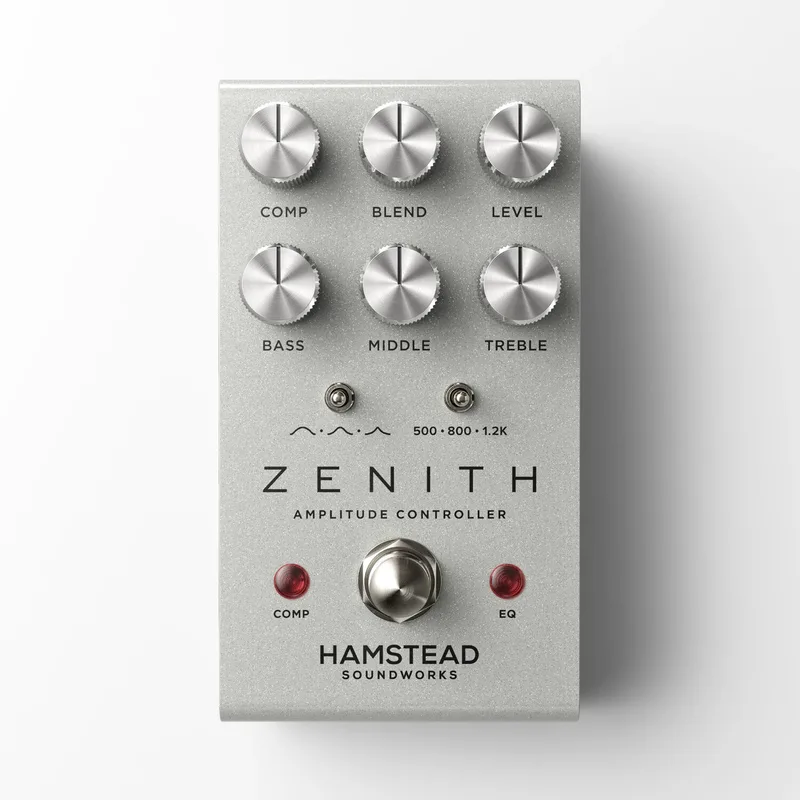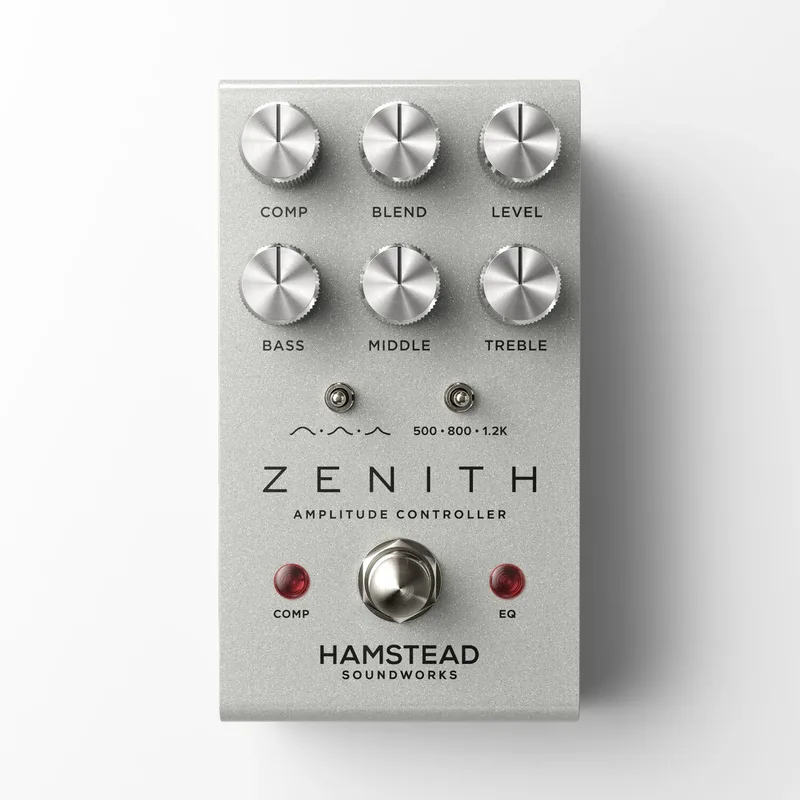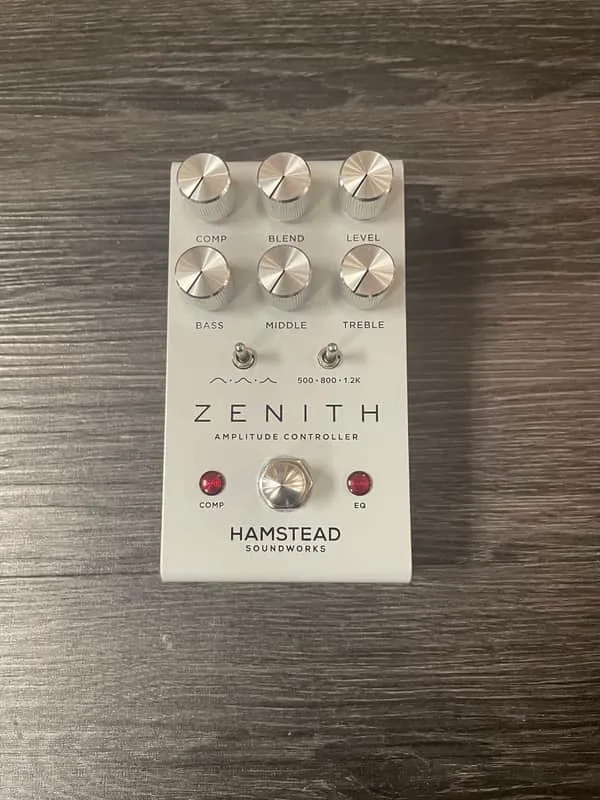

The Hamstead Soundworks Zenith Amplitude Controller packs an EQ, a compressor and a boost into one compact pedal, with switching that lets you use each circuit on its own or in combination. Hamstead describes it as "a powerful EQ, Boost, and Compressor delivered in one compact and incredibly flexible package," covering ground "from subtle tone shaping and compression that is felt and not heard, through to extreme sound sculpting and sustain beyond the natural realm"1.
The audio path is analog throughout, but the routing is handled by digital switching, which is what makes the flexibility possible. Guitar World's reviewer, Trevor Curwen, put it this way: "The signal path is all analogue, but three selectable routing options and some clever digital switching technology give" the pedal its range2. The pedal is built in the UK and listed at $3492.
EQ, compressor and boost in one pedal
The Zenith Amplitude Controller carries forward the idea of a boost, EQ, and compressor in a single box, with an OptoKick footswitch among its features, at a list price of $349 in the US. For many players, it can replace three separate pedals2.
Each of the three circuits does its own job:
- Compressor: a single-knob Comp control, with what Curwen found to be "very fast attack and medium/long release compression that evens things out and adds sustain with a pleasing note bloom at higher settings"2.
- EQ: three-band Bass, Middle and Treble, each offering 15dB of cut or boost2.
- Boost: the output Level knob "can add up to 20dB of boost to solidly hit your amp's front-end"2.
The controls
The front panel holds Comp, Blend, Level, Bass, Middle and Treble knobs, plus a Q switch, a Frequency switch, a Circuit Order switch and a bypass footswitch, with an internal trim pot for the Compressor Master Level2.
| Control | What it does |
|---|---|
| Comp | Single-knob compression control2 |
| Blend | Mixes compressed and uncompressed signal2 |
| Level | Output level, up to 20dB of boost2 |
| Bass | 15dB of cut or boost2 |
| Middle | 15dB of cut or boost, with switchable center frequency and Q2 |
| Treble | 15dB of cut or boost, adjusting the natural airy top-end2 |
| Q switch | Wide, medium or narrow Q (bandwidth) for the mid band2 |
| Frequency switch | Mid center frequencies of 500Hz, 800Hz or 1.2 kHz2 |
| Circuit Order switch | Sets the serial order of EQ and compression2 |
| Internal trim pot | Compressor Master Level2 |
The mid band is the most flexible part of the EQ: the Frequency switch selects center frequencies of 500Hz, 800Hz or 1.2 kHz, and the Q switch chooses between wide, medium and narrow bandwidths2.
Routing and switching modes
The Circuit Order switch decides whether the EQ feeds the compressor or the compressor feeds the EQ when the two run in series, and a parallel option splits the signal instead. As Curwen explains, "In Parallel mode the signal is split, so both get it equally, giving you the chance to mix two different versions of you," layering a compressed take and an EQ'd take together through the Blend knob2.
The single OptoKick footswitch behaves differently depending on which of four modes you select12:
- EQ Always On: the EQ runs constantly and the footswitch brings in the compressor2.
- Comp Always On: the compressor runs constantly and the footswitch brings in the EQ; the Level knob is inactive until the EQ is switched in2.
- Flip/Flop: the footswitch alternates between EQ and comp, which Curwen notes "is useful if you're using the pedal with a separate switcher for bypass"2.
- Cycle: "subsequent presses go from bypass to comp on to EQ on to both on"2.
Independent switching of the EQ and comp circuits is also possible by connecting an external footswitch to the pedal's Control input2.
Power: 9V or 18V, 280mA
The Zenith runs on a 9V or 18V DC adapter, which is not supplied, drawing 280mA at 9V2. The maker's listing specifies 18V DC, center negative1.
At 280mA the Zenith draws more current than a typical analog pedal, so it needs its own adequately rated power supply rather than a low-current daisy chain output. No battery option is given.
Connections are a standard input, a standard output and a standard Control input for the external footswitch2.
What reviewers said
Guitar World's review highlighted the pedal's flexibility and its build, listing "solid build quality" among its features2. The review's verdict on the compressor's character, with its fast attack and medium to long release, points at players who want evenness and sustain without obvious pumping2.
Videos
Shawn Tubbs
Questions
Is the Hamstead Zenith true bypass?
No. The Zenith uses a buffered bypass rather than true bypass. The signal path is all analog, with digital switching technology handling the routing between the EQ and compressor circuits. An internal trim pot sets the Compressor Master Level for the bypassed signal path.
Can the EQ and compressor be switched separately?
Yes. Digitally controlled switching lets the analog EQ and compression circuits be accessed independently, and independent switching of the two circuits is also possible by plugging an external footswitch into the Control input. The Circuit Order switch sets which circuit comes first when they run in series.
What does the OptoKick footswitch do?
It depends on the mode you choose. In EQ Always On or Comp Always On mode it brings in the other effect. In Flip/Flop mode it alternates between EQ and comp. In Cycle mode, repeated presses move from bypass to comp on, to EQ on, to both on.
Is the Hamstead Zenith analog?
Yes, the audio signal path is fully analog, covering the EQ, compression and boost circuits. The switching and routing are handled by digital control, which is what allows the three circuits to be accessed independently from a single footswitch.
Sources (2)
- Zenith Amplitude Controller by Hamstead, RockBoard PedalPedia, 2026
- Hampstead Soundworks Zenith Amplitude Controller review, Guitar World, 2021-05-21