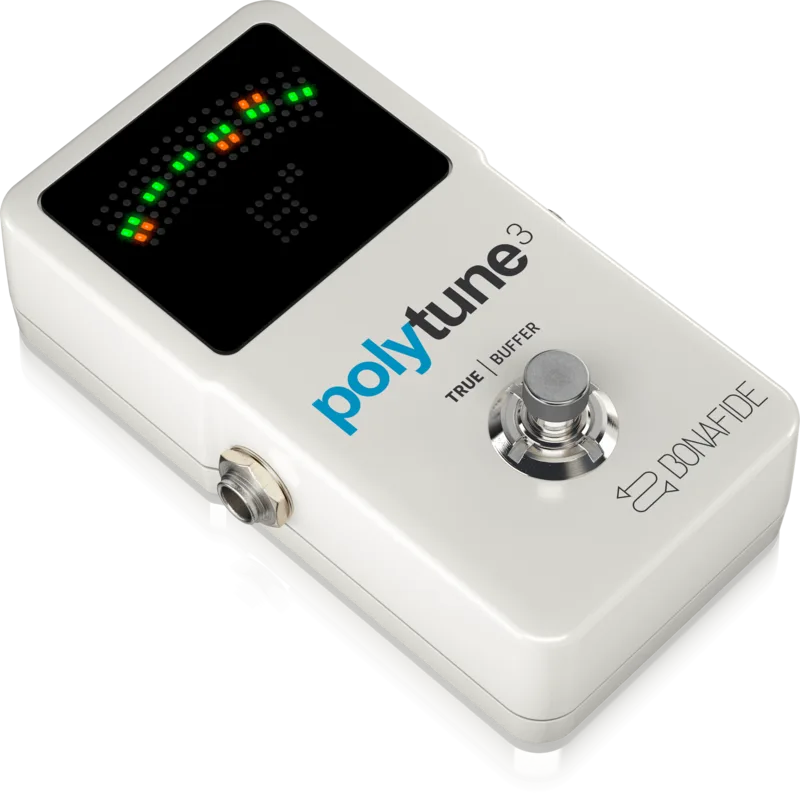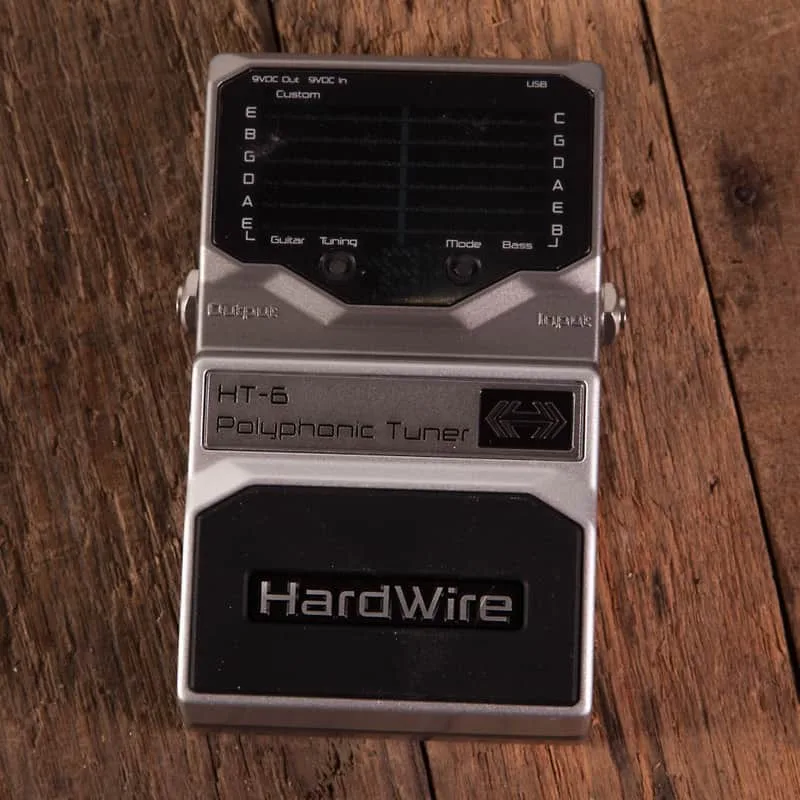


The HardWire HT-6 Polyphonic Tuner is a tuner pedal for guitarists and bassists that tunes all six strings of an instrument simultaneously: you strum all the strings at once and the pedal shows you which ones are out of tune1. HardWire announced it at NAMM 2011, with shipping expected in March 20111. It is built around technology from 3dB Research1, and it arrived as part of the wave of polyphonic tuners that TC Electronic's PolyTune started, whose technology also let the guitarist tune all the strings simultaneously2.
The pedal was also sold as the DigiTech HT-6 PolyChromatic Tuner, which Vintage Guitar described as wired true-bypass with a display that mimics the appearance of the frets on a guitar neck3.
What it does: tunes all six strings at once
The core idea is speed. Instead of picking one string at a time and waiting for a readout, you strum the open strings and the HT-6 shows the state of every string at once. The display is a matrix of 90 LEDs: six horizontal rows, with 15 lights for each string5. Premier Guitar's reviewer was impressed with how well it tracked:
"I was really impressed with how well the HT-6 tracked, all six rows lit up and it immediately told me my third string nee"4
The HT-6 can also be used as a standard single string tuner when you want to fine-tune one string1. MusicRadar's reviewer found the display's transition between polyphonic and single-string tuning less disruptive than its rival's, which he said made it arguably easier to use5.
The controls: footswitch, Mode and Tuning buttons
The HT-6 keeps its controls to a footswitch and two small buttons, with the buttons taking on different jobs depending on context45.
| Control | What it does |
|---|---|
| Footswitch | Tap to engage the tuner; hold down for a couple of seconds and strum the strings, and the HT-6 detects the guitar's pitch and calibrates itself to work at that tuning5 |
| Mode button | Selects between Standard and Strobe modes of the string grid; also acts as the minus increment button in Fret Offset mode45 |
| Tuning button | Accesses five preset tunings: Guitar Standard, Guitar Drop-D, 4-String Bass, 5-String Bass and 6-String Bass; also acts as the plus increment button in Fret Offset mode45 |
In Standard mode the LEDs function like a typical tuner, with the string being in tune when the lights move to the center of the display. There is also a Strobe mode for players who prefer that type of readout4. An LED next to the Custom label lights when the pedal is in Guitar Drop-D mode4.
The Fret Offset mode helps when you are using a capo or are tuned down up to three whole steps from standard tuning4. To set it, you hold the footswitch down, and the Tuning and Mode buttons become plus and minus increment buttons, letting you adjust the offset in half-step increments up to six semitones in either direction45.
For bass players, the Tuning button's presets cover 4-, 5- and 6-string bass, with B-E-A-D-G-C being the default tuning for the latter4.
Power
The HT-6 can run either on a 9-volt battery or with an optional AC power supply4. On the back of the pedal there are two power supply sockets: one for the power supply (the HT-6 also works from a standard PP3 battery), and one for daisy-chaining power from the adapter to the rest of your pedals5.
What reviewers said
Reviews were positive on performance and split on appearance. MusicRadar's reviewer found the tuning itself quick and stable54:
"It's fast and doesn't skip around too much, which is a flaw in a lot of tuners."5
The same reviewer wrote that the HT-6 beats its rival with its LED count and is arguably easier to use, since the display's transition between polyphonic and single-string tuning is less disruptive5. On the other hand, he felt it looks a little clunky, writing that "where it will divide opinion is over its looks, size and price"5. He also noted a £30 price difference between the HT-6 and its rival in UK pricing5. His overall verdict:
"Get over any aesthetic niggles, plus the £30 price difference between this and its rival, and the HT-6 is a serious contender for your cash."5
Premier Guitar's reviewer found it easy to use with a clear display, and judged the HT-6's rugged casing capable of standing up to the roughest gig conditions4.
Videos
Guitar World
Premier Guitar
Premier Guitar
Questions
Does the HardWire HT-6 take a 9V battery?
Yes. The HT-6 runs on a standard PP3 9-volt battery or on an optional AC power supply. It also has two power sockets on the back: one for the power supply and one for daisy-chaining power from the adapter to the rest of your pedals.
Can the HT-6 tune a 5-string or 6-string bass?
Yes. The Tuning button accesses five preset tunings: Guitar Standard, Guitar Drop-D, 4-String Bass, 5-String Bass and 6-String Bass. For 6-string bass the default tuning is B-E-A-D-G-C.
Can the HT-6 be used with a capo?
Yes. The Fret Offset mode helps when you are using a capo or are tuned down up to three whole steps from standard tuning. You can also offset manually in half-step increments up to six semitones in either direction using the Tuning and Mode buttons.
Does the HardWire HT-6 have a strobe mode?
Yes. The string grid can be operated in two modes, selected with the small Mode button: Standard mode, where the LEDs work like a typical tuner, and Strobe mode for players who prefer that type of readout.
Can the HT-6 tune one string at a time?
Yes. As well as polyphonic tuning, the HT-6 can be used as a standard single string tuner. MusicRadar's reviewer noted that the display's transition between polyphonic and single-string tuning is less disruptive than its rival's.
Sources (5)
- NAMM 2011: HardWire introduces HT-6 Polyphonic Tuner, MusicRadar, 2011-01-13
- TC Electronic announces PolyTune 2, MusicRadar, 2013-08-13
- Digitech Offers HT-6 PolyChromatic Tuner, Vintage Guitar magazine, 2012-07-23
- Hardwire HT-6 Polyphonic Tuner Review, Premier Guitar, 2011-06-14
- Hardwire HT-6 Polyphonic Tuner review, MusicRadar, 2011-07-13