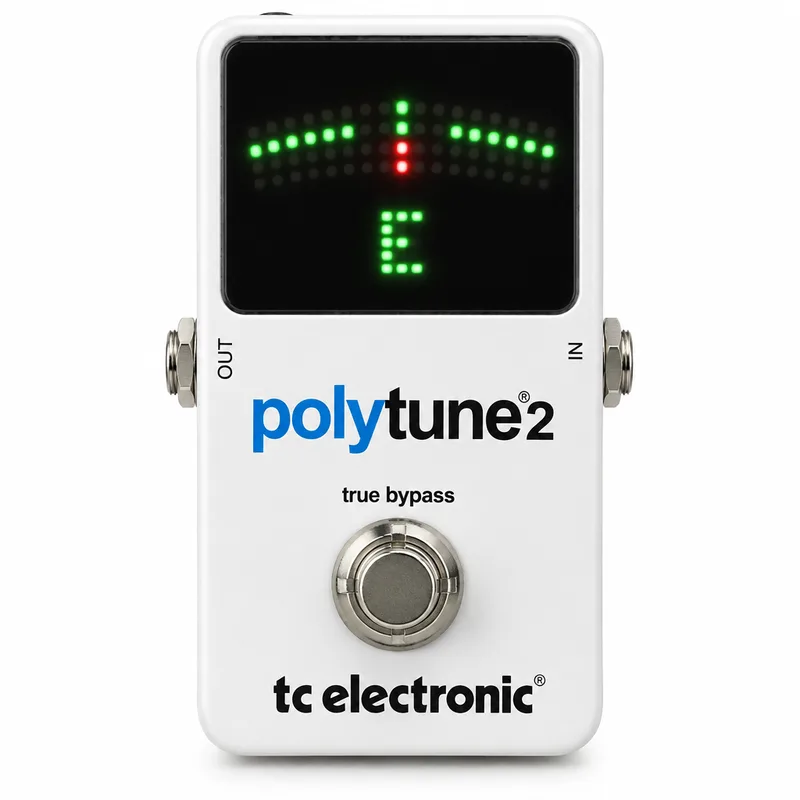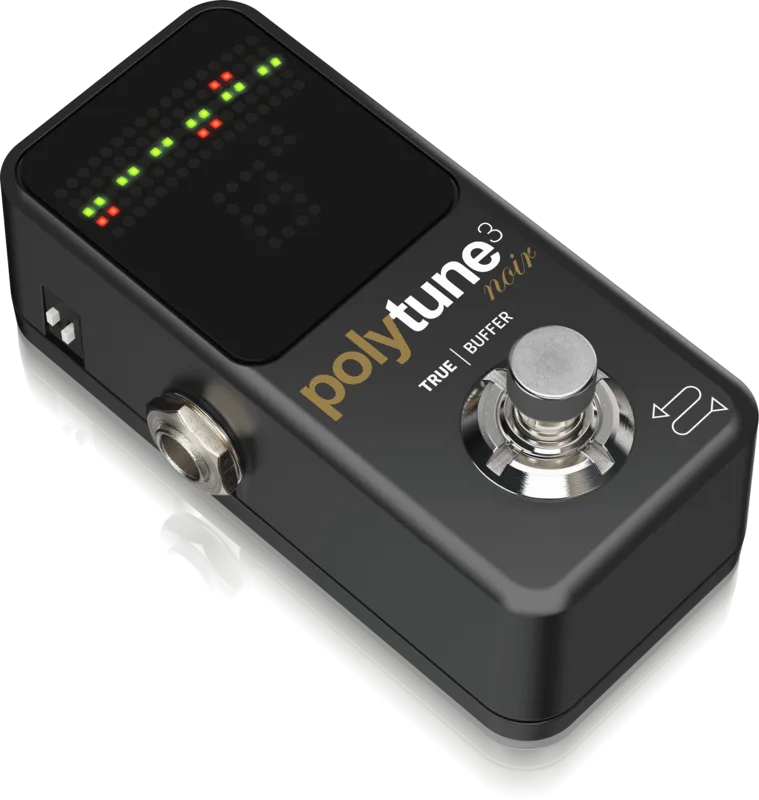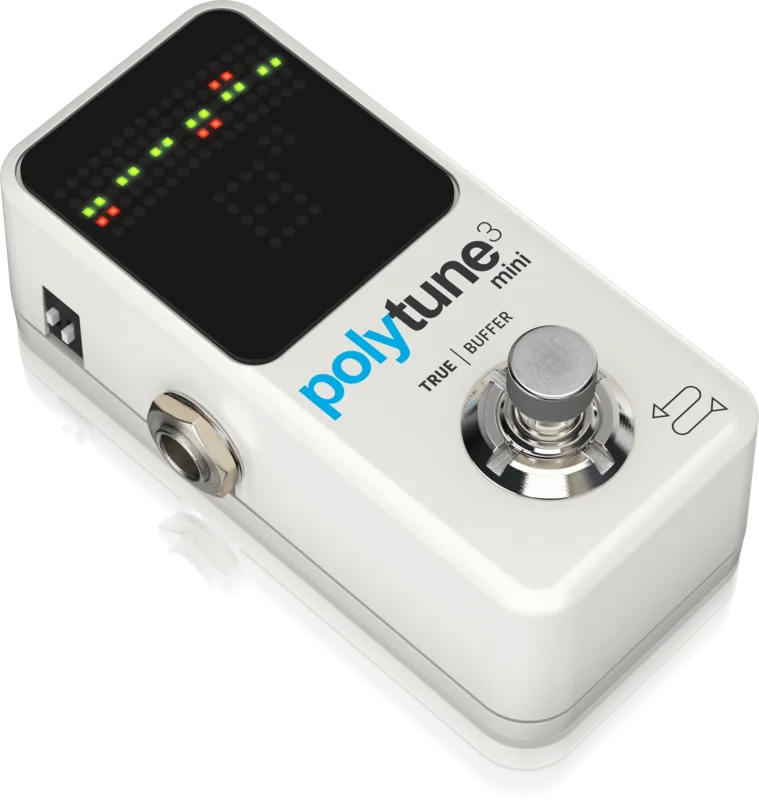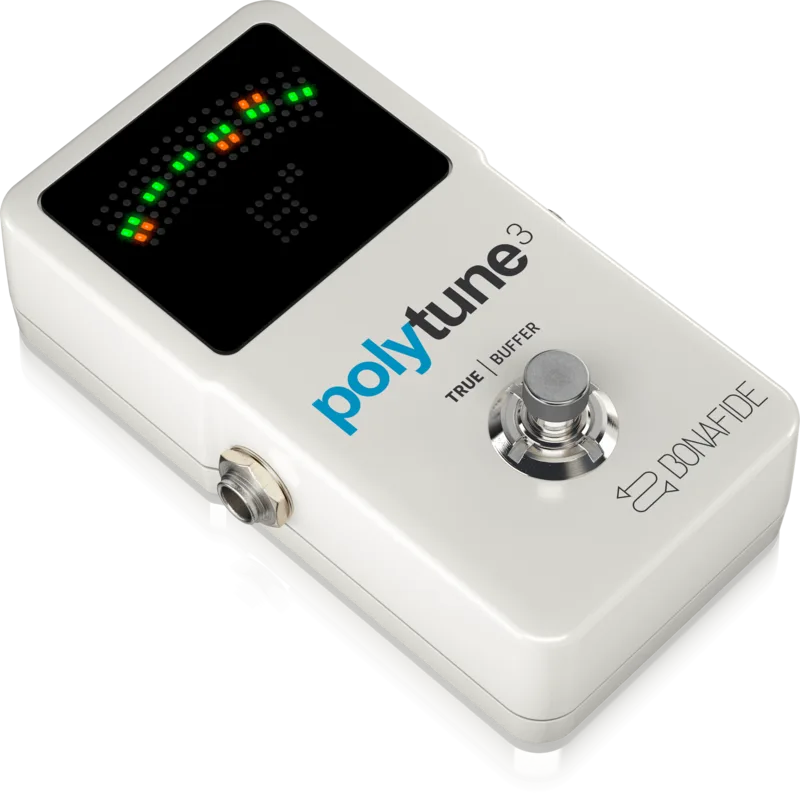


The TC Electronic PolyTune, released in 2010, was the world's first polyphonic guitar tuner: a tuner pedal that shows the tuning of all six strings from a single strum, instead of picking each string one at a time12. Made by TC Electronic, it arrived at a $99 street price in a diecast aluminum box with a heavy duty footswitch and a 100 LED display34. Guitar World later wrote that it "cemented PolyTune as the new standard in tuning"5.
The idea behind it is simple. Strum all six open strings at once and the display shows every string by note name, with red and green LED indicators showing which notes are flat or sharp6. Pick a single string and the pedal switches itself to a familiar chromatic needle display6. MusicPlayers.com's reviewer called the polyphonic mode "a manner that has never been accomplished before," provided you stick to standard tunings6.
Tunes all six strings with one strum
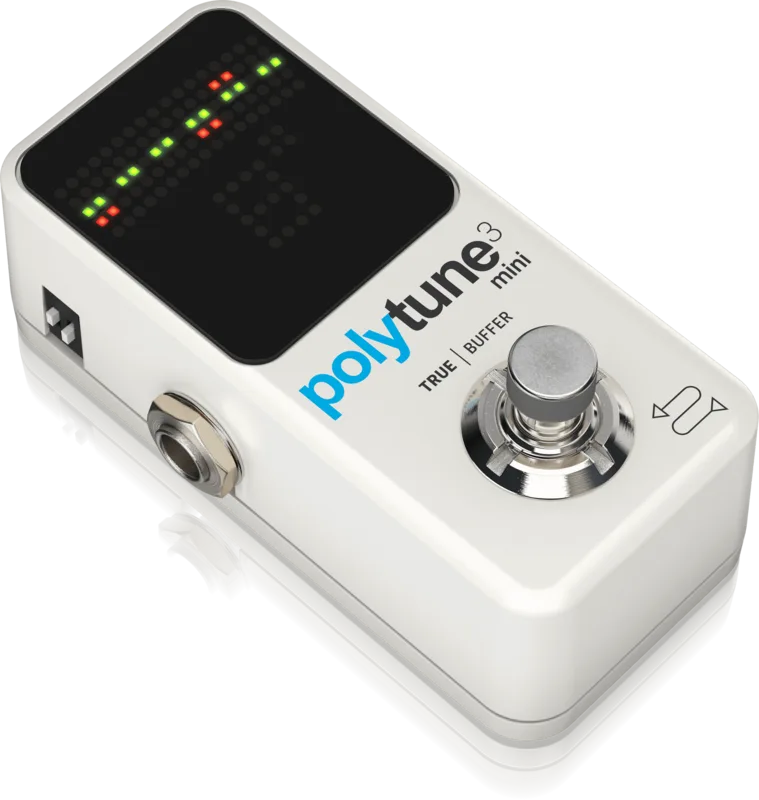
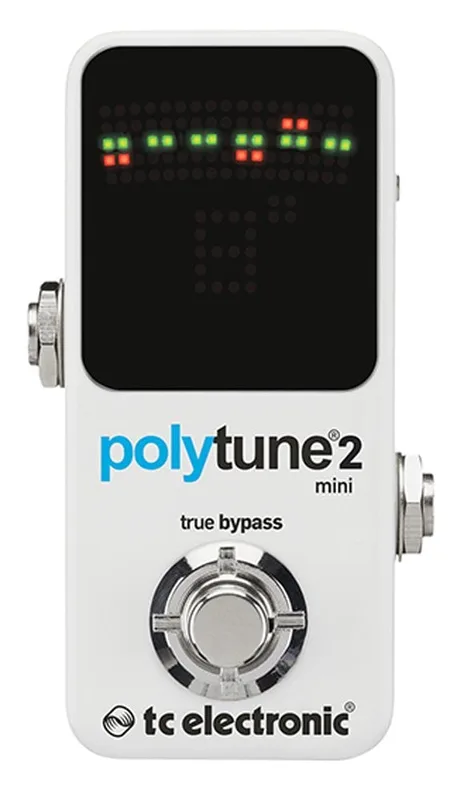
The headline feature is the polyphonic display. In poly-chromatic mode the display shows all of the strings by note name at once, and red and green LED indicators show which notes are flat or sharp6. The later Mini versions rendered this as six LED columns, one per string, where green means in tune, the LED above means sharp and the LED below means flat8.
The pedal decides which mode to use by itself: strum all the strings at once and it goes polyphonic, pick a single note and it drops into chromatic mode automatically6. The Mini and Noir versions kept this automatic switching910.
Tuning modes: polyphonic, chromatic and Stream
The original PolyTune offers three ways to read your tuning6:
| Mode | What it shows |
|---|---|
| Poly-chromatic | All strings by note name at once, red and green indicators for flat or sharp6 |
| Chromatic (Needel default) | A familiar needle display, shown automatically when you hit an individual note, with a customizable interface6 |
| Stream | A stroboscopic-style display, selected via a recessed button on the rear6 |
Stream mode is the precision option, familiar from strobe tuners, and is selected from a recessed rear button6. The Mini added two separate chromatic modes, needle mode and stream mode, to cater to individual preferences11. Later PolyTunes carry polyphonic, chromatic and strobe modes121314.
Drop D and capo tunings
At launch, polyphonic mode only worked with standard intervals in E, Eb, D, C#, C or B, down-tuned only2. Premier Guitar's reviewer found that dropped tunings made poly mode useless, while the monophonic strobe mode stayed accurate for any note3. In April 2011 TC Electronic answered what it called the single most demanded feature with a free software update adding Drop-D tuning and a Capo Mode that compensates when a capo is in use, available on TC's website1. Switching between standard tuning and Drop-D is done by pressing and holding the footswitch for two seconds1.
The footswitch and rear buttons
The original uses a compact metal enclosure with a Carling-style bypass/tune footswitch6. One recessed button on the rear switches the display to Stream mode; the other configures dropped tunings, up to five semitones across the entire guitar6.
The PolyTune 2 moved mode and tuning selection to two push buttons on the top side of the pedal7. The PolyTune 3's footswitch has a "notchless" soft touch feature that MusicRadar's reviewer found strong and secure13. On the PolyTune 3 Mini the single footswitch turns the tuner on and off, and holding it down toggles between standard and drop-D tuning1516.
Power: 9V, 45mA, with a 2000mA power out
The original runs from a 9V center-negative mains barrel jack or a single nine-volt battery, which TC claims gives approximately six or seven hours of use2. The pedal itself draws 45mA of current6. The input and output jacks are mounted at the same height as standard Boss Compacts, which suits cable-less straight plugs2.
The power output is the practical extra: you can chain multiple pedals to its Power Out connector, and other 9V center-negative pedals can be daisy chained up to a full 2000mA with a suitably currented adaptor26. The PolyTune 2 and PolyTune 3 both keep a 9V output jack for powering another pedal in your chain717.
MusicPlayers.com's reviewer felt the documentation did not provide adequate warnings about choosing power supplies and powering additional pedals, so plan your power distribution before daisy chaining6.
The Mini versions differ: the PolyTune Mini requires a 9V power supply at all times, with no battery option and no PSU included188, and the PolyTune 2 Mini has no DC out for powering other pedals19.
From the original PolyTune to the PolyTune 3 and Mini
| Version | Released | What changed |
|---|---|---|
| PolyTune | 20102 | First polyphonic tuner, true bypass, $99 street64 |
| PolyTune Mini | 2012 | A third the size of the original, +/- 0.5 cent accuracy, true bypass, no battery918 |
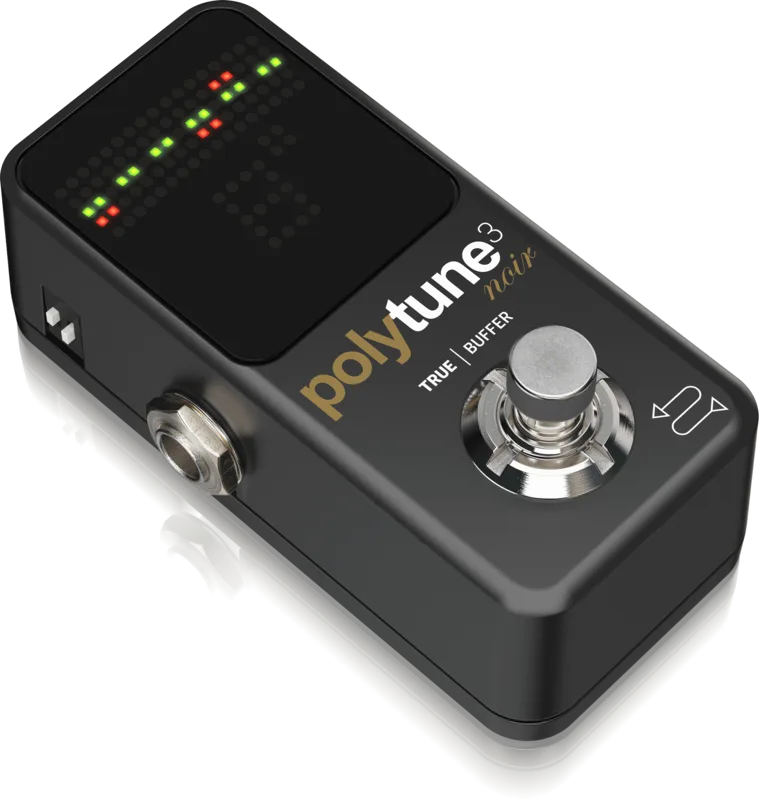
| PolyTune Noir | 2012 | Noir finish with drop-D and capo modes, true bypass1020 |
| PolyTune 2 | August 201321 | More accurate, easier to read, drop-D and capo modes, true bypass, 9V battery or adapter722 |
| PolyTune 2 Mini | 2014 | Mini format, true bypass, chromatic mode, no DC out1923 |
| PolyTune 3 | May 2017172425 | Built-in all-analog BonaFide Buffer, switchable true bypass or buffer, $99172425 |
| PolyTune 3 Mini and 3 Noir | 201912 | Compact versions of the 3 series, switchable true and buffered bypass1512 |
The PolyTune 2, announced in August 2013 as the followup to the popular original, is a more accurate and easier-to-read version that displays all six strings simultaneously, showing which are sharp, flat or in tune7522. The PolyTune 3, announced in April 2017, retains the previous features and adds an all-analog BonaFide Buffer, letting you choose between true bypass and buffered bypass depending on your setup; it shipped worldwide in May 2017 at $99221726. The 3 Mini and 3 Noir, unveiled in 2019, shrink that feature set into a smaller footprint, with the 3 Mini's price still to be announced at the time1512.
What reviewers said
MusicRadar's review of the original listed "Polyphonic mode is a revelation. Brilliant battery access. Bright display. 2mA power out for other pedals." among its reasons to buy2. MusicPlayers.com found it "just as easy to use as any other tuner pedal" and that "the revolutionary product worked as advertised," while noting the true bypass circuitry worked as expected, with the bypassed signal sounding the same as a cable straight into the amp6.
"Our initial impression was extremely positive, the polytune does a good job of tuning in a manner that has never been accomplished before."
Premier Guitar's reviewer agreed the polyphonic mode only pays off in standard tuning, including transposed standard tunings down to B, but found the strobe mode accurate for any note3. Guitar World's review of the Mini praised how "the bright display and Polyphonic mode let you tune up astonishingly quickly and accurately"27, and MusicRadar's Mini review cited price, options and size as reasons to buy8. Premier Guitar summed up the PolyTune 2 Mini as "Bright, fast, accurate, small, and inexpensive."19. On the PolyTune 3, MusicRadar found highly accurate tuning a plus1326, while Gearnews wrote that "the PolyTune is a pretty decent tuner, and quality does comes with" a cost26.
Videos
ProGuitarShopDemos
Premier Guitar
TC Electronic
Questions
Does the TC Electronic PolyTune take a battery?
Yes. The original PolyTune runs on a single nine-volt battery, which TC claimed gives approximately six or seven hours of use, or on a 9V centre-negative power supply. The Mini versions dropped the battery and require a 9V power supply at all times.
Is the original PolyTune true bypass?
Yes. TC Electronic described the PolyTune as true bypass, letting the signal flow unaffected when the pedal is bypassed and muting it for silent tuning when engaged. A reviewer found the bypassed signal sounded the same as a cable straight into the amp.
Does PolyTune polyphonic mode work in Drop D?
Not on the original at launch. Polyphonic mode only worked with standard intervals in E, Eb, D, C#, C or B. Drop-D support was added in 2011 as a free software update, and later PolyTunes include drop-D and capo modes.
How accurate is the TC Electronic PolyTune?
TC claimed plus or minus 1 cent for the original, compared with Boss's plus or minus 3 cents for the TU-2. The PolyTune Mini is rated at plus or minus 0.5 cent, and the PolyTune 3 at 0.5 cents in chromatic mode and 0.02 cents in strobe mode.
Can the PolyTune power other pedals?
Yes. The original has a power output that lets you daisy chain other 9V centre-negative pedals, up to 2000mA with a suitably rated adaptor. The PolyTune 2 and 3 also carry a 9V output jack, though the PolyTune 2 Mini has no DC out.
Sources (27)
- Musikmesse 2011: TC Electronic Polytune adds drop-D tuning, MusicRadar, 2011-04-04
- TC Electronic PolyTune review, MusicRadar, 2010-01-20
- TC Electronic PolyTune Poly-Chromatic Tuner Review, Premier Guitar, 2010-03-11
- TC Electronic Introduces PolyTune and More at NAMM, Premier Guitar, 2010-01-16
- TC Electronic Announces PolyTune 2 Pedal, Guitar World, 2013-08-14
- TC Electronic polytune poly-chromatic tuner, MusicPlayers.com, 2010-03-10
- TC Electronic PolyTune 2 review, MusicRadar, 2013-09-05
- TC Electronic PolyTune Mini review, MusicRadar, 2012-02-02
- NAMM 2012: TC Electronic introduces PolyTune Mini, MusicRadar, 2012-01-19
- TC Electronic to Offer “Noir” Version of PolyTune Mini, Vintage Guitar magazine, 2012-10-04
- NAMM 2012: TC Electronic Introduces PolyTune Mini Tuner, Guitar World, 2012-01-20
- TC Electronic adds Polytune 3 Mini and 3 Noir to its tuner range, Guitar.com, 2019-05-01
- TC Electronic PolyTune 3 review, MusicRadar, 2021-12-14
- TC Electronic unveils PolyTune 3 Mini & Noir, MusicRadar, 2019-04-17
- TC Electronic PolyTune 3 Mini review, Guitar World, 2021-12-14
- TC Electronic PolyTune 3 Mini review, MusicRadar, 2022-01-06
- TC Electronic Unveils the PolyTune 3, Premier Guitar, 2017-04-21
- TC Electronic PolyTune Mini Tuner Review, Premier Guitar, 2012-01-25
- Quick Hit: TC Electronic PolyTune 2 Mini Review, Premier Guitar, 2014-11-30
- TC Electronic Announces Limited-Time-Only PolyTune Noir, Guitar Interactive Magazine, 2012-10-05
- TC Electronic Announces PolyTune 2, Guitar Interactive Magazine, 2013-08-14
- TC Electronic PolyTune 2 Review, Premier Guitar, 2013-10-06
- TC Electronic announces PolyTune 2 Mini and PolyTune 2 Noir, Guitar Interactive Magazine, 2014-09-02
- TC Electronic unveils PolyTune 3 polyphonic tuner pedal with built-in buffer, MusicRadar, 2017-04-24
- Fender Strobo-Sonic Pro Tuner review: fast and accurate, Guitar.com, 2026-04-27
- TC Electronics PolyTune 3 with BonaFide Buffer: A new standard in tuner pedals?, gearnews.com, 2017-04-24
- Review: TC Electronic PolyTune Mini Tuner, Guitar World, 2012-04-16
 Dustie Waring
 Paul Waggoner