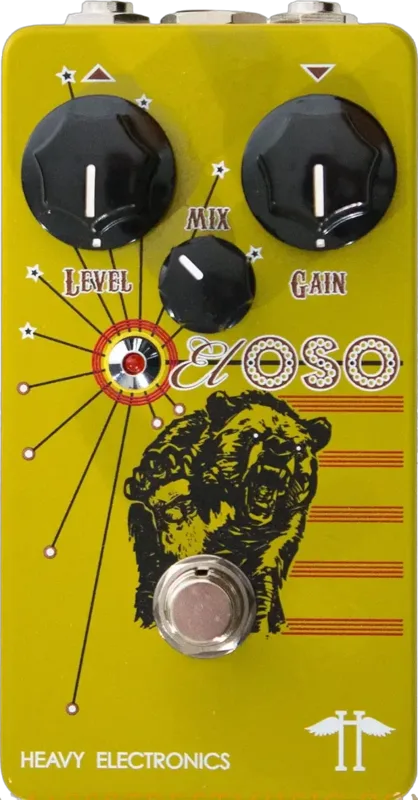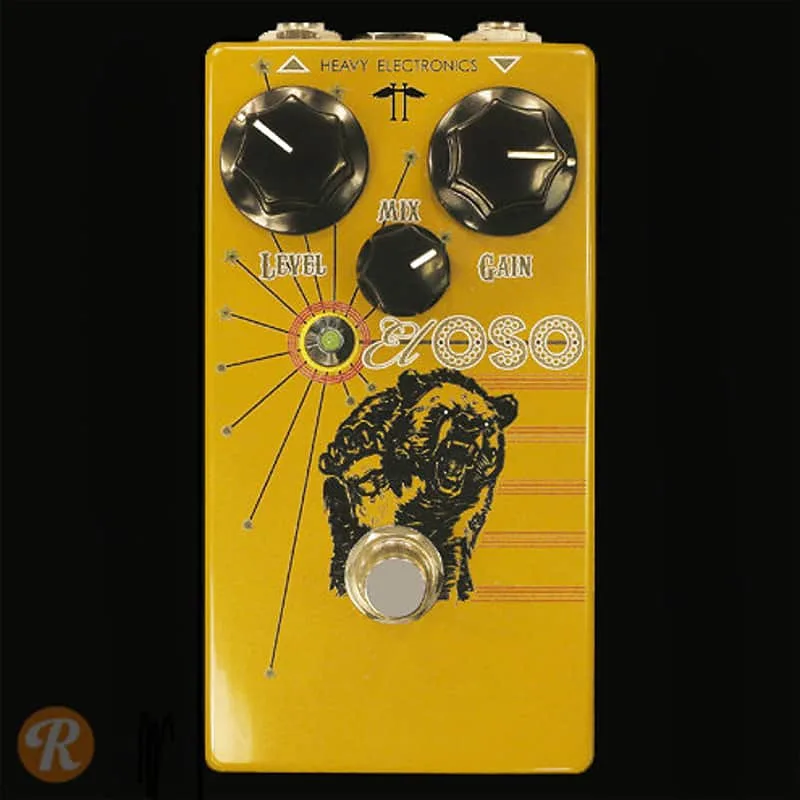


The Heavy Electronics El Oso is a distortion pedal aimed squarely at bass players who want grit without losing their low end. Premier Guitar's reviewer described it as "aimed at providing the grit and grind that rock bassists need to be heard and felt in the mix"1. What sets it apart from a plain distortion box is its Mix knob, which blends the distorted signal with your clean signal so the fundamental thump of the bass stays intact while the gain layer sits on top.
Heavy Electronics announced the El Oso in July 2011, describing it as a pedal that "blends roaring low-end gain with the dry signal and readily pours out both thump and gain to the input of your amp"2. No Treble reported it as a new bass distortion pedal shipping to stores at a street price of $1493. It is hand-made in Minneapolis, Minnesota by musicians2, and it carries a lifetime warranty.
Bass distortion blended with the dry signal
The core idea of the El Oso is the clean blend. Distorting a bass the usual way, by pushing the whole signal into clipping, can thin out the low frequencies that a bassist depends on. The El Oso splits that job: the distortion circuit does the grinding, and the Mix knob decides how much of it reaches your amp alongside the untouched dry signal421.
Pedal of the Day put it plainly:
"having the option to blend your clean signal with the distorted one is pure bliss"4
Pedal of the Day, 20164
The launch announcement described the extremes of the Mix control: "With the Mix knob at full mix, there is no hint of the dry signal and at zero mix the output signal is indistinguishable" from the bypassed signal2. That means the knob sweeps from fully wet distortion to effectively off, all without touching the footswitch.
The voicing is shaped with the top end in mind. The maker described the distortion's high frequencies as rolled off "nicely with enough contouring to do away with harshness," so the gain layer reads as grind rather than fizz2. A JFET input buffer sits at the front of the circuit, which the maker says "guarantees a solid match with the wide variety of impedances found in bass pickups"2. Pedal of the Day noted the same buffer helps the pedal match impedances across both guitar and bass pickups4.
The controls: Gain, Mix and Level
The front panel keeps things to three knobs, set against graphics Premier Guitar's reviewer described as an "old Vegas motif"1.
| Control | What it does |
|---|---|
| Gain | Sets the amount of distortion4 |
| Mix | Blends the distorted signal with the dry signal; full mix is all distortion, zero mix is indistinguishable from bypass2 |
| Level | Sets the output volume4 |
The maker positions Gain and Mix as a pair to work together: "Using the mix and gain knob together the user can create a deep palette of bass distortion tones"2. In practice that means high gain with the Mix pulled back for a subtle grind under a clean foundation, or the Mix pushed up for full-on distortion.
Build, power and bypass
Inside the housing, Premier Guitar's reviewer found "an expertly soldered PCB board, all-analog components, and a super-clean wiring job"1. Pedal of the Day described the circuit as a single point mounted PCB4. The enclosure is powder-coated die-cast aluminum2.
Power comes from an external 9V wall-wart or an internal 9V battery1, and the maker specifies 9V at 200mA "for Maximum Compatibility" with pedalboard power supplies2. Switching is true bypass with minimum length leads2, a point both the launch announcement and Pedal of the Day confirm4.
The 200mA draw is on the higher side for a compact analog pedal, so check that a daisy-chain supply has headroom before powering it alongside several other pedals.
Guitar, bass and other instruments
Although it is marketed as a bass distortion, the El Oso is "voiced openly for guitar, bass or any instrument," according to the launch announcement2. Pedal of the Day tested it on both instruments and found "using that open voicing to work well with guitar, even though it may be geared a little bit more towards bass"4. The JFET input buffer is part of why it travels well between instruments, since it accommodates the range of pickup impedances a player is likely to encounter4.
What reviewers said
Premier Guitar reviewed the El Oso, testing it with a 1987 USA Kramer Striker bass into a Traynor YBA300 head and matching 8x10 cabinet1. The reviewer's verdict centered on the voicing:
"the El Oso's strongest quality is how perfectly voiced the distortion tones are"1
Premier Guitar, 20261
Specifically, the reviewer found no frequencies overbearing or harsh across the Gain range1. Pedal of the Day called it "a monster distortion pedal" that "adds some great dirt and crunch to both instruments," crediting the clean blend as the feature that makes it4.
Warranty and service
Heavy Electronics backs the El Oso with a lifetime warranty, described at launch as "Lifetime Warranty (Barring Obvious Abuse)"2. Premier Guitar's review also notes that the builder provides repair and modification services1.
Videos
Bass Club Chicago
Prymaxe
Chris Igidbashian
Questions
Does the Heavy Electronics El Oso take a battery?
Yes. Power comes from an external 9V wall-wart or from an internal 9V battery, so it runs either way. The maker also specifies 9V at 200mA for maximum compatibility with common pedal power supplies.
Is the El Oso true bypass?
Yes. The pedal uses true bypass switching with minimum length leads, so when it is off the signal passes through without the circuit in the path. At zero Mix the output is described as indistinguishable from the bypassed signal.
Is the El Oso analog?
Yes. Premier Guitar's reviewer found all-analog components inside the housing, along with a cleanly wired, single point mounted PCB. There is no digital processing in the signal path.
Can you use the El Oso with a guitar?
Yes. It is voiced openly for guitar, bass or any instrument, and Pedal of the Day found the open voicing lets it work well with guitar even though it leans a little more toward bass. A JFET input buffer matches the wide range of pickup impedances.
Where is the El Oso made?
It is hand-made in Minneapolis, Minnesota by musicians, according to the original announcement, and Pedal of Day later described it as made by hand in Minnesota with high-quality components.
Does the El Oso have a warranty?
Yes. Heavy Electronics offers a lifetime warranty for the El Oso, described in the launch announcement as barring obvious abuse, and also provides repair and modification services.
Sources (4)
- Heavy Electronics El Oso Bass Distortion Pedal Review, Premier Guitar, 2011-11-30
- Heavy Electronics Releases El Oso Distortion Pedal, Premier Guitar, 2011-07-16
- Heavy Electronics Releases El Oso Bass Distortion, No Treble, 2011-07-16
- Heavy Electronics El Oso Bass Distortion, Pedal of the Day, 2016-11-11