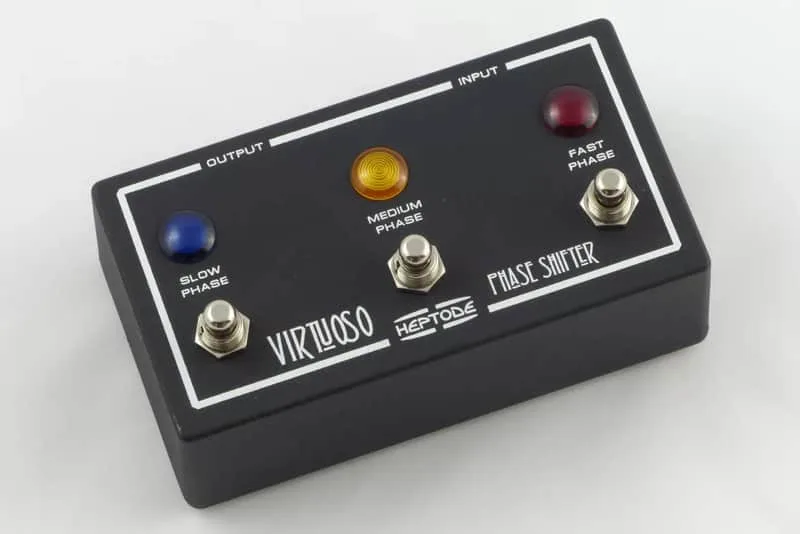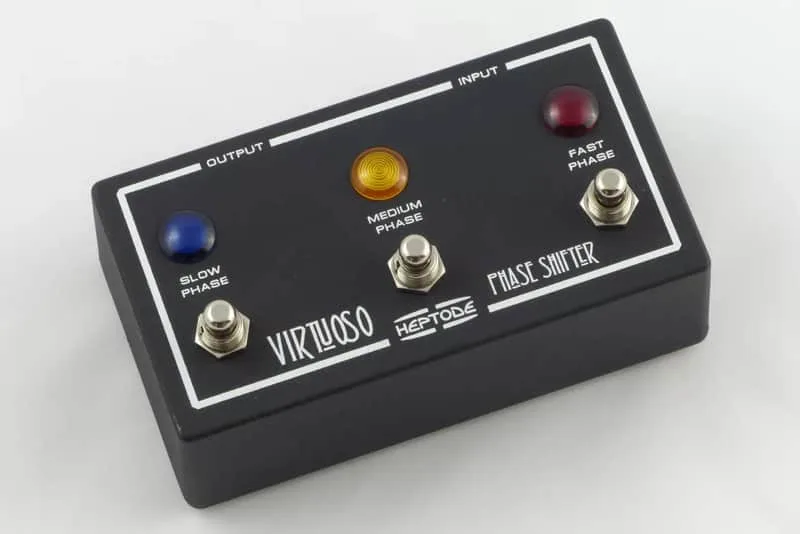


The Heptode Virtuoso is a phaser, a pedal that sweeps a notch-rich modulation across your signal for that swirling, jet-plane movement familiar from phaser pedals of the early 1970s. It is a re-creation of the Maestro PS-1A Phase Shifter, the '70s unit that Vintage Guitar magazine describes as the original it follows1. Heptode added it to its line of guitar effects in 2013, when Delicious Audio reported it as new to the Heptode range2.
What sets the Virtuoso apart from most modern phasers is how speed is handled: there is no speed knob. Instead, three speeds are selected by footswitch, and the speed ramps up or down when you switch from one to another, so you can change the effect while you play. MusicRadar's reviewer, Trevor Curwen, found that arrangement works: "We didn't miss a speed knob because the three speeds cover plenty of musical possibilities," adding that "the option of changes on the fly is a great onstage asset with the speed ramping up or down when switched, as on the original"3.
The Maestro PS-1A connection
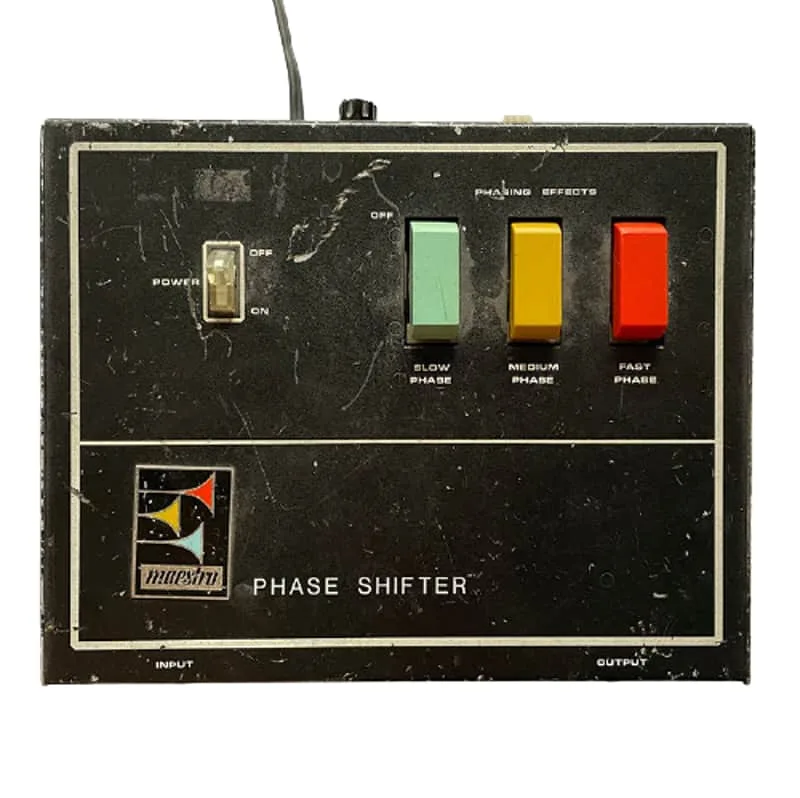
The pedal's circuit is based on the Maestro PS-1A3, a unit with real history. Premier Guitar dates it to 1971: "Back in 1971, nothing made heads spin like the Maestro PS-1A phase shifter"4. JHS Pedals' history of the phaser credits its origin to Tom Oberheim, writing that "Tom Oberheim creates the first phaser and turns it into the Maestro Phase Shifter PS-1A"5.
The original was an unusual piece of hardware. As JHS Pedals describes it, "this is a larger box that's meant to be mounted on a mic stand and features three paddle rocker knobs"5. Premier Guitar's review of a later Fender Waylon Jennings phaser notes the original was a 6-stage phaser, and that Jennings used one6. It also found its way onto records and stages beyond guitar: "You'll hear the Maestro Phase Shifter on a lot of classic recordings in the very early seventies," according to JHS Pedals5, and Delicious Audio notes the PS-1A was "as used in the 1970s by keyboardist John Paul Jones (Led Zeppelin)"2.
The Virtuoso cuts that design down for a pedalboard. MusicRadar's reviewer notes that "Where the original Maestro PS-1A was a beast of a pedal, Heptode's take cuts it down to a manageable footprint"3. For more on the original unit, see the Maestro PS-1A page.
Controls and layout
The Virtuoso keeps the original's multi-speed idea but puts it under your feet. MusicRadar describes a housing "just right for housing three footswitches (each with a different coloured LED)"3, so you can see at a glance which speed is engaged on a dark stage.
| Control | What it does |
|---|---|
| Three footswitches | Select one of three speeds, each marked by a different colored LED3 |
| Speed ramping | The effect ramps up or down when changing from one speed to another, allowing changes on the fly31 |
One thing to know about the size: cutting the PS-1A down did not make the pedal short. MusicRadar notes "it remains rather tall at 70mm from the base of its rubber feet to the tip of a footswitch"3, worth checking against the clearance above your other pedals.
Power
The Virtuoso can be powered by a 9-volt battery or an AC adapter, according to Vintage Guitar magazine1, so it works with either a battery or a standard pedal power supply.
What reviewers said
MusicRadar's Trevor Curwen was positive on the sound: "The phasing sound is thick and natural, sits well with guitar and features a unique complexity to the sweep with bags of" vintage flavor, and on the overall verdict, "If you want a certain early 70s flavour, you'll find it here"3. Delicious Audio's Gus, writing when the pedal was announced, said "I am very intrigued by this unique boutique vintage offering from Heptode"2.
Vintage Guitar also notes that, like the original, the Virtuoso "works well with guitar or keyboards"1, which suits players who run the effect on synth or keys as well as guitar.
Videos
gearmanndude
Guitar Player Magazine
MrSanSystem
Questions
Does the Heptode Virtuoso Phase Shifter have a speed knob?
No. MusicRadar's review notes the pedal has no speed knob: three speeds are selected by footswitch, and the reviewer found the three speeds cover plenty of musical possibilities. The speed also ramps up or down when you switch from one to another, so you can make changes on the fly while playing, as on the original Maestro.
Is the Heptode Virtuoso Phase Shifter true bypass?
Yes. Vintage Guitar magazine reports that the Virtuoso is wired true-bypass, so when the effect is off, your guitar's signal passes through without the phaser circuit loading it.
Does the Heptode Virtuoso take a 9-volt battery?
Yes. Vintage Guitar magazine reports the Virtuoso can be powered by a 9-volt battery or an AC adapter, so it works either on battery power or with a standard pedal power supply.
What is the Maestro PS-1A?
The Maestro Phase Shifter PS-1A, released in 1971, is widely credited as the first phaser, created by Tom Oberheim. It is a larger box meant to be mounted on a mic stand, with three paddle rocker knobs, and it is a 6-stage phaser. It was used by Waylon Jennings and, in the 1970s, by Led Zeppelin keyboardist John Paul Jones.
Can the Heptode Virtuoso be used with keyboards?
Yes. Vintage Guitar magazine reports that, like the original Maestro PS-1A, the Virtuoso works well with guitar or keyboards. That fits the original's history: Led Zeppelin keyboardist John Paul Jones used the PS-1A in the 1970s.
Sources (6)
- Heptode Line Expands with Virtuoso Phase Shifter, Vintage Guitar magazine, 2013-05-03
- Pedal News Heptode Virtuoso Phase Shifter, Delicious Audio, 2013-05-06
- Heptode Virtuoso Phase Shifter review, MusicRadar, 2017-01-21
- Heptode Virtuoso Phase Shifter Review, Premier Guitar, 2013-09-10
- 4 WAYS TO USE A PHASER PEDAL, JHS Pedals
- Fender Waylon Jennings Phaser Review, Premier Guitar, 2023-11-06