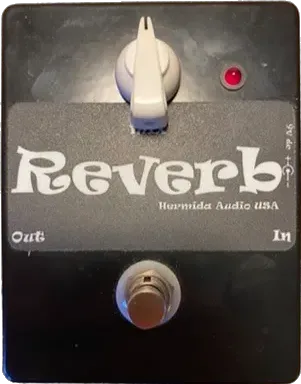
The Hermida Audio Reverb is a reverb pedal from [Hermida Audio], a maker better known among players for its overdrive designs. It offers what RockBoard's PedalPedia describes as a simple and effective way to add reverb to your favorite amplifier, sitting alongside the dry signal rather than replacing it.1
How the circuit works
The Reverb is unusual among reverb pedals in how it handles the signal. Hermida Audio describes it as having both analog and digital signal paths in order to maintain the warmth and response of the original signal. The digital side generates the reverb, while the analog side carries the dry signal untouched. Both signals are then mixed together and sent to the output of the pedal.1
For a player, that design means the core of your tone stays in the analog domain, with the reverb blended in behind it, rather than the whole signal passing through a digital converter. RockBoard's PedalPedia lists the circuit type as analog, reflecting that dry path.1
Power requirements
The pedal runs on a 9V DC supply with a center negative plug, the standard for compact pedals. What sets it apart is the current draw: RockBoard's PedalPedia lists it at 200mA, which is far more than a typical analog pedal needs.1
The Reverb needs a power supply output rated for its current draw. A low-current output or a daisy chain meant for a row of standard pedals will not run it reliably, so give it a dedicated output on your pedalboard power supply.1
Where it sits on a board
As a reverb pedal, the Reverb belongs to the effect family covered on the Reverb Pedals page, where it can be compared with other spatial and ambience effects. Players building a first board around it often pair reverb with time-based and dynamic effects such as Delay Pedals or Compressor Pedals.1
Questions
What power supply does the Hermida Audio Reverb 1.0 use?
The Reverb 1.0 runs on a 9V DC supply with a center negative plug, the same standard used by most compact pedals. Because it draws 200mA, it needs a supply output rated for at least that much current rather than a low-current output meant for smaller pedals.
How much current does the Hermida Audio Reverb 1.0 draw?
Hermida Audio lists the current draw at 200mA. That is well above what a typical analog overdrive needs, so plan your pedalboard power accordingly and give the pedal its own adequately rated output.
Is the Hermida Audio Reverb 1.0 analog or digital?
It is both. The pedal carries analog and digital signal paths at the same time: the digital path generates the reverb while the analog path preserves the warmth and response of the original signal, and the two are mixed together at the output.
Who makes the Hermida Audio Reverb 1.0?
The Reverb 1.0 is made by Hermida Audio, the pedal builder also known for its overdrive designs.
Sources (1)
- Reverb 1.0 by Hermida Audio, RockBoard (rockboard.de PedalPedia), 2026