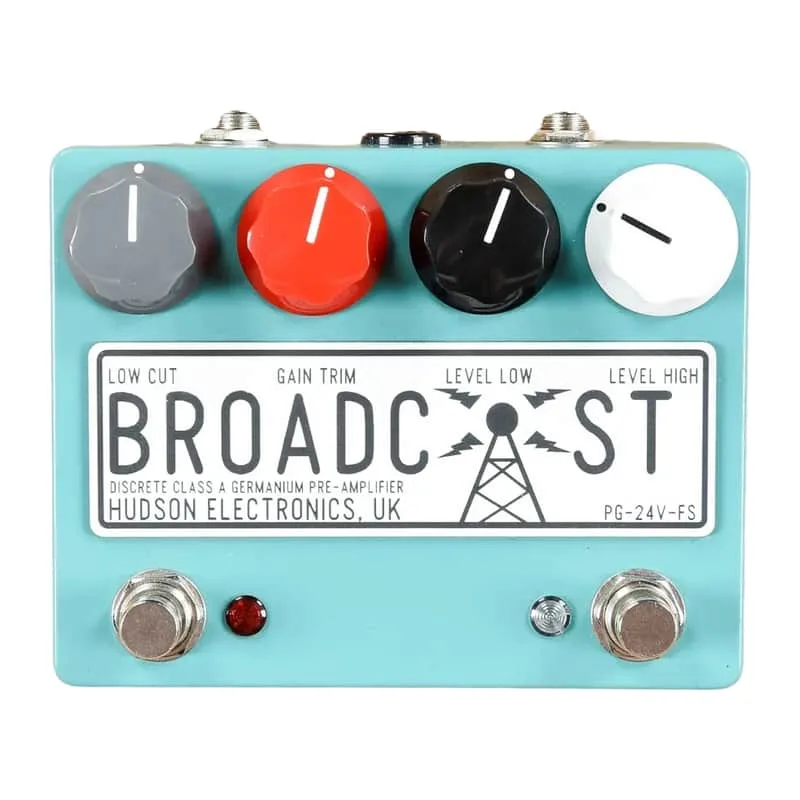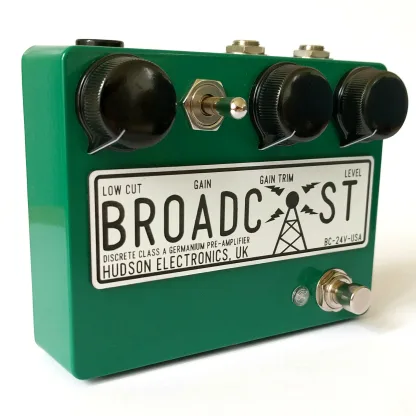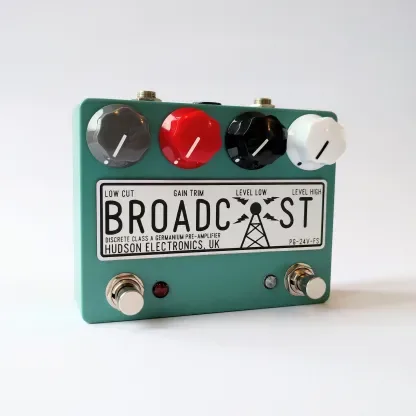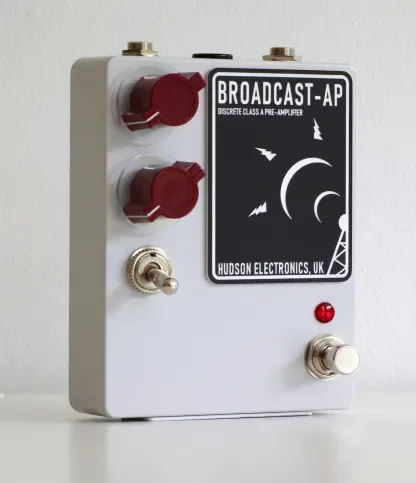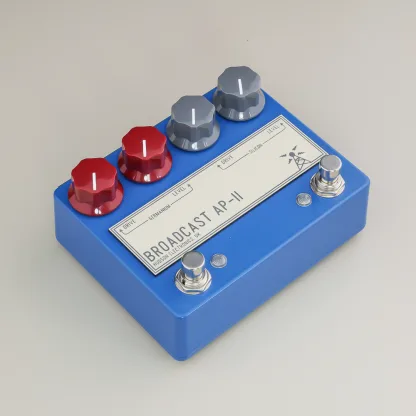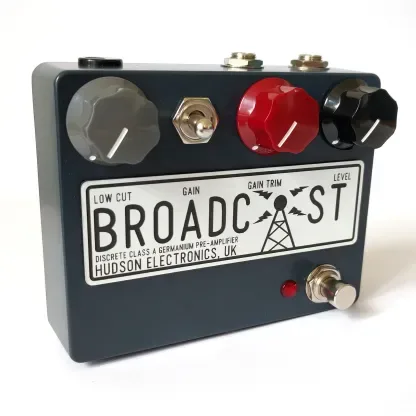


The Hudson Electronics Broadcast is a transformer-coupled, discrete Class-A germanium preamp pedal based on the classic broadcast consoles of the 1960s1. Where most overdrive and fuzz pedals are built around clipping diodes, the Broadcast gets its character from a specially chosen TRIAD Magnetics steel-core transformer and selected germanium and silicon transistors, which saturate and color the signal as the gain comes up1. Hudson describes the result as running from sparkling clean boost through transparent overdrive in the low-gain setting, into heavier distorted sounds with a warm and fuzzy edge in the high setting with the trim wound up2. It is Hudson's most popular pedal and the one that started the company, according to JHS Pedals3.
What it does: a 1960s broadcast console preamp
The Broadcast takes its inspiration from the preamps in classic recording and broadcast consoles of the 1960s, a lineage Guitar Pedal X also traces when grouping it among console-style preamp pedals17. Advancing the gain saturates the transformer and the discrete circuitry, which Hudson says gives a gentle, dynamic compression and a subtle thickening of the midrange8. Because of that, players use it in several ways: as a characterful boost in front of an amp, as a low-gain overdrive, or as a full-on distortion when pushed.
The pedal suits bass and other higher-output instruments too. Hudson notes that running it at voltages above 9V gives more headroom, output level and clarity, which is useful with bass guitar, synths or studio line-level gear, or when using it as a clean preamp boost1. On That Pedal Show, the presenters used one in a segment on what a guitar preamp is and why you would want one, treating it as a prime example of the type9.
The controls
The standard Broadcast keeps its control set small. RockBoard lists it as a preamp overdrive with a gain switch offering low and high settings2.
| Control | What it does |
|---|---|
| LEVEL | Controls the overall volume of the pedal1 |
| GAIN TRIM | Controls the gain level; at higher settings the high end of the signal is gently rolled off1011 |
| LOW CUT | Attenuates the low end; sits at the front end of the circuit and is interactive with the gain controls12 |
| Gain switch | Selects low or high gain, each with its own character413 |
In the low-gain setting the pedal covers everything from clean boost to transparent overdrive, with plenty of volume to push an amp214. With the gain switch high and the trim wound up, it delivers heavier distorted sounds with a warm and fuzzy edge2. Pedal of the Day's reviewer put it similarly: "The distortion is heavy, the overdrive is ballsy and there can even be elements of fuzz present if you listen right and, well, crank it"13. The dual-footswitch version moves the gain switch to a stomp and adds a second level control, giving Low Cut, Gain Trim, Level Low, Level High, Engage and a Low/High gain select158.
Power: 9V to 24V
The Broadcast requires a DC power supply and runs at voltages between 9V and 24V, through a 2.1mm negative center barrel plug, drawing typically less than 20mA1. There is no battery option; MusicRadar confirms it operates from a nine-volt DC supply but not batteries4. JHS Pedals notes the pedals accept 9, 12, 18 or 24 volts3.
Higher voltage is part of the design rather than a footnote. Hudson says running above 9V gives more headroom, output and clarity1, and the RockBoard listing for the Broadcast 24V says the increased voltage gives extra headroom and a tighter low end, for less saturation and grit without losing the Broadcast sound16. The BC-24V-USA version builds in a voltage booster that raises a standard 9V supply to 24V internally10.
No battery, and check your PSU: Hudson asks for a minimum of 20mA and a 2.1mm negative center barrel plug1. Some versions, like the PG-24V-FS, ask for a minimum of 50mA11.
History and versions
The Broadcast was originally released in 2015 according to Aion FX5, though guitar.com's review of the signature version dates the original's arrival to 20166. It has since grown into a family:
- Broadcast (standard): the original single-channel germanium preamp1
- Broadcast 24V and BC-24V-USA: versions running at 24 volts, the latter with an internal voltage booster from a 9V supply1610
- Dual Broadcast: a second footswitchable gain mode with its own level control515
- Broadcast-AP (2019): an Ariel Posen signature evolution of the Broadcast, controlled by level and gain trim knobs, sold exclusively through Andertons1718
- Broadcast AP-II (2023): a dual-channel update with two independent, differently-voiced preamp circuits1920
Aion FX also notes a limited-run version that combined features into one unit5, and Hudson has issued limited color runs of the AP521. The AP-II is the current flagship: its silicon channel (gray knobs) carries the smooth, darker tone of the original AP, while its germanium channel (red knobs) is brighter and more aggressive, each with Drive and Level controls1920. Guitar.com's guide named the AP-II its best dual overdrive22.
DIY layouts
A stripboard layout of the Broadcast was published on Guitar FX Layouts, in two versions: standard 9V and one with a 24V charge pump8. The build thread covers practical details: any PNP germanium transistor with an hFE in the 70 to 120 range works in the OC71 position, with the AC125 suggested as a cheap substitute; electrolytics on the 24V layout should be rated above 30V; and a builder reported a steady, rapid ticking noise on the charge-pump layout that gets louder with more gain8. Aion FX sells its own adaptation of the circuit as a project PCB5.
What reviewers said
The Broadcast built a strong reputation early: Delicious Audio notes it "has a stellar reputation and made several best-of lists when it came out a few years ago"17. Back in 2019, Richard Purvis was seriously impressed with the original AP21, and guitar.com rated the AP-II 9 out of 10, calling it "the most impressive version of the Broadcast yet, offering a mind-boggling selection of hugely usable dirty tones," though pricey21. On That Pedal Show, the presenters called the Dual Broadcast "so powerful" and well loved for good reason23.
On That Pedal Show's review of the Broadcast Dual, the presenters ran it at 9 volts while noting that 18 volts would give more headroom, and that it can go up to 24. They also confirmed the range of versions: a single-sided version, the dual, and artist signature versions, all handmade in England23.
Videos
We As A Company
Eirik Stordrange
Joe Perkins
News
Questions
Does the Hudson Broadcast take a battery?
No. Hudson states that the Broadcast requires a DC power supply unit and cannot run on batteries. It needs a 2.1mm negative center barrel plug, and the PSU should supply between 9V and 24V with a minimum current of 20mA. MusicRadar's review confirms the pedal operates from a nine-volt DC supply but not batteries.
What is the difference between the Broadcast and the Broadcast AP-II?
The standard Broadcast is a single-channel germanium preamp with a low/high gain switch. The Broadcast AP-II, developed with Ariel Posen, has two independent, differently-voiced preamp channels: a silicon channel with the smooth, darker tone of the original AP, and a germanium channel with a brighter, more aggressive tone, each with its own Drive and Level controls and footswitch.
Is the Hudson Broadcast a fuzz or an overdrive?
It is a preamp that spans both. Hudson and RockBoard describe the low-gain setting as covering clean boost through transparent overdrive, while the high gain setting with the trim control wound up delivers heavier distorted sounds with a warm, fuzzy edge. Reviewers have placed it across boost, overdrive, distortion and fuzz territory.
Is there a DIY Hudson Broadcast layout?
Yes. Guitar FX Layouts published a stripboard layout of the Broadcast in December 2016, reverse-engineered by a builder, in two versions: one for 9V and one with a 24V charge pump. Builders on that page discuss transistor substitutions, capacitor voltage ratings, and noise issues reported with the charge-pump version.
Where is the Hudson Broadcast made?
In Yorkshire, England. Hudson states that each Broadcast is individually hand-built onto a high-quality PCB, then assembled, hand-wired, tested and packaged all by Michael Hudson. That Pedal Show describes the Dual Broadcast as handmade in England, and Guitar.com calls the AP-II a UK-made pedal.
Sources (23)
- BROADCAST, Hudson Electronics UK, 2026
- Broadcast by Hudson Electronics, RockBoard PedalPedia, 2026
- WHY YOU NEED TO KNOW HUDSON ELECTRONICS, JHS Pedals
- Hudson Electronics Broadcast review, MusicRadar, 2016-07-18
- Skywave Germanium Drive / Hudson Broadcast, Aion FX, 2023-07-03
- Review: Hudson Electronics Broadcast-AP, guitar.com, 2019-11-13
- Guitar Pedal X, Guitar Pedal X, 2025-01-20
- Guitar FX Layouts: Hudson Electronics Broadcast, Guitar FX Layouts (tagboardeffects.blogspot.com), 2016-12-01
- What Is A Guitar Preamp & Why Would You Have One?, That Pedal Show, 2020-09-18
- BC-24V-USA, Hudson Electronics UK
- PG-24V-FS, Hudson Electronics UK
- PG-24V-FS, Hudson Electronics UK, 2026
- Hudson Electronics Broadcast Pre-Amp, Pedal of the Day, 2016-02-27
- BROADCAST, HUDSON ELECTRONICS UK, 2026
- Guitar Pedal X, Guitar Pedal X, 2021-08-23
- Broadcast 24v by Hudson Electronics, RockBoard PedalPedia, 2026
- Hudson Electronics Broadcast AP-II, Delicious Audio, 2026-02-19
- Hudson Electronics unveils Ariel Posen signature Broadcast-AP preamp pedal, MusicRadar, 2019-10-01
- BROADCAST AP-II, Hudson Electronics UK
- Hudson Electronics updates Ariel Posen's signature Broadcast preamp pedal with added germanium for “subtle boosts through to heavily-distorted sounds”, MusicRadar, 2023-12-15
- Hudson Electronics Broadcast AP-II review: two drive tones, endless possibilities, Guitar.com, 2024-02-26
- All gain, no pain: the 10 best overdrive pedals you can buy in 2026, Guitar.com, 2026-02-11
- Guitar Boost & Simple Preamp Pedals £50, That Pedal Show (YouTube), 2026-07-10