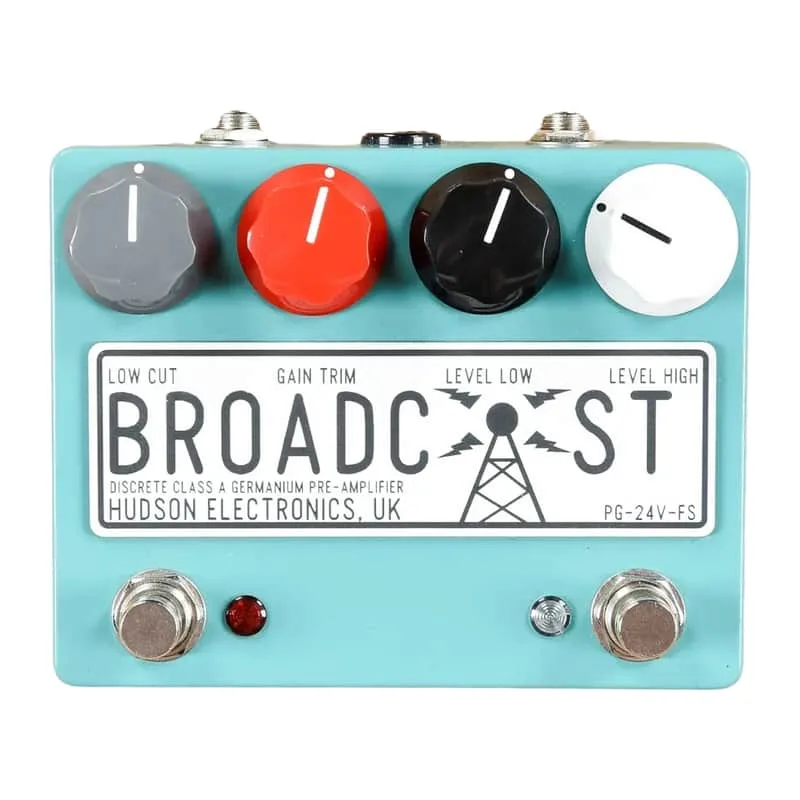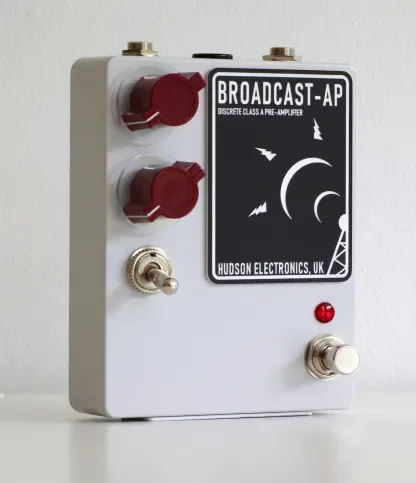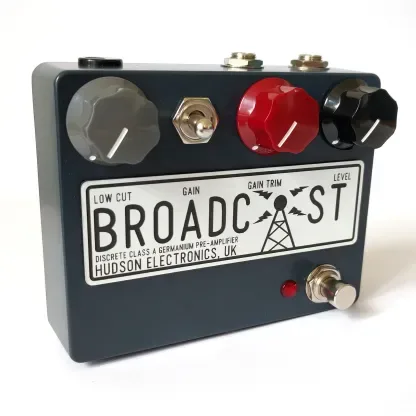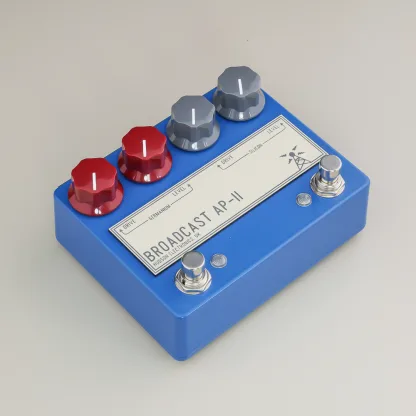


The Hudson Electronics Broadcast AP-II is a dual preamplifier pedal designed in conjunction with guitarist Ariel Posen, whose signature pedal it is12. It carries two independent, differently-voiced preamp circuits which each add their own subtle color, placed in series with separate footswitches so each channel can be engaged or bypassed on its own134. Both circuits can produce extended saturation covering medium-gain overdrive terrain, and beyond when cascaded into each other3.
The pedal sits in a long line of Broadcast versions: the original Ariel Posen signature Broadcast-AP arrived in 2019, and before that there had been a 24-volt version and a dual-footswitch version of the standard Broadcast2. The AP-II, released in December 2023, is the update that turns the single-channel AP into the two-channel pedal sold today3.
Two preamps in one: silicon with transformer, germanium without
The two channels are the heart of the pedal, and they are voiced differently on purpose143.
- Channel one (gray knobs): silicon-based, fitted with a silicon transistor and an OEP transformer. Hudson says it brings the smooth, darker tone of the original Broadcast-AP, the same character that made the Broadcast name13.
- Channel two (red knobs): removes the transformer and replaces the silicon with a germanium transistor, which Hudson says results in a brighter, more aggressive tone13.
The silicon channel's lineage goes back to the original Broadcast-AP of 2019, which used a pair of selected silicon transistors in place of the germanium transistor of the standard Broadcast, in conjunction with an OEP transformer, and was built on the same class-A discrete, transformer-coupled circuit designed to saturate like vintage recording and broadcast consoles536. The AP-II keeps that recipe for channel one and adds the germanium, transformerless channel two as the new voice13.
Guitar.com's reviewer, Josh Gardner, found real character in both sides. On the silicon side, he wrote721:
"As a clean boost, the pedal gives a pleasantly rounded thump to single-coils, reminding you of the Broadcast’s roots as a pedal designed to emulate the warmth of a Neve console, but there’s much more fun to be had here."2
Of the germanium side he found a dirt that is no less transparent but more aggressive and bratty, with an added punch of treble that brightens humbuckers and P-90s well, reaching full fuzz territory with the gain all the way up2.
The controls and the send/return loop
Each preamp section has its own DRIVE control, and each channel has an independent footswitch to engage or bypass it14.
| Control | What it does |
|---|---|
| DRIVE (silicon section) | Controls the gain of the silicon preamplifier section1 |
| DRIVE (germanium section) | Controls the gain of the germanium preamplifier section1 |
| Footswitches | Independent engage/bypass for each preamp channel4 |
Between the two sections sits a send/return loop, the big functional change over the original single-channel AP1:
- SEND: sends out the signal from the silicon section to another pedal; Hudson notes this can also be thought of as the output of the silicon section1.
- RETURN: receives the signal back into the pedal; this can also be thought of as the input of the germanium section1.
Because the two channels run in series, a player can patch another effect between them, so the silicon channel can push, say, a delay or another drive before the germanium channel adds its color. On the original Broadcast-AP the controls were simpler: Level and Gain Trim knobs plus a low-cut switch for activating a high-pass filter, with the low-cut control later becoming a simple on/off toggle86.
Power: 9V to 24V, 50mA
The AP-II runs on a regulated supply between 9V DC and 24V DC, through a 2.1mm negative-center barrel plug1. MusicRadar reports a maximum current draw of 50mA4.
Hudson specifies a regulated supply only. The wide 9V to 24V range means the pedal can run at higher voltages than most, but the supply's output must be regulated, so check any power brick's specs before plugging in.
What reviewers said
Guitar.com's review in February 2024 rated the AP-II 9 out of 10, calling it pricey but versatile27:
"Pricey but versatile, the second version of the Broadcast AP is the most impressive yet, and offers a mind-boggling selection of hugely usable dirty tones."2
The same reviewer found the price reflected in an absolutely rock-solid build inside and out, and described it as the second version of the tweaked Broadcast created by UK engineer Michael Hudson in partnership with Posen2. Guitar.com's best-overdrive buying guide also named the AP-II its best dual overdrive7.
The pedal has drawn demo attention too: That Pedal Show featured the Broadcast AP-II in its "Where does distortion become fuzz?" episode, from 33:589.
Videos
Ariel Posen
Eirik Stordrange
Peter “Danish Pete” Honoré
News
Questions
What is the difference between the Hudson Broadcast AP and AP-II?
The original Broadcast-AP, released in 2019, was a single preamp circuit with silicon transistors and an OEP transformer, with Level and Gain Trim controls and a low-cut toggle. The AP-II, released in December 2023, doubles the channels and places them in series with separate footswitches, adding a second, transformerless germanium channel and a send/return loop between the two.
Can I put another pedal between the two channels of the Broadcast AP-II?
Yes. The pedal has a send/return loop between its two preamp sections. The SEND jack puts out the signal from the silicon section, which can also be thought of as the output of the silicon section, and the RETURN jack receives the signal back into the pedal, acting as the input of the germanium section.
Can the Broadcast AP-II be used as a clean boost?
Yes. Guitar.com's reviewer found that the silicon, transformer-coupled side used as a clean boost gives a pleasantly rounded thump to single-coils, with transparent but chunky drive that gets more compressed and fuzzier as gain and level are turned up.
Where is the Hudson Broadcast AP-II made?
In the UK. Guitar.com's reviewer described it as a UK-made dirtbox, and the pedal is the second version of the tweaked Broadcast created by UK engineer Michael Hudson in partnership with Ariel Posen.
Sources (9)
- BROADCAST AP-II, Hudson Electronics UK
- Hudson Electronics Broadcast AP-II review: two drive tones, endless possibilities, Guitar.com, 2024-02-26
- Hudson Electronics Broadcast AP-II, Delicious Audio, 2026-02-19
- Hudson Electronics updates Ariel Posen's signature Broadcast preamp pedal with added germanium for “subtle boosts through to heavily-distorted sounds”, MusicRadar, 2023-12-15
- BROADCAST-AP, Hudson Electronics UK
- Hudson Electronics releases Ariel Posen signature Broadcast-AP preamp pedal, gearnews.com, 2019-10-03
- All gain, no pain: the 10 best overdrive pedals you can buy in 2026, Guitar.com, 2026-02-11
- Review: Hudson Electronics Broadcast-AP, guitar.com, 2019-11-13
- Where Does Distortion Become Fuzz? Hudson AP-II, Hawaiian Pizza, Hurts, TODP, Focus Fuzz Deluxe, That Pedal Show, 2025-05-23