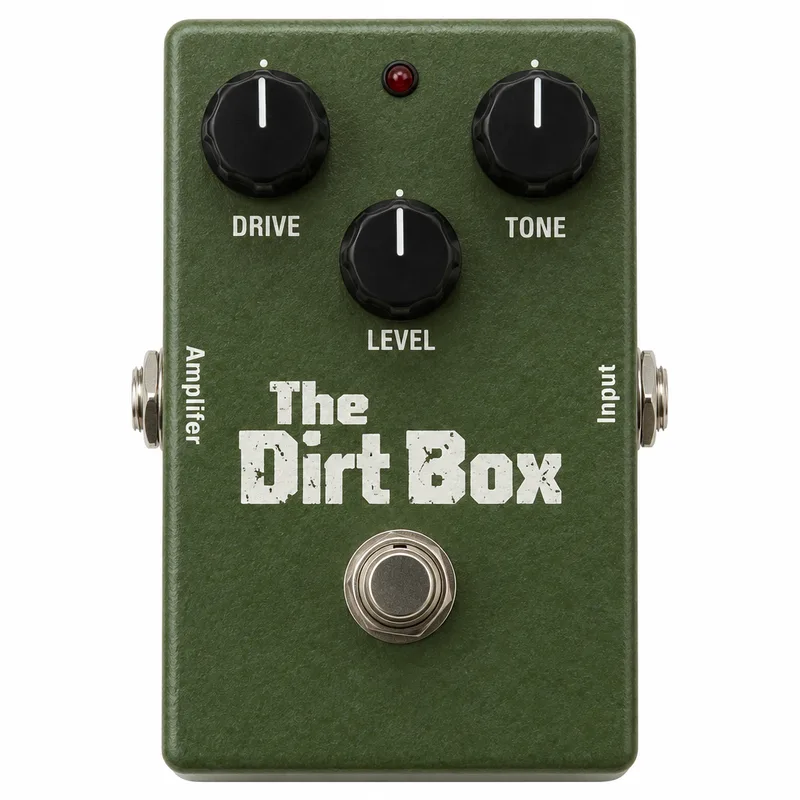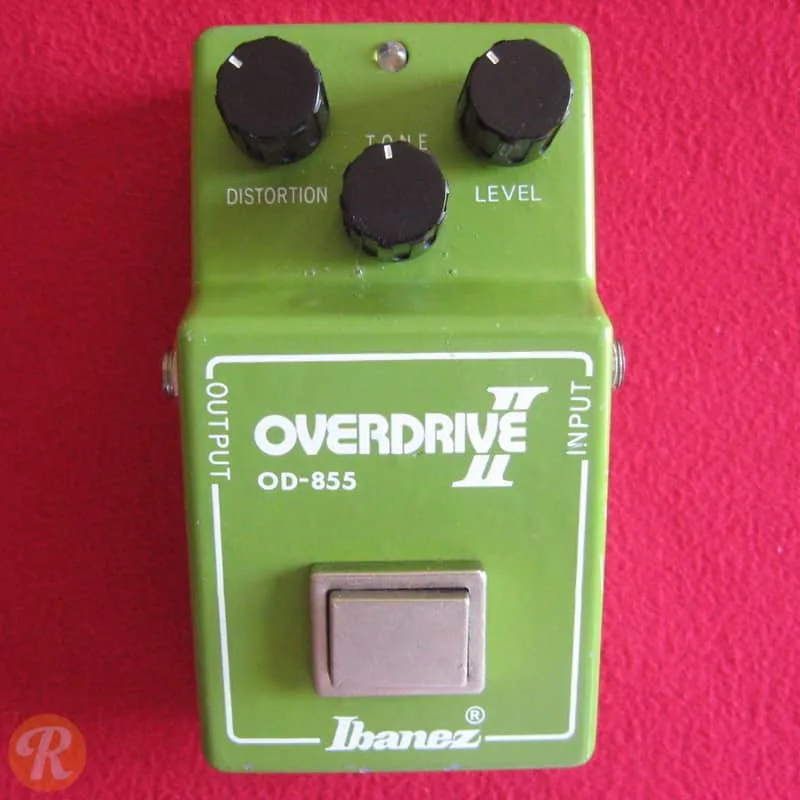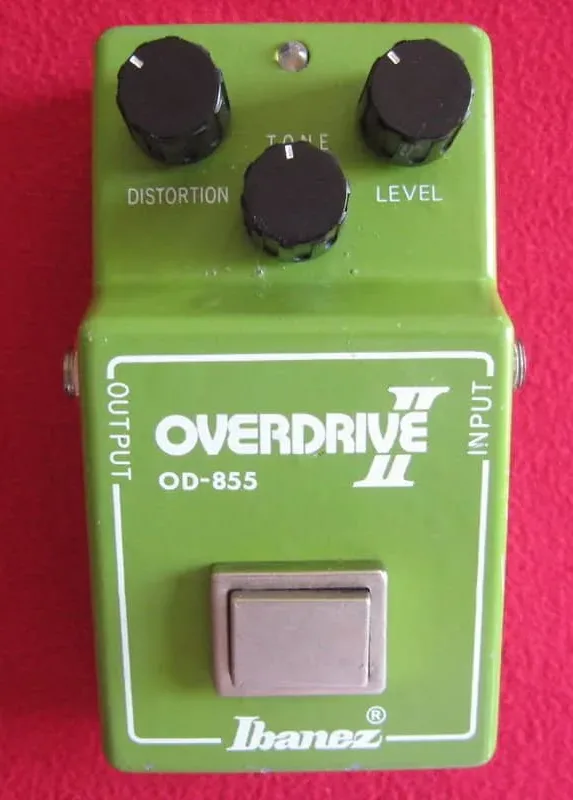


The Ibanez Overdrive II is a vintage overdrive pedal from Ibanez that, despite its name, leans toward distortion. In a 2001 ToneQuest Report interview, Analog Mike described it as "a little less fuzzy, but I would consider it to be more of a distortion pedal than an overdrive"1. The name covers two related but distinct pedals: the original Overdrive II, whose circuit was also sold as The Dirt Box, and the OD-855 Overdrive II, which sits right before the famous Tube Screamer in Ibanez's lineup23.
Vintage Guitar's history of Ibanez overdrives called the OD-855 "an impressive pedal for overdrive lovers" and noted it is quite versatile4.
More distortion than overdrive
The Overdrive II earned its distortion reputation from players who compared it against Ibanez's other overdrives. Analog Mike's assessment in the ToneQuest interview puts it plainly: less fuzzy than its sibling, but fundamentally a distortion pedal1.
Vintage Guitar's testing of the OD-855 found it versatile across settings4:
| Setting | What Vintage Guitar found |
|---|---|
| Balance midway, distortion around three o'clock | Fat-sounding distortion or overdrive, similar to a lower-gain Marshall amplifier tone, with notes that ring and sustain47 |
| Tone and distortion around midway | Tones similar to the TS-808, very hard to tell them apart in an A/B comparison with a Strat and a Vibrolux7 |
| Lower to mid gain | Distortion tones similar to the TS-808, capturing the natural overdriven tube amp sound, smooth and sustaining with a slight harmonic overtone7 |
| Balance at three o'clock or higher, distortion all the way down | A very usable, clean signal boost7 |
| With a small tube amp like a Fender Champ | Very smooth distortion7 |
| Distortion and balance all the way up | "It can get pretty squirrelly"7 |
The magazine also noted a limitation: with humbuckers, neither the Overdrive II nor its sibling cleans up the distortion as well4.
The circuit: gain, clipping, then tone
The original Overdrive II and the OD-855 use different topologies, which is the key to telling them apart. On the original Overdrive II, the stages run gain, then clipping, then tone. The OD-855 rearranges this to buffer, tone, gain, clipping, buffer, with both input and output buffers2.
The original's design is basically an MXR Distortion+ / DOD OD250 circuit with an active tone control added after the clipping stage2. Aion FX's analysis of the OD-855 reaches a similar conclusion: with its diodes-to-ground clipping setup, the OD-855 has a little more in common with an MXR Distortion+ than with the feedback-clipping Tube Screamer that followed it8.
That placement matters for how the pedal sounds. As GuitarPCB's technical analysis explains, when clipping components are placed after the gain stage, they limit the waveform more directly9. This is the classic diodes-to-ground approach shared with the Distortion+, rather than the Tube Screamer's method of clipping inside the op-amp's feedback loop.
The OD-855's clipping diodes are 1N60 germanium types per the schematic, with OA91 or 1N270 suggested as substitutes104. One builder on the Guitar FX Layouts blog noted of the circuit: "Probably the only one that doesn't suck with Ge diodes :)"2. Another builder tested it with 1N60, BAT41, 1N4448 and 1N914 diodes and found the transistor choices made no difference compared with the diode substitutions10.
The original Overdrive II is prone to oscillation when all knobs are maxed if the output level is raised2. Players running everything at ten should back off the output level to keep the pedal stable.
Versions and common modifications
ToneHome's production records track the OD-855 through several versions across two body styles653:
| Version | Years | Details |
|---|---|---|
| v1 (First Series) | 1976 to 1978 | First production run6 |
| v2 (1978) | 1978 | Block logo with flying fingers, no power jack, knobs: Distortion, Tone, Balance3 |
| v6 | later | Standard box with knurled nut on power jack, pcb "A"5 |
| v7 | later | Standard box with plain power jack, pcb "B"5 |
| Narrow box | 1978 to 1980 | Round-switch narrow box series production3 |
The original Overdrive II is a separate circuit from the OD-855, a distinction the Guitar FX Layouts blog stresses directly: "This layout is for the original Overdrive II, not OD-855"2. The same circuit was also sold as The Dirt Box2.
Builders on the Guitar FX Layouts blog documented a set of modifications to the original circuit2:
- Changed a 4k7 resistor to 2k7 and linked sustain 3 to 1
- Replaced the first 1M resistor with a 1M linear pot for more responsive gain
- Replaced a 200R resistor with a jumper
- Changed a 220n capacitor to 470n for a darker tone
- Swapped the bottom 100K for a 47K resistor and used a 100K linear pot for balance, to fix a reversed tone control and low output level
The blog's layout for the original shows 27 components, while original photographs show 25 or sometimes 26 components, a small discrepancy builders should be aware of2. The OD-855 layout went through corrections before builders confirmed "The effect works fine now"104; its layout image is labeled OD885 rather than OD85510.
A 1977 gear test from Fachblatt 10/77 documents the pedal being reviewed in the German press during its original production run6.
How it relates to later Ibanez overdrives
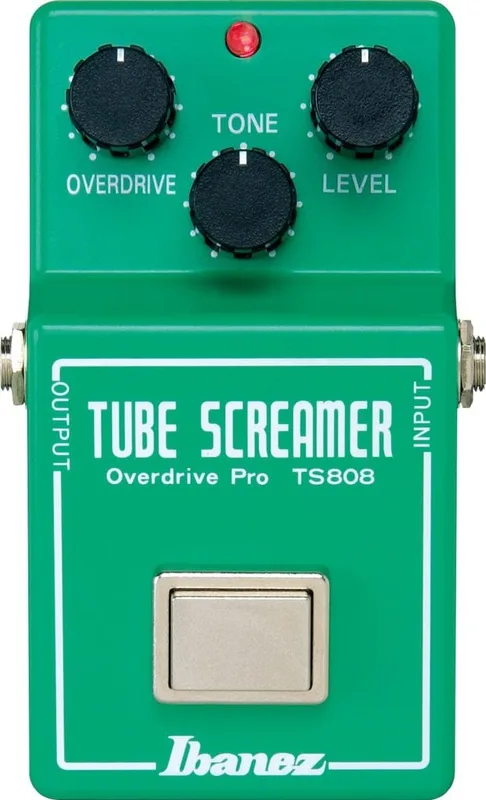
ToneHome places the OD-855 right before the famous Tube Screamer in Ibanez's pedal history3. Vintage Guitar's A/B testing found that at midway settings the OD-855 produces tones similar to the TS-808, with little difference revealed using a Strat and a Vibrolux7. The circuits differ underneath, though: the OD-855's diodes-to-ground clipping shares more with the MXR Distortion+ than with the Tube Screamer's feedback clipping8.
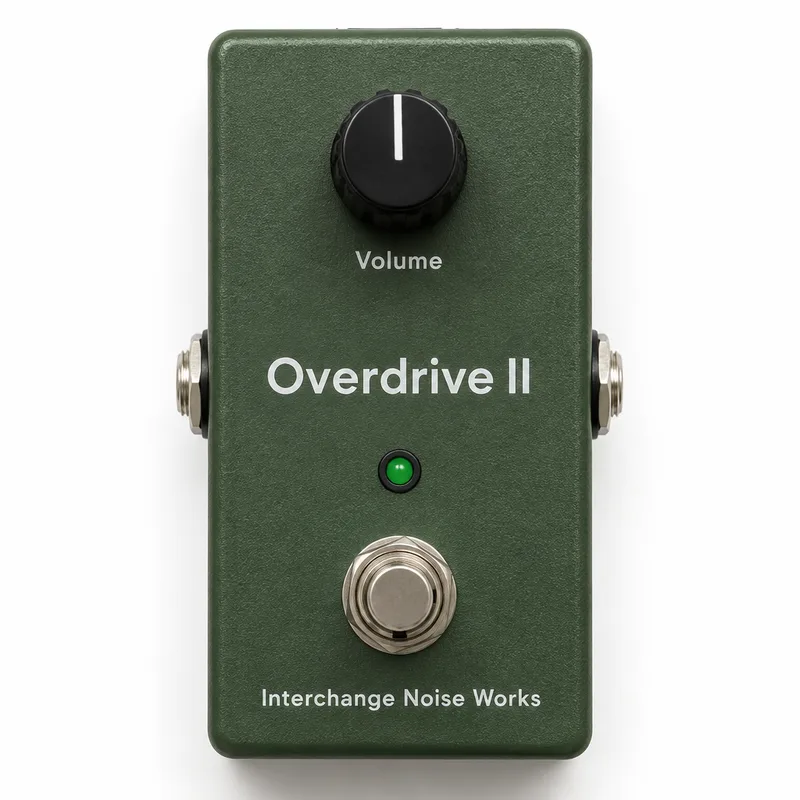
The Overdrive II name also lives on in modern pedals. The Interchange Noise Works Overdrive II takes its elements from the Electra Distortion circuit and carries just one Volume control, a very different design from the vintage original11.
Videos
akallons
akallons
Questions
Is the Ibanez Overdrive II the same circuit as The Dirt Box?
Yes. The original Overdrive II circuit was also sold as The Dirt Box. The related OD-855 Overdrive II is a different pedal: it adds input and output buffers and rearranges the stages, so the two should not be confused when comparing builds or buying vintage units.
Why does the Overdrive II oscillate with all knobs maxed?
The original Overdrive II is prone to oscillation when all knobs are maxed if the output level is raised. Taking the output higher pushes the high-gain circuit into self-oscillation, so players running everything at ten should back off the output level to keep the pedal stable.
Can the Overdrive II use germanium diodes?
Yes. The OD-855 layout calls for 1N60 germanium clipping diodes, with OA91 or 1N270 suggested as substitutes. Builders who tested 1N60, BAT41, 1N4448 and 1N914 diodes found the transistor choices made no difference, and one builder noted it is probably the only circuit that doesn't suck with germanium diodes.
What is the Overdrive II circuit based on?
The original Overdrive II is basically an MXR Distortion+ / DOD OD250 style design with an active tone control placed after the clipping stage. Its clipping uses diodes to ground, which gives it more in common with the Distortion+ than with the later Tube Screamer's feedback clipping.
Sources (11)
- http:, ToneQuest Report (republished on analogman.com), 2001-11
- Guitar FX Layouts: Ibanez Overdrive II / Dirt Box, Guitar FX Layouts (tagboardeffects.blogspot.com), 2013-08-25
- TONEHOME, TONEHOME, 1978
- Ibanez Overdrives, Vintage Guitar magazine, 2004-10-12
- TONEHOME, TONEHOME
- TONEHOME, TONEHOME, 1977-10
- Ibanez Overdrives, Vintage Guitar magazine, 2004-10-12
- Cumulus Vintage Overdrive, Aion FX, 2021-03-19
- How-Gain-Headroom-and-Clipping-Shape-Your-Tone.pdf, GuitarPCB, 2026
- Guitar FX Layouts: Ibanez OD855 Overdrive II, Guitar FX Layouts (tagboardeffects.blogspot.com), 2013-08-26
- Interchange Noise Works Overdrives I, II & III, Pedal of the Day, 2021-08-14