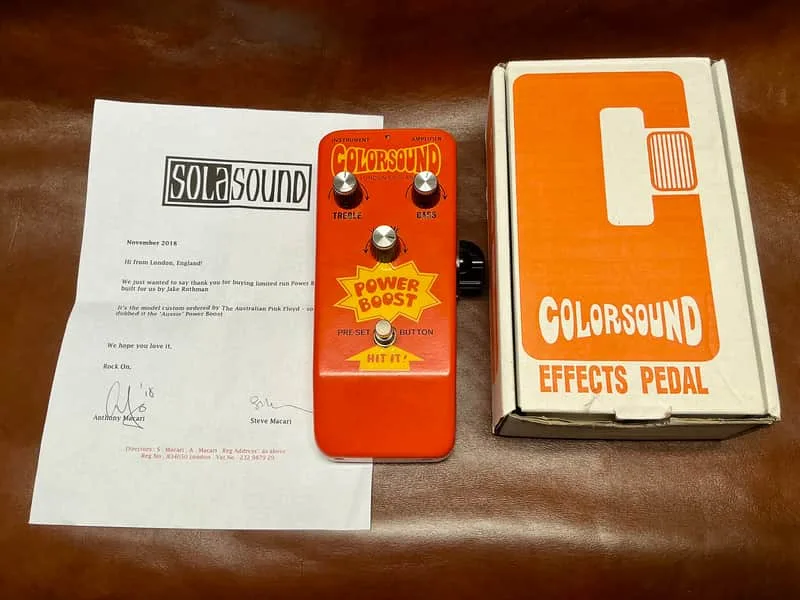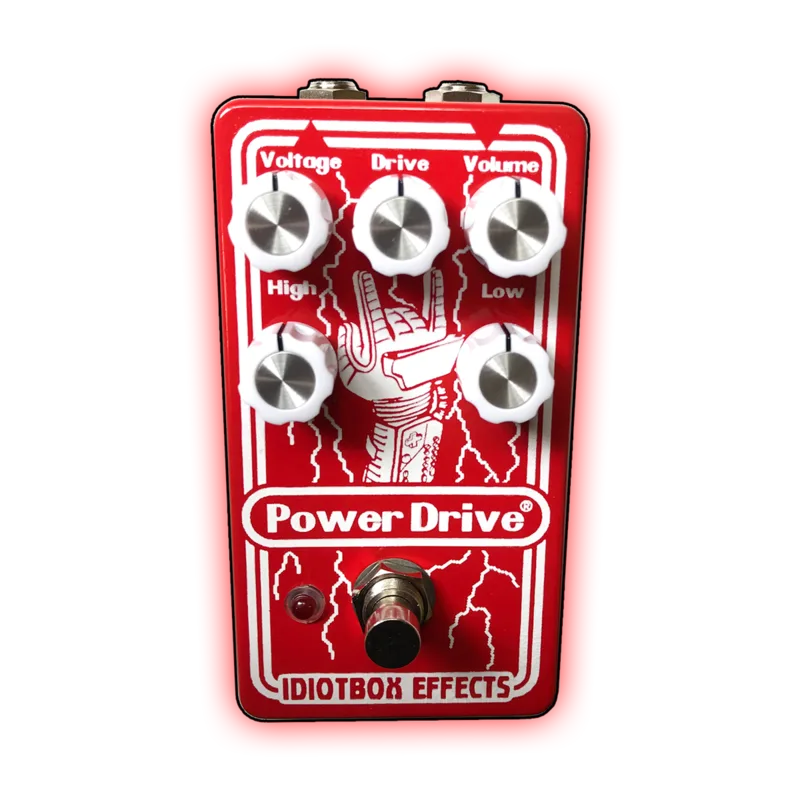


The IdiotBox Power Drive is a boost and overdrive pedal from IdiotBox Effects, built around the circuit of the old Colorsound Power Boost. The maker calls it a new and improved take on the earlier IdiotBox PowerBoost, which was itself based on the Colorsound original1. What sets the Power Drive apart is a front-panel Voltage knob that lets you dial the circuit's internal supply from a full 17v down to 3v, moving between high-headroom, full-throttle overdrive and a sputtery, starved sound1.
IdiotBox describes the sound plainly: "it is dirty, it is raw, it is loud and it is all POWER!"1. This is not a clean or transparent boost. Delicious Audio's write-up agrees, calling it "Dirty, raw and full of gain, this is not a transparent pedal by any means."2
The Colorsound Power Boost lineage
The original Colorsound Power Boost was first released in 1970, sold by the Macaris music store in London3. Aion FX describes it as a transistor-based boost/drive pedal with a 2-band tonestack, a discrete transistor boost/overdrive design34. Tru-Fi's history of the pedal says it "was designed to be a clean, high-headroom booster" created to push the front end of guitar amplifiers5.
The key to the original's character was its power. The Power Boost ran at 18 volts, using two internal 9V batteries in series46. That high voltage is what gave the pedal its headroom and its clean-into-overdrive push. Later versions came in different colors, and Aion FX notes at least two known variants, an early one and a later one, with a few different parts between them35.
The Power Drive carries that 18v idea into a modern 9V pedal. IdiotBox added a charge pump to get the circuit "pretty close to the original 18v with a 9v supply"1, and then went further by making that internal voltage adjustable from the front panel.
The Voltage knob
The Voltage control is the pedal's defining feature. Delicious Audio's reviewer singled it out: "it's the Voltage knob that makes things interesting, letting you choose the internal voltage directly from the front panel"2. Set to the full 17v, the pedal runs with high headroom for full-throttle overdrive; turned down to 3v, the circuit becomes sputtery and starved12.
For a player, this works like a built-in sag control. Instead of swapping batteries or rigging an adjustable supply, you get the starved, dying-battery character of a low-voltage fuzz or boost on one knob, alongside the cleaner, louder behavior of the original high-voltage design12.
The maker warns not to use any power supply rated over 9V DC with the Power Drive, as damage could occur. The charge pump generates the higher internal voltage itself; the pedal only ever needs a standard 9V supply1.
Controls, power and size
| Feature | Detail |
|---|---|
| Voltage knob | Internal circuit voltage, from full 17v down to 3v1 |
| Charge pump | Lifts a 9V supply close to the original 18v1 |
| Bypass | True bypass switching1 |
| Power input | 9V DC center negative, 2.1mm BOSS style1 |
| Current draw | 16mA1 |
| Battery | Battery snap included1 |
| Enclosure | 125B sized, 4.7" x 2.6" x 1.5"1 |
The 16mA draw and standard center negative input mean it fits a typical pedalboard power supply without any special arrangement. The battery snap gives it a standalone option, though the maker's 9V ceiling applies to both supply types1.
How it compares
The Power Drive sits in the boost and overdrive family rather than the distortion or fuzz camps, though its low-voltage settings lean toward starved-fuzz textures. Compared with a transparent boost, which aims to raise level without coloring the signal, the Power Drive is the opposite: IdiotBox and Delicious Audio both describe it as dirty, raw and gain-heavy, not transparent12.
Among IdiotBox's own line, it is the company's Colorsound-based voice. Its earlier PowerBoost covered the same circuit without the adjustable voltage, and the Power Drive is the refined version with the charge pump and Voltage knob in a smaller 125B enclosure12.
A note on the original circuit
Builders who have worked with the Colorsound circuit report quirks that the Power Drive's design addresses. On Tagboardeffects, Zach found the drive control on an 18V Power Boost build "bunched up at the end of the pot," and fixed it by swapping a 10k volume pot for a 1k, giving full gain clockwise with a more controllable response7. He also produced layouts with an added master volume pot, so the gain could be maxed while the output level was controlled separately7. These are the kinds of usability issues a purpose-built modern version can design out from the start.
Videos
Demos In The Dark
GuitarVacation
Questions
Is the IdiotBox Power Drive true bypass?
Yes. IdiotBox Effects lists true bypass switching among the pedal's features on its product page, so the signal passes through untouched when the effect is off.
How much current does the IdiotBox Power Drive draw?
The maker lists a current draw of 16mA. It runs from a common 9V DC center negative 2.1mm BOSS style power input, so it fits a standard pedalboard power supply.
Can the IdiotBox Power Drive use a battery?
Yes. The pedal includes a battery snap as well as the 9V DC power input, so it can run on an internal battery. Note that the maker warns against using any power supply rated over 9V DC, since damage could occur.
Is the Power Drive a transparent overdrive?
No. IdiotBox describes it as dirty, raw and loud, and Delicious Audio's write-up calls it dirty, raw and full of gain, not a transparent pedal by any means. It is a boost and overdrive with its own character.
Sources (7)
- Power Drive, IdiotBox Effects
- Idiotbox FX Power Drive, Delicious Audio, 2020-05-08
- Plasma Vintage Drive / Colorsound Overdriver, Aion FX, 2020-07-03
- Nucleus Vintage Boost / Colorsound Power Booster, Aion FX, 2020-07-03
- The Creation of the Colorsound Power Booster, tru-fi.com
- Tru-Fi Colordriver 9V version, loved by guitar pedal fuzz lovers worldwide, used by Jeff Beck and David Gilmour in the 70s, Tru-Fi
- Guitar FX Layouts: 18v Colorsound Power Boost, Tagboardeffects (tagboardeffects.blogspot.com), 2024-02-22