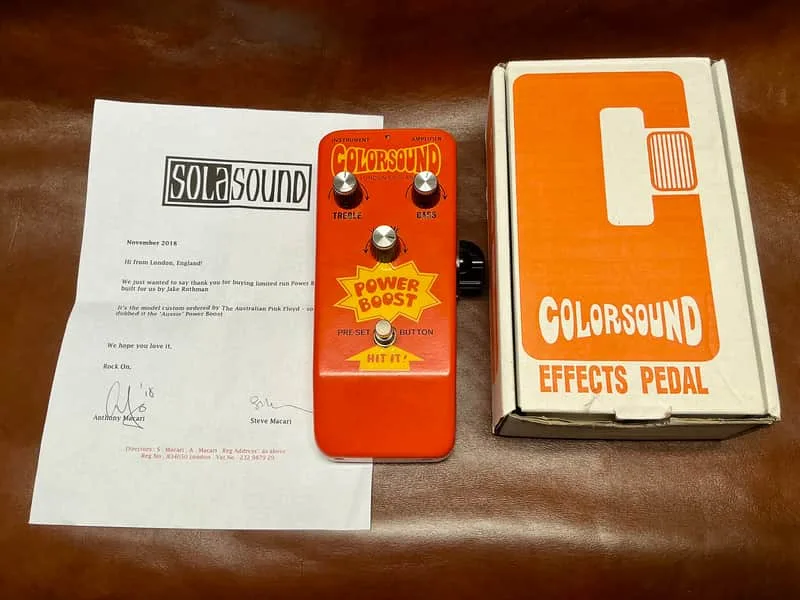


The Colorsound Power Boost is a British boost and overdrive pedal from the late 1960s, built around a simple three-transistor preamp with a two-band Baxandall EQ1. It was designed to be a clean, high-headroom booster that pushed the front end of a guitar amp into natural overdrive2, and it ran at 18 volts from two 9V batteries, which gave it far more output than most pedals of its day34.
It was created around 1968 by Gary Hurst1 and released by Sola Sound, the London company behind the Tone Bender156. Players know it best through David Gilmour, who used it extensively during the 1970s, and Jeff Beck, who used it for what Tru-Fi calls a "thick, explosive lead tone"632. Production of the 18V version ended in 1971, when Colorsound revised it into the 9V Overdriver784.
What it does to your sound
The Power Boost was designed as a clean, high-headroom booster meant to drive an amplifier's input harder, producing overdrive from the amp itself rather than from the pedal2. Its two-band Baxandall EQ lets you shape bass and treble independently, a feature carried over from hi-fi preamp design and unusual on a pedal of this era1.
One quirk matters to anyone playing an original or an accurate clone: on the original, the pot labeled Volume behaves more as a gain control than a true volume control9. There was no master volume, so the pedal's output level rose with its gain setting.
"The pedal was known for it's powerful overdrive but also it's incredible boost factor"4
Power: 18 volts
The Power Boost ran at 18 volts, supplied by two 9V batteries in series34. That doubled voltage is the heart of the pedal's character: it is what gave the circuit its high headroom and its very large boost factor.
It is also why the pedal gained a reputation for being too loud. Tru-Fi is blunt about it84:
"before the master volume mod the pedal was TOO LOUD at 18V so the 9V version was released."
Colorsound later added a master volume mod, letting a player max the gain and control the output level separately4. DIY builders commonly make the same change: Tagboardeffects published four stripboard layouts of the circuit, two identical to the original early and late versions and two with an added master volume pot, precisely so a builder can run full gain and set the level independently9.
Who designed it, and where it came from
The circuit is credited to Gary Hurst, created around 19681. Sola Sound, the London company behind the Tone Bender, released it in 19696, and it was first sold in 1970 through the Macaris music store in London3. Premier Guitar's history of the Tone Bender notes the Power Boost was added to the Colorsound line alongside another three-transistor fuzz10.
The release date is genuinely disputed. Tru-Fi says 19696, Aion FX's research says it was first sold in 1970 and notes that Macari's own website claims 1968, while Kit Rae's research dates the Colorsound brand itself to 1970, which Aion FX finds more trustworthy3111. With no ruling between them, the honest answer is 1968 to 1970 depending on whose account you read.
The original units came in a distinctive orange enclosure, though later versions appeared in different colors, some with slight modifications to the circuitry or controls2. Aion FX identifies at least two circuit variants, an early version and a later version with a few different parts between them311.
The Power Boost and the Overdriver
For a player comparing the two today, the practical differences are the power supply (18V versus 9V) and the tamed output. Vintage Power Boost units are sought after by collectors and enthusiasts2.
Who used it
- David Gilmour used the Power Boost extensively during the 1970s, an association Tru-Fi links to his iconic tones of that era2. RockBoard's PedalPedia lists Gilmour among the pros whose 70s signature tones relied on it12.
- Jeff Beck used it for a thick, explosive lead tone6, and Pedal of the Day names him alongside Gilmour as a favorite of the pedal613.
Clones and modern versions
The original's popularity has produced reissues and clones from various manufacturers2. A few the press has covered:
For DIY builders, Tagboardeffects published verified stripboard layouts in 2017 covering the early and late versions plus the master volume mods9. One builder reported that the drive bunched up at the end of the pot and fixed it by swapping the 10k volume pot for a 1k, and that after trying the circuit at 18 volts he actually preferred it at 9 volts9.
Videos
gilmourish
gilmourish
blackholeproductions
News
Questions
Who designed the Colorsound Power Boost?
The circuit is credited to Gary Hurst, who created it around 1968. It was built and sold by Sola Sound, the London company also behind the Tone Bender, and first sold through the Macaris music store in London. Hurst is also associated with the Tone Bender line of fuzzes.
What is the difference between the Power Boost and the Overdriver?
The Overdriver is the Power Boost revised to run on a single 9V battery instead of 18 volts. Colorsound made the change in 1971, partly to tame the original's very high output. Premier Guitar dates the renaming to the Colorsound Overdriver in 1973, and Aion FX describes the Overdriver as a third revision of the circuit from 1972.
When was the Colorsound Power Boost released?
Sources disagree on the exact year. Tru-Fi says Sola Sound released it in 1969, Aion FX says it was first sold in 1970 by the Macaris music store in London, and Macari's own website says 1968. Production of the 18V version ended in 1971 when it became the Overdriver.
Why was the original Power Boost considered too loud?
Running at 18 volts from two 9V batteries, the pedal had a very large boost factor and no master volume, so its output could overwhelm an amp. Tru-Fi describes it as simply too loud at 18V before the master volume mod, which is why Colorsound released the tamer 9V Overdriver.
Are there clones of the Colorsound Power Boost?
Yes. Tru-Fi notes that the original's popularity has led to reissues and clones from various manufacturers, including modern pedals from Tru-Fi, BLAMMO! Electronics, Vick Audio and others. DIY stripboard layouts of both early and late versions are also published on Tagboardeffects.
Sources (13)
- Voltage Booster, BLAMMO! Electronics
- The Creation of the Colorsound Power Booster, tru-fi.com
- Nucleus Vintage Boost / Colorsound Power Booster, Aion FX, 2020-07-03
- Tru-Fi Colordriver 18 Volt Guitar Pedal like the original Colorsound Power Booster, Tru-Fi
- BLAMMO! Electronics Voltage Booster, Delicious Audio, 2022-10-05
- Tru-Fi '69 Colordriver Pedalboard Mini Version Guitar Pedal, Tru-Fi
- Tru-Fi COLORDRIVER Overdrive/Fuzz, Delicious Audio, 2020-06-15
- Tru-Fi Colordriver 9V version, loved by guitar pedal fuzz lovers worldwide, used by Jeff Beck and David Gilmour in the 70s, Tru-Fi
- Guitar FX Layouts: 18v Colorsound Power Boost, Tagboardeffects (tagboardeffects.blogspot.com), 2024-02-22
- Stompbox Classics: Tone Bender, Part 2, Premier Guitar, 2009-10-21
- Plasma Vintage Drive / Colorsound Overdriver, Aion FX, 2020-07-03
- Overdrive Boost by ThroBak, RockBoard (PedalPedia), 2026
- FTelettronica Pedals Final Cut Preamp Booster EQ, Pedal of the Day, 2025-01-04