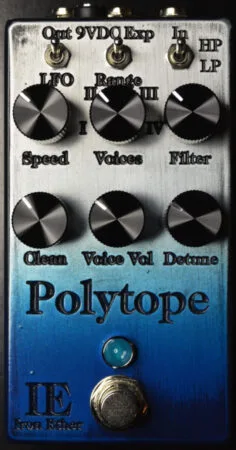


The Iron Ether Polytope is a four-voice detuner, chorus and vibrato pedal. It creates up to four copies of the input signal, each detuned in pitch, which the maker says produces everything from subtle thickening to huge multi-voice detuned synth sounds. With the clean signal removed it becomes a true pitch vibrato, and with the detuned voices blended against the dry signal it works as a chorus, sitting somewhere between the usual chorus pedals and octave and pitch pedals in what it does.1
What it does
The Polytope's core idea is stacking detuned copies of your note. The Voices knob fades up each detune voice in sequence: first a voice shifting up from the original pitch, then one shifting down, then two more voices twice as far from the original note. Each new voice alternates above and below the original pitch, which is how the pedal moves from a gentle thickening to wide, synth-like detuned stacks.13
Because the detuned voices can be heard against the clean signal or on their own, one pedal covers three related jobs14:
- Detuner: fixed pitch offsets on up to four voices for thickening a single note or chord.
- Chorus: the detuned voices blended with the clean signal for movement and width.
- Vibrato: the clean signal removed, leaving true pitch vibrato. Iron Ether describes the range as "slight wavering to tape-style wow and flutter, slow seasick wobbles and high speed FM synth-style modulation."1
The controls
| Control | What it does |
|---|---|
| Clean | Controls the volume of the clean signal; adding it creates detune or chorus sounds, removing it creates vibrato1 |
| Voices | Fades up the volume of each detune voice in sequence, starting with one voice above the original pitch, then a down-shifting voice, then two more voices twice as far from the original note1 |
| Filter | Sets the cutoff frequency of a filter before the detuning, switchable between high-pass and low-pass1 |
| Speed | When the LFO is engaged, controls the speed of the LFO that sweeps the pitch up and down, from one cycle over many seconds up to low audio frequencies1 |
| LFO | Switch; setting it up engages the LFO1 |
The filter before the detuning is worth noting for bass players: rolling the filter toward low-pass or high-pass shapes which part of the signal gets the detuning treatment, which is not a control most chorus pedals offer1.
Expression pedal control and the 2017 update
The Polytope debuted in December 2011, when No Treble described it as a quad-voice pitch detuner that was already shipping.3 In May 2017, Gearnews reported a new version with what it called substantial updates, the headline change being an external jack for an expression pedal: "you can now use an external expression pedal to either control the detuning amount or chorus/vibrato depth."2 That makes the pedal's intensity playable in real time, sweeping from no effect to full depth with your foot. See expression pedals for what works in that jack.
Power, build and price
Iron Ether specifies an industry-standard 9 volt DC center-negative supply with an 85mA current draw.1 That draw rules out running it comfortably from a battery or a lightly rated daisy-chain output.
At 85mA, the Polytope needs a supply output rated for at least that much current. Check the ratings on a shared supply before adding it to a daisy chain.1
The enclosure is powder coated in teal vein with three-dimensionally engraved graphics, and the pedal measures 4.7" x 2.5" (12cm x 6.3cm).1 No Treble reported it is made in the USA.3
On price: the pedal listed at $205 when it debuted in 2011,3 and Iron Ether's current product pages list it at $315.00 USD as of 2026-10-26.45
Videos
Arturo Castillo Delgado
Prymaxe
MrExcane
Questions
Does the Iron Ether Polytope have true bypass?
Yes. When No Treble covered the pedal's release in December 2011, the publication listed relay-based true bypass among its features, so the pedal switches with a relay rather than a conventional footswitch and keeps the signal path out of the circuit when it is off.
What power supply does the Iron Ether Polytope need?
Iron Ether says the Polytope runs on an industry-standard 9 volt DC center-negative power supply and draws 85mA. That draw is high enough that a battery is not the intended option, and a shared daisy chain with several other pedals may not be comfortable either, so a dedicated supply output is the safer choice.
Can you control the Polytope with an expression pedal?
Yes, on the 2017 version. Gearnews reported that the updated Polytope added an external jack for an expression pedal, which can control either the detuning amount or the chorus and vibrato depth, opening up what the maker calls expressive and unusual sounds.
Can the Polytope work as a vibrato without the clean signal?
Yes. Iron Ether explains that removing the clean signal allows for true pitch vibrato, ranging from a slight wavering to tape-style wow and flutter, slow seasick wobbles, and high-speed FM synth-style modulation. The Clean knob controls how much of the untouched signal is blended back in.
Where is the Iron Ether Polytope made?
No Treble reported that the Polytope is made in the USA when the pedal debuted in December 2011. The enclosure is powder coated in teal vein with three-dimensionally engraved graphics, according to Iron Ether's product page.
Sources (5)
- Polytope, Iron Ether
- Iron Ether’s Polytope Detuner/Chorus/Vibrato bass pedal gets an expressive update, gearnews.com, 2017-05-17
- Iron Ether Debuts Polytope Pedal, No Treble, 2011-12-17
- Polytope, Iron Ether
- FMeron - Iron Ether, Iron Ether