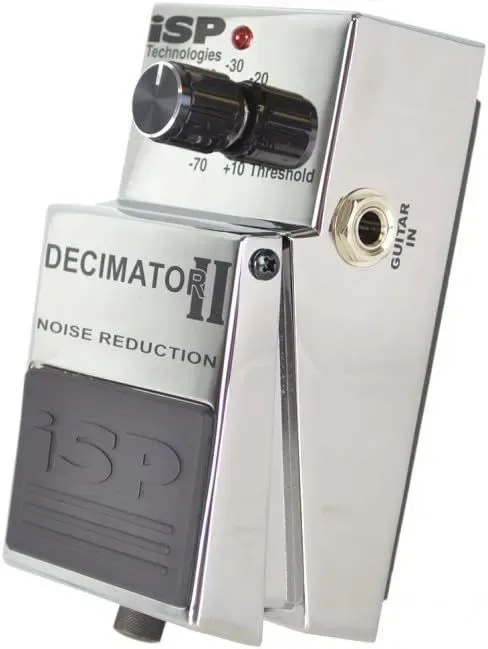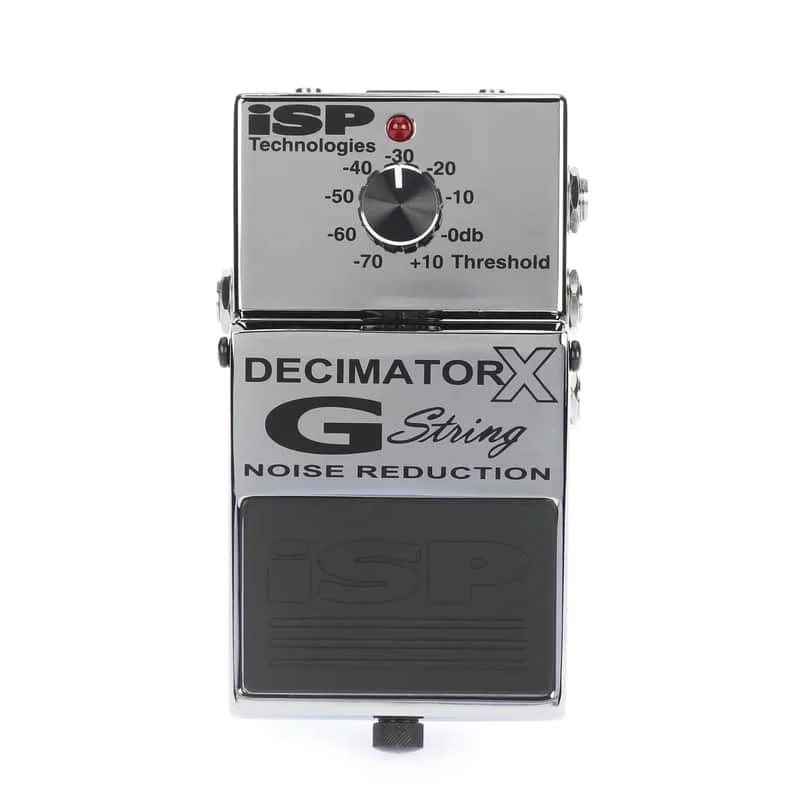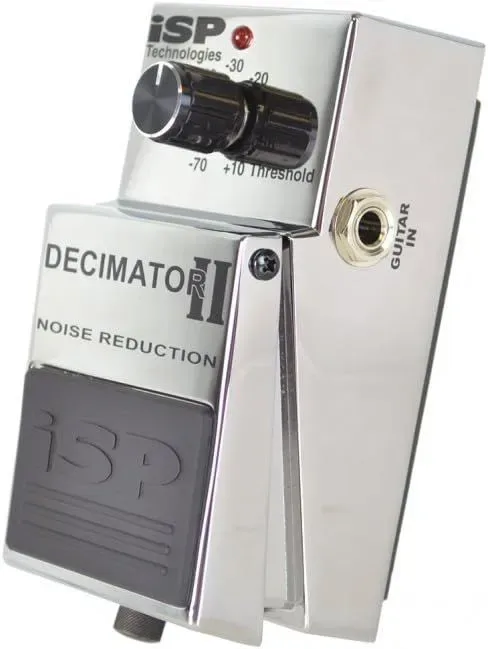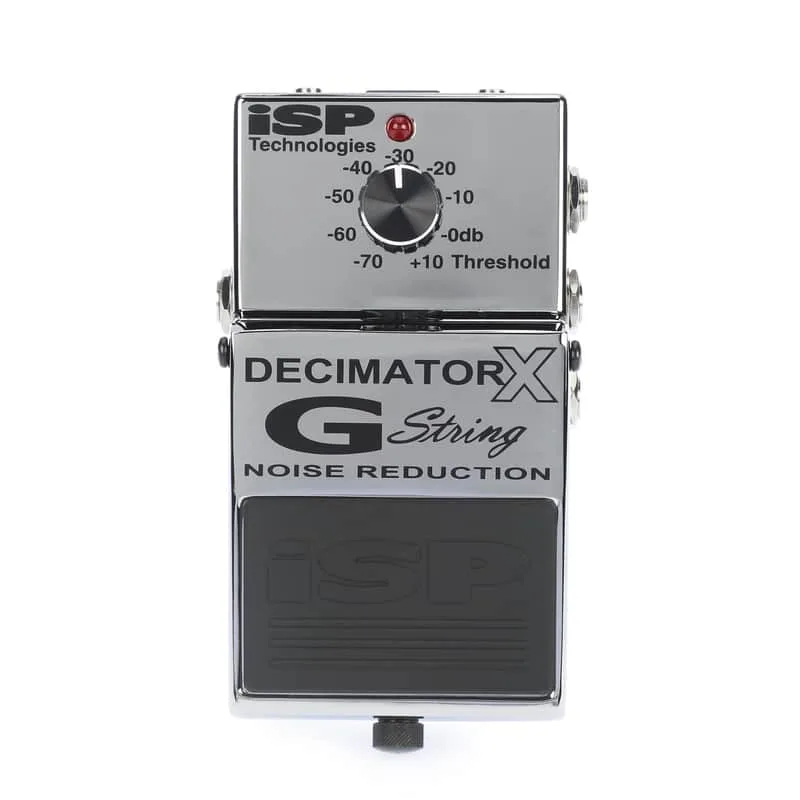


The ISP Technologies Decimator G String is a noise reduction pedal aimed at players whose rigs hiss and hum, especially those running high-gain pedals or a hot preamp. It comes from the original Rocktron engineering team that designed the Hush noise reduction, and it uses ISP's Time Vector Processing, which Premier Guitar describes as responding "instantly and accurately to all varieties of note durations"1. What sets the G String apart from a plain inline noise gate is its loop connection: it tracks the signal straight from the guitar while its processing channel cleans up the noisy part of the chain further downstream.
The threshold knob and footswitch
Operation is deliberately simple. The pedal consists of one threshold knob and an active/bypass switch1. You turn the threshold up until the noise or hum present when you are not playing disappears, and you use the footswitch to take the whole circuit out of the signal path when you do not want any processing at all. There are no attack, release or decay controls to balance; the Time Vector Processing circuit handles how the reduction follows your notes, which Premier Guitar found tracked everything from quick staccato playing to held sustains1.
| Control | What it does |
|---|---|
| Threshold knob | Raised until no noise or hum is present with the guitar at rest1 |
| Active/bypass switch | Engages or removes the noise reduction circuit1 |
Link jacks and loop placement
The G String's reason for existing is placement flexibility. Premier Guitar notes it can be inserted into a series effects loop or at the end of your chain of badly behaved, noisy pedals4. ISP describes the current versions' design as letting you connect the processing channel into your effects loop after your high-gain pedals or preamp, while the pedal still tracks the signal directly from your guitar23. That split is the point: a gate placed after your distortion sees a compressed, noisy signal and can clamp down on your sustain, whereas the G String reads the clean guitar output and applies the right amount of reduction downstream.
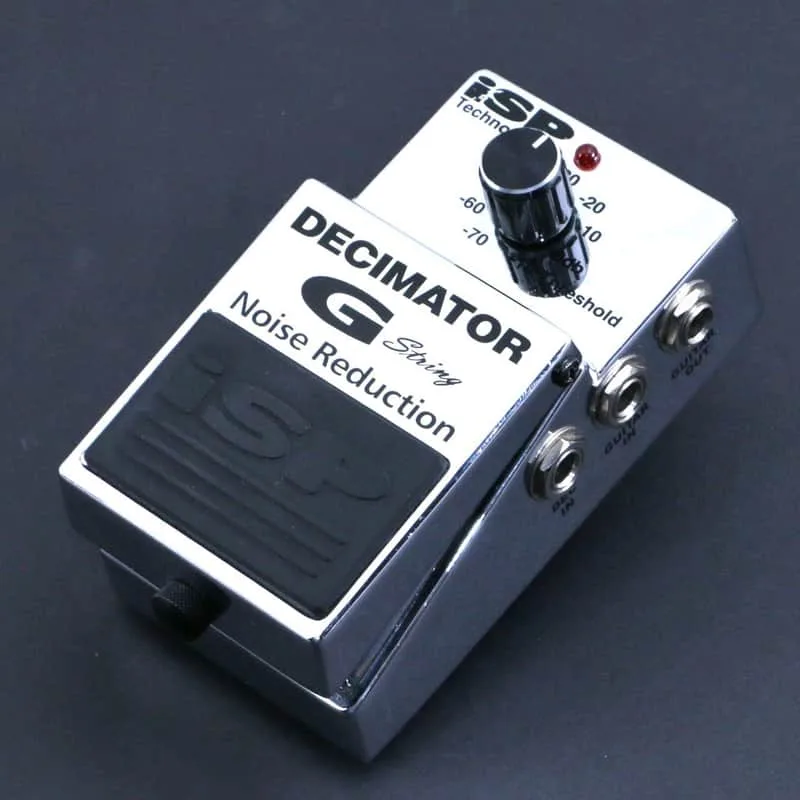
The current-generation pedals carry this out with a dedicated jack set: a 1/4 inch instrument input and a 1/4 inch loop return on the way in, and a 1/4 inch main out plus a 1/4 inch loop send on the way out23.
The G String II, introduced in June 2013, added LINK IN and LINK OUT: two 1/8 inch jacks that let two ISP pedals be linked with a common Tip/Sleeve or Tip/Ring/Sleeve phone cord, so a pair of units can work together in a larger rig56. The current G String X and Decimator II G String keep 2 x 1/8 inch link in/out connections23.
Where it came from and how it differs from the alternatives
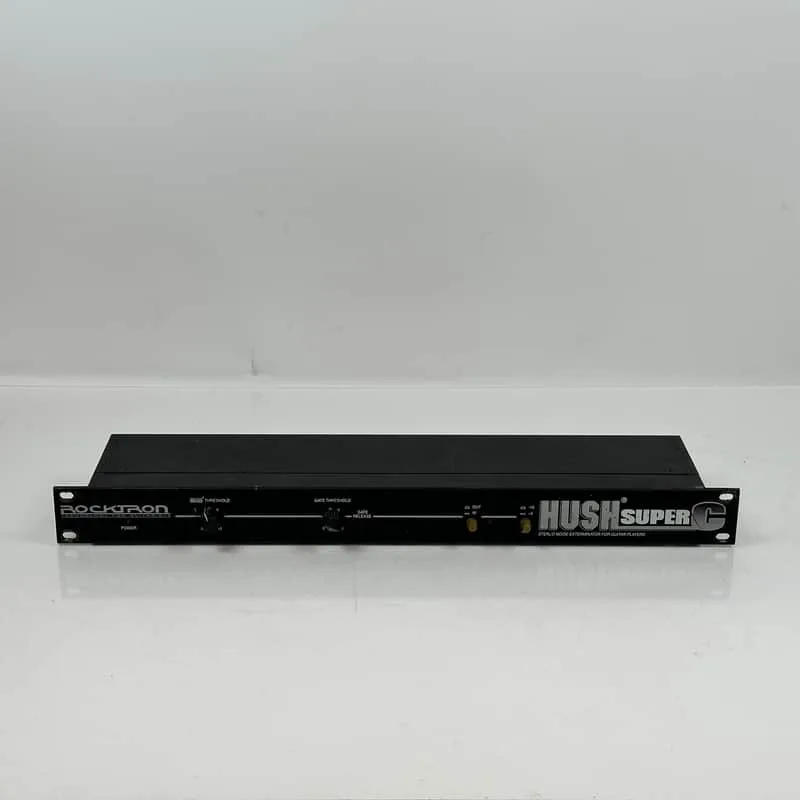
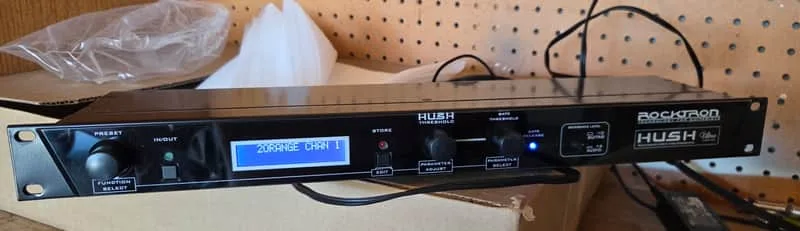
ISP Technologies was founded by the original Rocktron engineering team that designed the Hush noise reduction, the technology behind rack units like the Rocktron HUSH Super C and Rocktron HUSH Ultra1. The Decimator line carries that lineage into pedal form, and the Decimator's smooth chrome chassis carries the same look1.
The line has evolved over more than a decade:
- Decimator G String (original): one threshold knob, active/bypass switch, chrome chassis, $249 MSRP1
- Decimator G String II (June 2013): added LINK IN/OUT for linking two pedals, with improved expander tracking56
- Decimator X G String (announced May 2024): the adaptive version, built on ISP's newer Decimator X technology7
- Decimator G String X (current): 9V DC power supply (sold separately), instrument and loop return inputs, main out and loop send outputs, 2 x 1/8 inch link in/out3
Against the compact competition, the comparison depends on what you need. The ISP Technologies DECI-MATE G Micro Decimator packs the company's noise reduction, with patent pending tracking improvements, into a small micro pedal running on a tip negative, sleeve positive supply8, but it is an inline unit without the G String's loop connection. Loop-based gates from other makers, such as the Boss NS-2 Noise Suppressor and Electro-Harmonix The Silencer, take a similar send/return approach to separating tracking from processing.
What reviewers said
Premier Guitar's review of the original pedal was direct about both the function and the sound1:
"the Decimator successfully killed the extraneous noise instantly. It was also totally transparent and didn’t morph my guitar tone into some feeble shadow of its former self."1
Premier Guitar's reviewer1
The same review called it "a welcomed addition to any noisy guitar rig"1, while noting with some humor that the smooth chrome chassis appeals to players who like their pedals to be seen as well as heard1.
Videos
Sweetwater
Kelster Von Shredster
Blue Collar Gear Review
Questions
What is the difference between the Decimator and the Decimator G String?
The standard Decimator is a straightforward noise reduction pedal. The G String is a version of the same circuit with send and return connections, so it can be placed in an effects loop or at the end of a chain of noisy pedals while still tracking the guitar's own signal. Guitar World notes it is a bit more expensive than the plain Decimator.
What is Time Vector Processing?
Time Vector Processing is the tracking technology ISP Technologies uses in the Decimator. Premier Guitar describes it as responding instantly and accurately to all varieties of note durations, so the noise reduction follows both short staccato notes and sustained ones without cutting them off abruptly.
Does the Decimator G String change your tone?
In Premier Guitar's review, the Decimator killed extraneous noise instantly and was totally transparent, with no alteration of the guitar's tone. As with any noise reduction pedal, setting the threshold too aggressively can affect decay, so the knob is adjusted only until noise and hum disappear.
Where should a noise reduction pedal go in a signal chain?
The G String can be inserted into a series effects loop or placed at the end of a chain of noisy pedals. Its design lets the processing channel sit after your high-gain pedals or preamp while it tracks the signal directly from the guitar, which is what separates it from a simple inline gate.
What does the Link In and Link Out on the G String II do?
The Decimator G String II, released in 2013, adds LINK IN and LINK OUT jacks that let two pedals be linked with a common 1/8 inch Tip/Sleeve or Tip/Ring/Sleeve phone cord. This allows a pair of ISP pedals to share tracking information and work together in a stereo or dual-chain setup.
How does the Decimator G String compare with the Deci-Mate?
The Deci-Mate is ISP's micro-pedal version of the Decimator noise reduction system, built into a much smaller enclosure with a single threshold control and patent pending tracking improvements. The G String adds the loop connection for placing the processing channel after high-gain pedals, which the compact Deci-Mate format does not offer.
Sources (8)
- ISP Technologies G-String Decimator Pedal Review, Premier Guitar, 2008-10-15
- ISP Technologies, ISP Technologies
- ISP Technologies, ISP Technologies
- Stomp on This! 28 Stompboxes Reviewed, Premier Guitar, 2008-10-15
- ISP Launches Decimator II & G String II Noise Gates, Premier Guitar, 2013-06-20
- ISP Technologies Release the Decimator II and Decimator G String II Updates, Guitar Interactive Magazine, 2013-06-24
- The All New Decimator X Adaptive Noise Reduction Pedal, ISP Technologies, 2024-05-31
- ISP Technologies, ISP Technologies