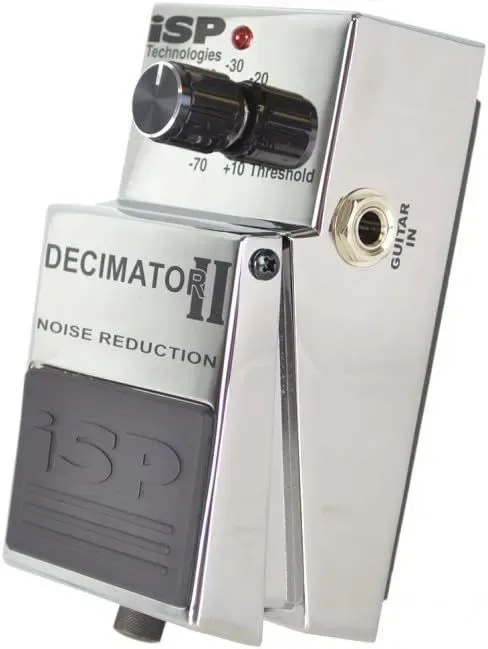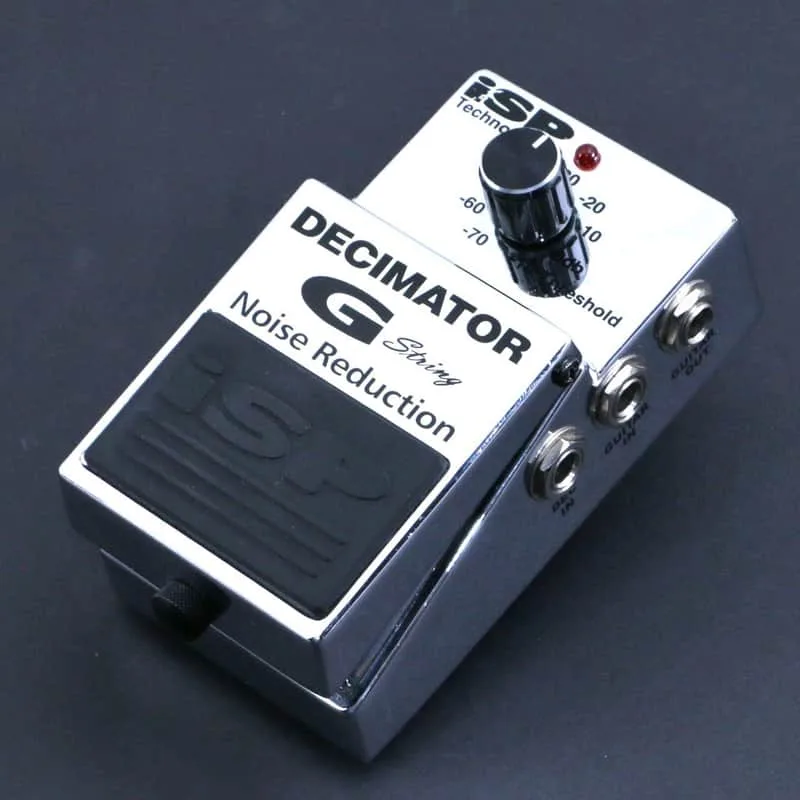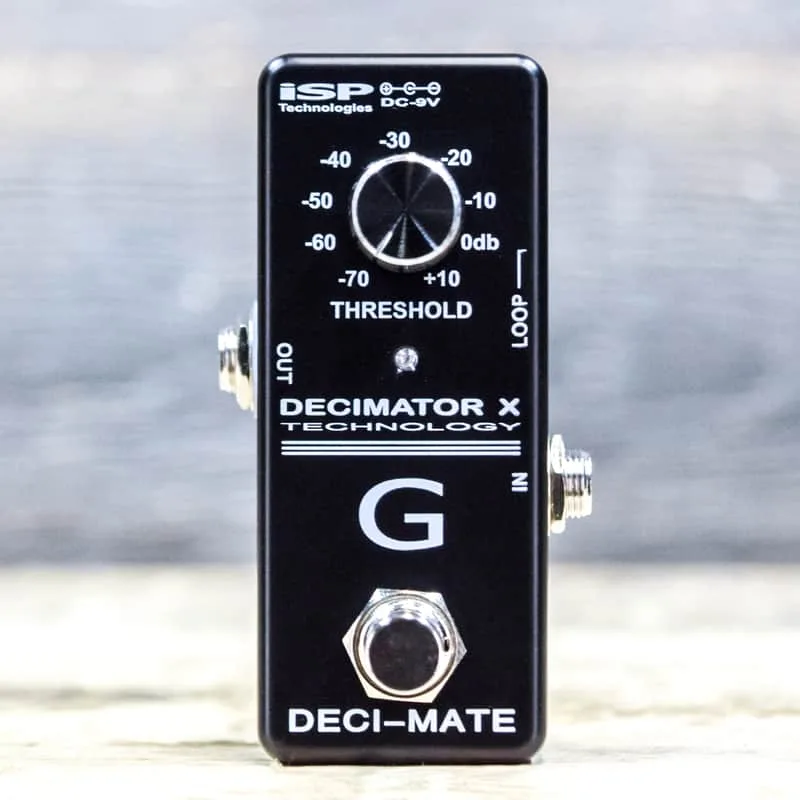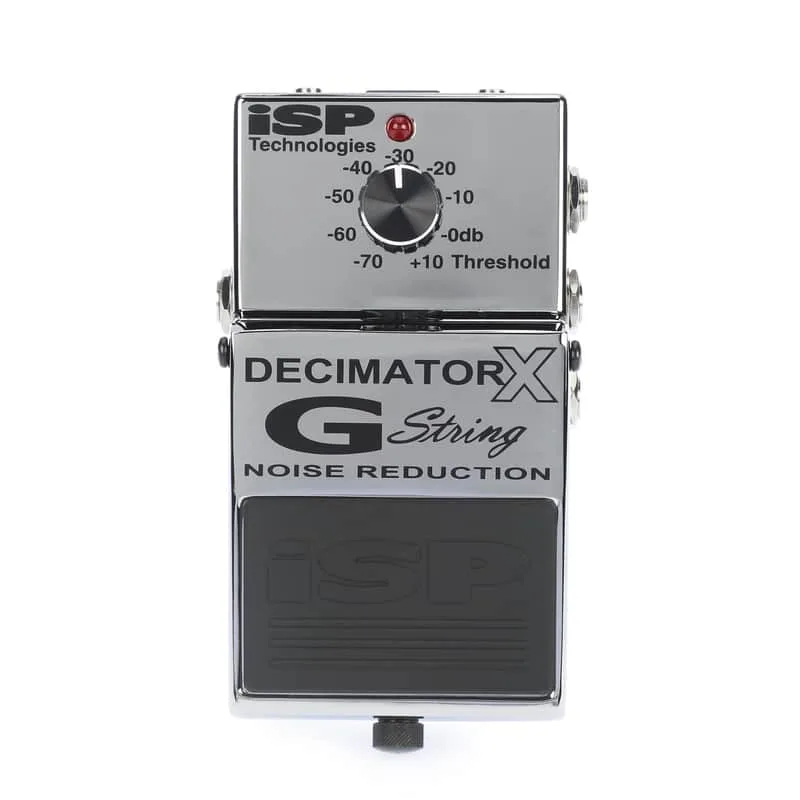


The Decimator G String X is a guitar noise reduction pedal from ISP Technologies. Unlike a simple noise gate that sits in one spot on your board and cuts everything at a fixed threshold, it uses two signal paths: it tracks the signal directly from your guitar at the instrument input, while your noisy pedals, or your amplifier's effects loop, run through its own send and return loop. The maker says this delivers "smooth transitions between fast staccato notes and long sustained tones while eliminating undesirable noise and modulation"1.
The Decimator G String X is a guitar noise reduction pedal from ISP Technologies. ISP says it tracks the signal directly from your guitar, ensuring smooth transitions between fast staccato notes and long sustained tones while eliminating undesirable noise and modulation1. It is a compact pedal, measuring 2.3" high, 2.7" wide and 5" deep1.
Adaptive noise reduction with a loop
The core idea is the split between tracking and gating. The pedal reads your playing from the guitar itself, where the signal is cleanest, and applies the noise reduction in the loop, where your high-gain pedals and modulation live. ISP's earlier Decimator pedals worked the same way: Premier Guitar's review of the Decimator G String noted that its Time Vector Processing "instantly and accurately responds to all varieties of note durations" because it tracks the guitar signal directly2. The G String X carries that loop-based approach forward with the adaptive technology of the X generation1.
The loop itself is a common pattern in noise reduction. ISP's smaller DECI-MATE G Micro Decimator has a loop "to insert your noisy pedals or connect to the effects loop of a guitar amplifier"3, and Guitar World's 2026 noise gate buyer's guide describes the G String concept the same way, as a version of the Decimator with send and return, at a bit more expense than the standard pedal4.
Inputs, outputs and link jacks
The rear panel carries four 1/4" jacks and two 1/8" link jacks1:
| Jack | Type | Purpose |
|---|---|---|
| Instrument | 1/4" input | Guitar goes here for tracking |
| Loop return | 1/4" input | Return from your noisy pedals or amp loop |
| Main out | 1/4" output | To the rest of your rig or amp input |
| Loop send | 1/4" output | Send to the pedals being gated |
| Link in/out | 2 x 1/8" | Connects two Decimators together |
The link jacks are for running two units as a pair. The G String X carries 2 x 1/8" link in/out jacks1, the same arrangement as the Decimator II G String, which also lists 2 x 1/8" link in/out among its other I/O5. Both units share the same main connections: a 1/4" instrument input and 1/4" loop return on the input side, and a 1/4" main out plus 1/4" loop send on the output side1.
Power and current draw
The G String X runs on a 9V DC power supply, which is sold separately, and draws 35mA1. That draw matches the earlier Decimator II G String, also listed at 35mA5, and it is light compared with ISP's rack units: the Decimator Pro Rack G Stereo Mod Version ships with a 9V DC 900mA supply6.
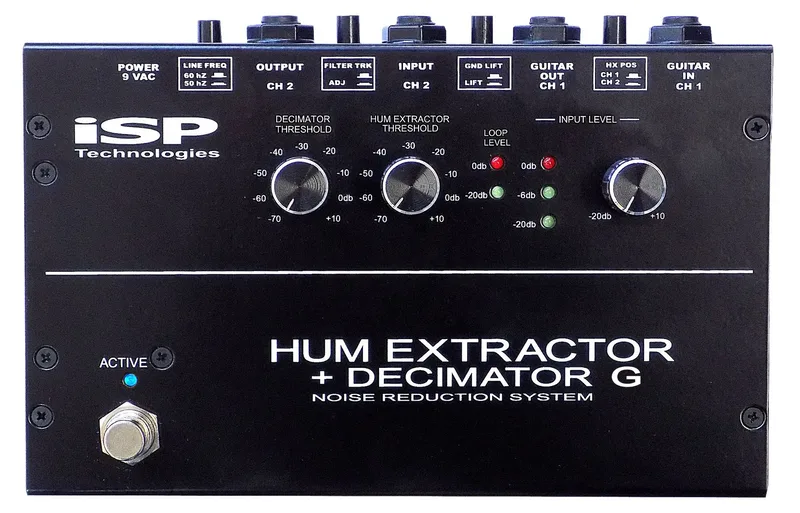
No power supply is included with the G String X1. If you are coming from ISP's rack products, note that those differ: the Pro Rack G uses a 9V AC supply that is included, and the Hum Extractor + Decimator G runs on 9VAC RMS at 1.5 amps7.
Where it sits in the Decimator line
The G String X is the loop-equipped member of the Decimator X generation, alongside the Decimator X. Compared with the earlier Decimator II G String, the jack layout is identical: one instrument input, one loop return, one main out, one loop send, and two 1/8" link jacks, and both are digital circuits drawing 35mA15. What the X adds is the adaptive noise reduction of its generation, protected by US Patent 11,641,1831.
For players who want ISP noise reduction in a smaller or simpler form, the company also makes the all-analog DECI-MATE G, which Pedal of the Day reviewed in 2020, noting that "the all-analog design makes sure you won't alter your tone in the least"8. The G String X takes the opposite trade: a digital circuit with the flexibility of a loop and link jacks for two-channel or stereo setups1.
Videos
Wyatt Scott
Beyond Gadget Zone
Questions
What is the difference between the Decimator G String X and the original Decimator G String?
The G String X is a digital pedal built on ISP's patented adaptive noise reduction technology, covered by US Patent 11,641,183. The original G String was a version of the Decimator with a send and return loop for gating noisy pedals or an amplifier's effects loop, which Guitar World noted made it a bit more expensive than the standard Decimator. The X keeps the same loop-based approach with updated tracking.
Does the Decimator G String X come with a power supply?
No. ISP Technologies lists the power source as a 9V DC power supply sold separately, so you need to supply your own. The pedal draws 35mA, which is modest by pedal standards and easy for most isolated power supplies to cover.
Is the Decimator G String X analog or digital?
It is digital. ISP Technologies lists the G String X as a digital circuit, as it did with the earlier Decimator II G String. That contrasts with the company's smaller DECI-MATE G, which Pedal of the Day described as an all-analog design.
How much current does the Decimator G String X draw?
The maker lists power usage of 35mA at 9V DC. That is a light draw compared with ISP's rack units, such as the Decimator Pro Rack G Stereo Mod Version, whose included supply is rated at 900mA.
What is the loop on the Decimator G String X for?
The loop lets you place your noisy pedals, or an amplifier's series effects loop, inside the gate's signal path while the pedal tracks your guitar directly from the instrument input. That way the gating decision follows what your hands are playing rather than the noisier signal after your gain and modulation pedals.
What do the link jacks do?
The two 1/8 inch link in and link out jacks connect two Decimators together. On the Decimator II G String, ISP describes using an 1/8 inch phone cord to engage the linking function for two channels of noise reduction or a stereo setup, and the G String X carries the same link jacks.
Sources (8)
- ISP Technologies, ISP Technologies
- Stomp on This! 28 Stompboxes Reviewed, Premier Guitar, 2008-10-15
- ISP Technologies, ISP Technologies
- Best noise gate pedals 2026: clean up your signal, Guitar World, 2021-03-19
- ISP Technologies, ISP Technologies
- ISP Technologies, ISP Technologies
- ISP Technologies, ISP Technologies
- ISP Technologies DECI-MATE G Micro Decimator Noise Reduction, Pedal of the Day, 2020-04-02